.svg)
In this article
- Where merchandise planning meets the developing range
- Check whether the range adds up to the plan
- Review the price ladder while products are still taking shape
- Define newness before counting it
- Check the range by delivery window
- Capture what each market adopts and why
- How shared product context supports useful AI analysis
- A range review that leads to a product decision
Visual line planning connects merchandise planning targets with the products teams are building. Five decisions about range coverage, price architecture, newness, delivery timing and regional adoption determine how closely that range follows the plan.
A range can reach its planned option count and still have the wrong products. Knitwear might be crowded at one price, while handbags have lost the opening price option that was supposed to bring customers into the category. Both problems can survive a review that looks only at the total.
That is the work we are demonstrating at RE:PLAN Europe in London on 13 and 14 October 2026: how buying and merchandising teams can keep the developing range connected to the commercial plan, while there is still time to change the products.
The focus is on five decisions made as the range takes shape. Does it add up to the plan? Are the price points right? How much is truly new? What will land in each delivery? And which products will each market adopt?
Each question connects a planning assumption to a product choice. Together, they explain why product line creation needs a shared working view of the range, with enough detail to make a decision before it becomes expensive to reverse.
Where merchandise planning meets the developing range
Merchandise planning establishes the commercial requirements for a season. Depending on the business, those requirements may include category mix, option counts, price bands and delivery windows. The work of creating the range then turns them into individual products.
A planned option starts as a requirement. A buyer or designer proposes a product to fill it. Development adds detail, cost assumptions change, and regional teams decide whether the product fits their market. The product line is the range those teams are building together.
When the plan sits in a planning system and the developing products sit across spreadsheets and presentation decks, someone has to reconcile the two before a review. A dropped style can remain in a presentation. A changed price can reach one team before another. The review may start with an argument about which version is current.
VibeIQ brings that range-building work into one live product line, connecting planning targets with product imagery and the commercial context behind each choice. Planning systems continue to manage the plan. Teams use the shared line to work through the products that will fulfil it, with PLM supporting the detailed development work downstream.
Visual line planning gives buying and merchandising teams a way to examine the actual products alongside the targets they are meant to meet. A product can look right on its own and still leave the range unbalanced.
1Check whether the range adds up to the plan
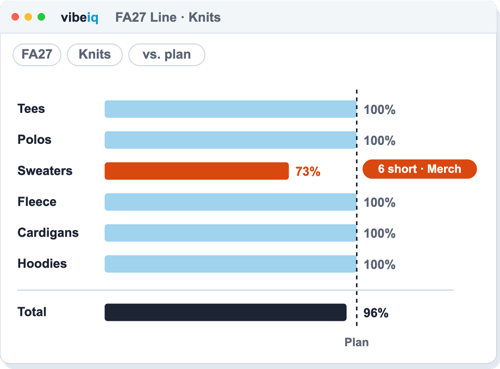
The total is a useful starting point, but it can hide the place that needs attention. In the illustrative knitwear example in our RE:PLAN slides, the range sits at 96% of plan overall. Sweaters are at 73%, while the other subcategories shown are at target.
Those figures lead to a specific conversation about sweaters. Which planned options remain unfilled? Has the team dropped products without replacing them? Does the gap reflect a deliberate change in strategy, or work that has fallen behind?
The comparison also needs a clear basis. If the target counts options, the range view must count options in the same way. A colourway count or a sales forecast answers a different question. Teams also need to agree which product statuses qualify for the comparison, so unapproved concepts do not make the range look more complete than it is.
This is where a shared line helps merchandising teams move from a general concern to an owned decision. They can identify the relevant products, assign the gap and agree whether to fill it or revise the target. Reviewing the subcategory while the range is still being built leaves more room for a considered response.
2Review the price ladder while products are still taking shape
A price ladder shows how products are distributed across the range's price points. It helps buyers and merchandisers check whether the entry offer is present, whether the middle of the range has become crowded, and whether customers have a reason to trade up.
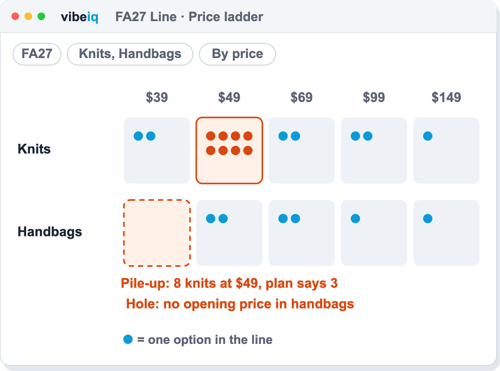
In the deck's illustrative example, eight knits occupy a price point where the plan calls for three. Handbags have no opening price option. The first issue is concentration. The second is missing coverage. Looking at the products alongside those counts helps the team understand what to change.
Eight options at one price may serve different customer needs. They may also be variations of the same idea. The buyer needs to see the differences in silhouette, material or use to judge whether the choice earns its place. A count highlights where to look, and the visual range supports the judgement.
An empty opening price position needs a different response. Teams may need a new concept or a change to an existing product's specification to make the intended price viable. Cost and margin assumptions belong in that discussion. Moving a product to a lower price on a chart does not solve the commercial problem if its cost remains the same.
Reviewing price architecture during product line creation gives those decisions time to influence what gets developed. Once the products are committed, the available remedies can be much narrower.
3Define newness before counting it
A target of 40% newness sounds clear until teams start classifying products. A new silhouette, an updated fabric and a new colour on a carryover style can all represent different degrees of change. Counting them together can make the range appear to meet a target that the products do not actually fulfil.
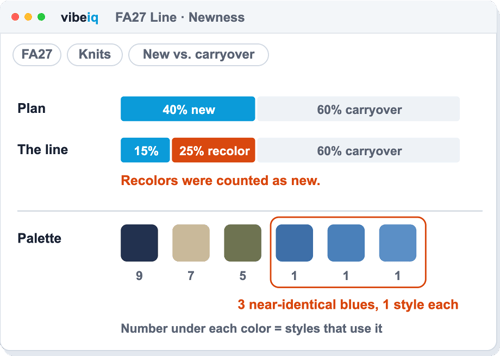
Our illustrative example separates 15% new product from 25% recolours, alongside 60% carryover. Whether that mix is appropriate depends on the category and the commercial brief. Recolours can be exactly what a proven product needs. The team should be able to see what is contributing to the newness figure and decide whether it matches the intention.
The definition therefore needs to come before the count. Teams can agree how they will distinguish new products from updates and carryover, then apply those definitions consistently as the range develops.
Colour adds another layer. A palette can look coherent on a moodboard, yet fragment when individual products use slightly different versions of the same shade. The slide example shows three near-identical blues, each used on one style. Viewing colour usage across the line makes that pattern visible and gives the team a chance to decide whether those differences are intentional.
4Check the range by delivery window
A seasonal range can look balanced in aggregate while a particular delivery lacks the products needed to support it. Each category may have a workable calendar, yet the combined range can arrive unevenly.
An outfit story is a simple example. If the knit arrives in one delivery and the coordinating bottom slips to the next, the products may eventually reach the business, but the intended offer is incomplete when customers first see it.
Reviewing the line by delivery window connects timing to the products and newness expected in each period. Development status can then inform a discussion about which styles may miss their window and what the range would look like without them.
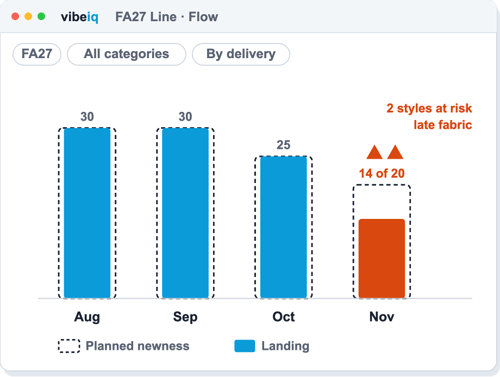
In the illustrative flow chart, November is short against the planned newness, with late fabric also putting styles at risk. That gives the team a reason to examine the affected products while there is time to consider alternatives. They might adjust the intended delivery, use a carryover product to support the offer, or reconsider a product whose timing no longer serves the season.
Earlier visibility gives the business more scope to make those trade-offs deliberately. It also helps teams discuss the commercial effect of a delay before a last-minute response creates extra cost.
5Capture what each market adopts and why
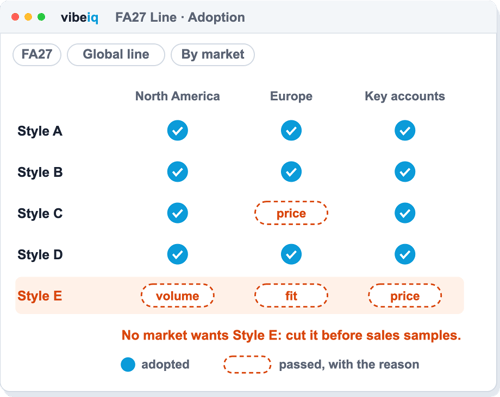
A global product line only becomes a local range when regional teams choose what to take. Recording those choices against the shared line helps the business see where the offer works, where it needs adaptation and where support is too weak to justify further investment.
The reason behind a decision matters. A product rejected on price raises a different question from one rejected on fit. If a region passes because it already has enough similar products, changing the global product may do little to resolve the issue.
In the illustrative adoption view, one style has no takers across North America, Europe and key accounts. The reasons differ by market. That is a useful point to reassess the product before commissioning sales samples. The team can decide whether a targeted change would make it viable, whether it has a strategic role, or whether to cut it.
The same principle applies to retailers reviewing an assortment across store clusters or channels. A visual comparison can reveal what is absent from a cluster, but the absence needs to be checked against the intended range. A smaller store may deliberately exclude a category. Another cluster may be missing products it was supposed to carry.
Keeping adoption decisions attached to the current product line also makes later reviews easier. Teams can follow what changed and why, and regional or sales teams can work from the products the business has agreed to support.
How shared product context supports useful AI analysis
These decisions also show where AI can be useful in product line creation. A request to identify gaps in a range needs the intended targets as well as the current products. An analysis of newness needs agreed definitions. Regional adoption needs the reasons behind a pass.
Without that context, a generated chart can describe the range without establishing whether it meets the brief. The work still needs a clear comparison, a product decision and a check that the change addressed the original gap.
For VibeIQ, the shared product line provides the context for that work. Embedded AI can help teams examine information as products develop, while buyers and merchandisers retain responsibility for the commercial judgement. The useful question is whether the analysis helps someone make a better decision about the products that belong in the range.
A range review that leads to a product decision
The five decisions overlap. Filling a missing price point changes the mix. Dropping an unadopted style can create a delivery gap. Adding colourways can change how the team interprets newness.
At RE:PLAN Europe, we are showing how VibeIQ supports that work between the merchandise plan and the developing range. If one of these decisions is difficult in your business, choose a category and ask us for a 20-minute walkthrough.