.svg)

Your Next Bad Season May
Already Be in the Line
Six ways product risk gets built into the line before it shows up as excess inventory, margin pressure, missed dates, or customer disruption.
VibeIQ Research · Product & Assortment Decisions · 8-minute read
Research basis
What we looked at, and what this report found
Across recent customer conversations, one pattern was consistent: product risk often becomes visible inside the line before it appears in inventory, margin, timing, or customer outcomes.
~800
Recent customer conversations reviewed
~200
Retail, apparel, footwear, and consumer-product organizations represented
6
Recurring product risks examined in this report
How the report is structured
We first show three operating patterns that explain why risk can become visible before the commercial result. We then examine six recurring risks leaders can identify while there is still time to change the outcome.
Research note: The findings are based on recurring themes across the conversations reviewed. They are directional and qualitative, not a prevalence study.
The line can show risk before the numbers do
The earliest warning signs are often visible in the shape of the line itself: where products cluster, where important roles are missing, where the assortment has become too heavy or too thin, and where teams cannot clearly see what should change. Those signals appear well before inventory, margin, or customer outcomes reveal the problem.
From the research
At one global footwear company, 220 products had already been sampled when the team needed to remove 40. The question was not simply which individual products were weakest. It was where the assortment was already too heavy, what role each product played, and which cuts would improve the line rather than create a new gap.
This wasn't a missing-data problem. The products existed. Their attributes existed. The issue was whether the organization could see where the line was heavy, where it was thin, and where a decision needed to be made.
That distinction matters. A weak season does not always begin with a bad product or a bad merchant decision. It can begin when the organization cannot see the products, commercial context, and decisions together clearly enough while the line is still taking shape.
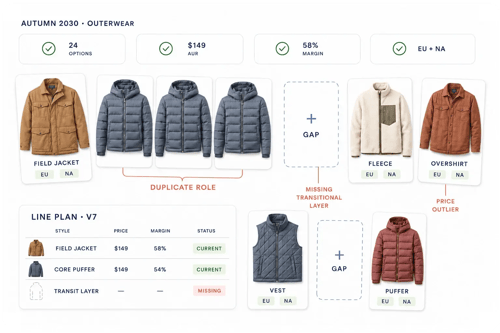
Commercial risk can be built into the line long before it appears in the commercial result. The warning signs are often visible while there is still time to act.
Product data is not the same as seeing the line.
Rework often starts with an upstream decision, not the downstream work.
Commercial problems often begin before they look commercial.
PATTERN 01
The problem is seeing the assortment as a whole
Most organizations do not lack product information. Product facts may exist across PLM, planning systems, spreadsheets, creative tools, decks, and regional files.
The harder problem is seeing those products as a line: where the assortment is too heavy or too thin, where products duplicate one another, which roles or price points are missing, what has changed, and what those changes mean for the decisions still to be made.
PATTERN 02
The visible rework often begins earlier
Manual execution is expensive, but the person rebuilding a deck, reconciling a spreadsheet, or re-entering product information is often dealing with a problem that began earlier.
A decision changed after downstream work had started. The reasoning behind it did not travel with the product. Or the change was made in one place without reaching every team that needed to act on it.
The rework appears downstream. Its cause often sits upstream in the decision.
PATTERN 03
Commercial outcomes often have upstream causes
Excess product, margin pressure, missed dates, incorrect selling, and customer disruption are visible outcomes. The conditions that create them can form much earlier, while the line is still being shaped and changed.
To see that risk earlier, leaders need to look beyond the final commercial result and examine six areas of the product process: assortment architecture, information integrity, cross-functional alignment, decision ownership, change control, and workflow execution.
Together, the three patterns surface six areas where product risk can build before it becomes visible in commercial results.
RISK 01
Assortment architecture
Can we see where the line is overbuilt, duplicated, or missing something before we commit further?
RISK 02
Information integrity
Can every team identify the same current product and line information without reconciling multiple versions?
RISK 03
Cross-functional alignment
Does the rationale behind a product decision travel with it as work moves between teams?
RISK 04
Decision ownership
Is it clear who owns each major decision, what criteria govern it, and why the choice was made?
RISK 05
Change control
Can we see what a proposed change will affect before we approve it?
RISK 06
Workflow execution
Can a decision move into execution without teams rebuilding the product, context, or work around it?
Risk 01 · Assortment architecture
An assortment can be wrong before anyone can see that it is wrong
Merchandising teams make individual product decisions in the context of a line. The strength of that line depends on how those choices work together across category, price, color, material, channel, region, consumer need, delivery, and product role.
A strong product can still sit inside a weak assortment. The line may be too heavy in one area, missing an important role or price point, carrying too much duplication, or allocating newness and carryover in the wrong places.
That makes visibility a decision requirement, not a reporting convenience.
What we heard from product teams
A global footwear team described manually counting products to understand color balance.
Another footwear team needed to reduce an oversized sample set but first had to identify where the assortment was concentrated.
Teams described taking weeks to assemble the information required for line architecture and assortment review.
Regional and channel assortments were often managed in separate views, making comparison difficult.
When the line is distributed across spreadsheets, presentations, creative boards, planning tools, and regional views, teams may be able to inspect every individual product and still struggle to judge the assortment as a whole. Duplication can hide across separate views. Gaps are harder to spot. Carryover and newness are difficult to compare. Regional or channel differences can be understood individually without making it clear how they change the overall line.
The problem becomes most obvious when a decision has to be made. A team may know that 20 products need to be removed without being able to see where the assortment is already too heavy, what roles those products play, or which cuts would strengthen the line rather than create a new gap.
Research signal: Across VibeIQ’s research, teams repeatedly described having to reconstruct the assortment before they could make those decisions. In one analysis spanning 14 organizations, poor visualization and limited reporting emerged as a recurring theme. The issue was not an inability to create another report. It was the difficulty of seeing enough of the line, in the right context, while there was still time to act.
The risk: An imbalanced, incomplete, or duplicative line can continue advancing while development work and commercial commitment accumulate around it.
The leadership question: Can we see where the line is heavy, thin, duplicated, or missing critical roles while there is still time to change it?
Risk 02 · Information Integrity
Having the data is not the same as having a trusted view of the line
What we heard from product teams
An apparel team repeatedly checked five documents to determine which information was correct.
Product changes did not always reach teams already developing sales or marketing materials.
Manual re-entry and correction introduced new opportunities for error.
Teams hesitated to trust reports when the underlying information had passed through several files and owners.
Product information is constantly changing while the line develops. Attributes evolve. Costs move. Colorways are renamed. Products are adopted, revised, or cancelled. A decision made in one review may change what another team should develop, buy, sell, or present.
The value of that information therefore depends on more than whether it exists somewhere. Teams need to know which version is current, whether it is authoritative, what has changed, and whether the people already acting on the product are working from the same information.
When that is unclear, the organization begins reconstructing the truth. People compare spreadsheets, decks, systems, and regional files to determine which one is right. Information is re-entered or backfilled. Corrections are made manually before another team can use it. Even when the underlying data is accurate somewhere, confidence in the line starts to erode.
In one global fashion organization, a colorway change was recorded in PLM but did not reach the sales organization. Sales continued selling products the company no longer intended to produce.
The problem was not that the change had never been recorded. It was that the change did not reliably reach the people making commitments from it.
The risk: Teams make product and commercial decisions from stale, incomplete, or conflicting versions of the line.
The leadership question: When something changes, can every affected team see the same current product truth without comparing files or reconstructing what happened?
Risk 03 · Cross-functional alignment
The product can survive the handoff while the decision behind it gets lost
Product creation crosses merchandising, design, planning, development, sourcing, sales, marketing, regions, and channels. Each function may need a different view of the product, but they still need a shared understanding of what has been decided and why.
That is where product context can disappear.
What we heard from product teams
Functions maintained separate approval documents and meeting notes.
Teams exported information for colleagues who could not access the working environment.
Product facts moved downstream without the rationale behind the decision.
Brand leaders described a “broken telephone” effect as information traveled through the organization.
A downstream team may receive the latest product attributes without knowing the commercial need behind the product, the role it is intended to play in the assortment, the alternatives that were considered, or the conditions attached to its approval. The product information moves forward, but the reasoning that shaped the decision does not.
Once that happens, teams begin reconstructing meaning for themselves. One function exports information for another. Approval notes live in a separate deck. Regions maintain their own views. The same product can then be interpreted differently depending on who is looking at it and what context they received.
“We do something in one place and then have to manually hand it off to someone else to do the next step, rather than having a fully immersive conversation throughout the entire process.”
Product leader, apparel company
Research signal: Across the research, teams described siloed communication and decisions that weakened as they moved between functions. One analysis found disconnected communication across 17 organizations; a separate rework analysis identified ineffective collaboration and misaligned decision-making across 21. These are overlapping signals, but they point to the same underlying problem: product decisions become less reliable when their context does not travel with them.
The risk: Teams may be working from the same product information while acting on different understandings of what was decided and why.
The leadership question: When a product decision moves between functions, regions, or channels, does its rationale travel with it?
Risk 04 · Decision ownership
A decision without an owner is only a temporary agreement
What we heard from product teams
Different functions evaluated the same choice using different KPIs.
A decision could be reversed by a later stakeholder without a clear governance path.
Approval status and rationale were maintained outside a shared decision record.
Meeting preparation became an exercise in reconstructing the case rather than testing it.
Product and assortment decisions are rarely made against a single objective. Merchandising may prioritize the architecture of the line. Design may protect creative intent. Planning may focus on productivity, margin, or volume. Regions and channels may bring different customer requirements.
Those are legitimate perspectives. The problem begins when it is unclear which criteria govern a particular decision, who has authority to resolve the trade-off, or whether an approval made today will still hold in the next conversation.
Agreement in a meeting is not enough if the owner, criteria, approval, and rationale do not remain connected to the decision after the meeting ends.
“The decision-making is all happening in spreadsheets.”
Merchandising leader, consumer goods company
Research signal: Across the research, teams described decisions made with one stakeholder being changed in a later conversation, milestone approvals managed manually, and checkpoint meetings where participants had to reconstruct the information needed to decide. At one consumer-products company, business-case updates relied heavily on Excel and PowerPoint, and teams scrambled ahead of checkpoint meetings to assemble the necessary inputs.
The spreadsheet was not the root problem. The deeper issue was that the decision itself, who owned it, what criteria governed it, what had been approved, and why, did not become a durable part of the product process.
The risk: Decisions stall, conflict, or reopen when ownership, governing criteria, approval status, and rationale are not durable beyond the meeting where the choice was made.
The leadership question: For every consequential line decision, can we see who owns it, which targets govern it, what was approved, and why?
Risk 05 · Change control
The later a product decision changes, the more expensive it becomes
Change is a necessary part of product creation. Teams explore, react to new information, refine the line, and make trade-offs as they learn.
But the cost of a change depends heavily on when it happens and how much work has already formed around the original decision.
A color, product, price, or assortment change made early may affect little beyond the decision itself. Make the same change after development has advanced, samples have been created, regional assortments have been built, or sales and marketing work has begun, and the consequences spread much further.
The challenge is therefore not to prevent change. It is to understand its impact before approving it.
What we heard from product teams
Late design handoffs and last-minute merchandising changes pushed footwear timelines.
Work could be ready to advance when a late leadership change triggered another round of revisions.
Price and product changes required manual outreach because downstream materials were already underway.
Changes recorded in one place did not automatically update every connected view.
Research signal: Across the research, teams described late design handoffs, last-minute merchandising changes, leadership decisions that reopened work already prepared to advance, and major review meetings that generated extensive downstream edits. In one example, a review produced roughly 200 changes, leaving teams to work back through the process and manually update what had already been built.
The cost was not only the effort required to make those updates. A late change can alter what gets developed, sampled, sourced, planned, presented, sold, or communicated. If the organization cannot see those dependencies before making the decision, it may approve the change without understanding its full cost.
Once a change is approved, it has to become the new state of the line. When teams rely on manual outreach or disconnected files to communicate it, the organization risks having the old and new decisions in motion at the same time.
The risk: A necessary product change can become disproportionately expensive when its downstream impact is unclear or the new decision does not reliably reach every affected team.
The leadership question: Before we approve a change, can we see what it will affect, and once we approve it, can we be confident the new decision will reach everywhere it needs to?
Risk 06 · Workflow execution
Teams should not have to rebuild a decision to execute it
What we heard from product teams
Sample-review decks were rebuilt manually from PLM images and attributes.
Business-case materials were assembled across spreadsheets and presentations before checkpoints.
Product information was copied between planning, creative, and development tools.
Teams spent days validating, formatting, and setting up information that already existed elsewhere.
A product decision is not complete simply because the organization has agreed on what to do. The next team or system still needs the current product information, visual context, and decision context required to act on it.
When that information has to be reconstructed for the next step, the organization is rebuilding a decision it has already made.
At one global footwear brand, development teams pulled product images and attributes from PLM and manually reconstructed the information in PowerPoint for sample reviews. Notes from those meetings then had to be carried back into the process.
At a consumer-products company, teams assembled business-case information across Excel and PowerPoint ahead of checkpoint meetings. A small apparel team described spending a full week in PLM simply ensuring that styles were set up correctly before work could continue.
The cost is not only administrative time. Every reconstruction creates another opportunity for context to disappear, an old version to re-enter the process, or an error to alter what the next team believes it is supposed to do. It also slows the point at which a decision can become action.
The risk: Time, accuracy, and decision context are lost when teams have to reconstruct work the organization has already completed.
The leadership question: Once a decision is made, can the next team or system act on it without recreating the product information, visual context, or reasoning behind it?
What happens when the risks combine
Individually, these risks create friction and rework. The greater commercial exposure appears when they begin to reinforce one another.
The six risks do not occur in isolation. As the line moves from early choices toward development, buying, selling, and inventory commitments, they begin to reinforce one another.
An assortment imbalance becomes harder to correct when teams cannot trust the current view of the line. A decision is more likely to reopen when its rationale or owner is unclear. A late change becomes more disruptive when teams cannot see what it will affect. And every one of those problems becomes more expensive when downstream teams have to reconstruct the work manually.
How the risks connect
architecture
integrity
alignment
ownership
control
execution
exposure
What surfaces downstream
The commercial result appears late. The conditions that created it often formed much earlier in the line.
The better standard is whether teams can work from a connected view of the line while the product information, commercial context, decisions, and rationale behind it remain connected as the line changes.
See the whole line
Teams should be able to judge balance, gaps, duplication, product roles, price architecture, and regional or channel differences without first rebuilding the assortment.
Keep product facts and decision context together
The product record should remain connected to why the product exists in the line, the commercial need it serves, the alternatives considered, the decision made, and the rationale behind it.
Preserve the decision as work moves
Different functions may need different views of the product, but they should not need to reconstruct what was decided or reinterpret why each time work changes hands.
Make ownership and approval explicit
Teams should be able to see who owns a consequential decision, which targets or criteria govern it, what has been approved, and why.
See the impact of change before approving it
Teams should be able to understand what a proposed change will affect, make the decision at the appropriate level, and ensure the new choice becomes the current state of the line.
Let execution follow the decision
Once a choice has been made, the next team or system should receive the current product information, visual context, and decision context needed to act without re-entry, reformatting, or reconstructing the work.
Assortment architecture
Information integrity
Cross-functional alignment
Decision ownership
Change control
Workflow execution
If several answers are uncertain, the organization may already be carrying product risk that has not yet appeared in its commercial results.
The product line is an early-warning system
By the time a weak season shows up in excess inventory, margin pressure, missed dates, or customer commitments, many of the decisions that created it may feel irreversible.
They were not always irreversible. Earlier in the process, the imbalance, conflicting information, lost rationale, late change, or execution gap may still have been visible in the line and far less expensive to correct.
The opportunity for leaders is not simply to explain what went wrong after the season is underway. It is to see product risk while the line is still being shaped, and to keep the product information, commercial context, decisions, and rationale connected as that line changes.
Your next bad season may already be in the line. The opportunity is to find it while there is still time to change the outcome.
See the line differently
See product risk while there is still time to change it
VibeIQ gives teams one live view of the line, connecting product information, visual and commercial context, and the decisions and rationale behind it as the line changes.
Review your line with us