.svg)
Last Updated September 1, 2026
Where the Retail Product Lifecycle Breaks
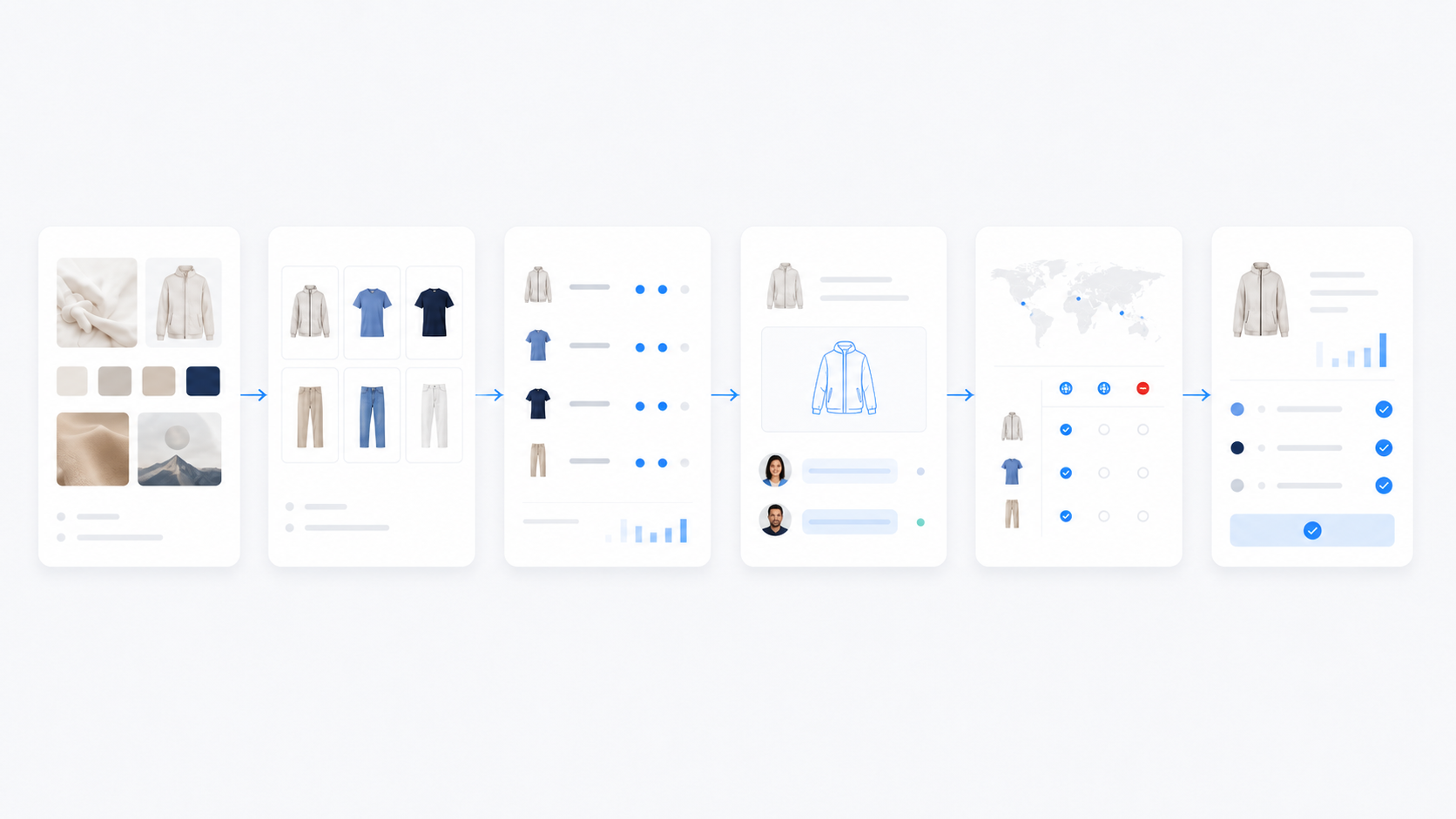
The six stages, and five critical handoffs, that determine whether product decisions survive from concept to commercial commitment.
At one global consumer-products brand, updates to the business case relied heavily on Excel files and PowerPoint. Ahead of checkpoint meetings, the team had to gather the information required to evaluate the product.
A global footwear brand described a different meeting with a similar problem. For sample reviews, development teams pulled images and product attributes from PLM, rebuilt the information in PowerPoint and then recorded notes manually during the meeting.
These are not administrative tasks happening around the product lifecycle. They are the product lifecycle. They are moments when teams decide whether a product should advance, change or stop.
Most lifecycle diagrams make the process look like a calendar: concept, planning, development, adoption and buy, with gates and deadlines moving neatly from left to right. But a retail product lifecycle is really a chain of decisions. Each decision only holds if the next team receives the current product information, the outcome and enough context to understand why the decision was made.
That is where the process often breaks.
Across VibeIQ’s research and calls with apparel, footwear, retail and consumer brands, the same operating pattern recurs. Information is exported, copied, reformatted, rebuilt for meetings and manually transferred to the next team.
The problem is rarely one isolated tool. It is what happens when a decision has to cross from one stage, team or tool into another.
What are the six stages of the retail product lifecycle?
The six stages are:
- Trend and concept
- Line architecture
- Assortment and line planning
- Development and sample review
- Regional and channel adoption
- Commercial commitment
Between them sit five critical handoffs. At each one, teams must carry the product, its current status and the reasoning behind the latest decision into a new working environment.
Stage 1: Trend and concept
- Decision: What should the season express, and which possibilities deserve further exploration?
- Teams involved: Often design, merchandising and creative leadership.
- Working tools: Mood boards, creative applications, presentations and reference libraries.
- Handoff: Seasonal intent and product concepts move into line architecture and commercial planning.
- Risk: The product advances, but the reasoning behind it remains in a presentation, board or individual’s memory.
In one recent conversation, a lifestyle brand described conducting substantial moodboarding and design work in Miro and Photoshop. A global apparel company described designers preferring Figma while CADs were repeatedly copied and pasted between working environments.
Those tools are appropriate for creative exploration. The problem appears when a concept has to become part of a commercially structured line.
A designer may understand why a silhouette, material or color matters to the season. But if that reasoning does not travel with the concept, the next team receives an image without the full intent behind it. The product can then be evaluated against a spreadsheet placeholder or financial target without a shared understanding of the role it was meant to play.
The first handoff is therefore more than a transfer of creative assets. It is the translation of creative intent into something the rest of the organization can evaluate and act on.
Stage 2: Line architecture
- Decision: What does the business need to build across categories, price points, deliveries and levels of newness?
- Teams involved: Usually merchandising and planning, with input from design and commercial leadership.
- Working tools: Line plans, range plans, planning systems and spreadsheets.
- Handoff: Commercial requirements and product placeholders must connect to the concepts being developed.
- Risk: The line appears complete in one representation while gaps, duplication or conflicting assumptions remain hidden elsewhere.
Line architecture gives the season its commercial shape. It may establish category targets, style counts, price tiers, revenue expectations, delivery windows and the balance between new and carryover products.
The work can be difficult to see as a whole.
One specialty retailer described assortment-architecture work taking weeks to a month because the available data could not be efficiently sliced and analyzed. A global footwear brand described visual line planning in Excel alongside a second visual representation, with no data connection between them.
That creates two versions of the emerging line: the commercial structure and the visual product view. A change to one may not reach the other.
The handoff breaks when a requirement is removed from the plan but design continues developing the corresponding product, or when a concept is added without anyone seeing that it duplicates something already in the assortment.
Line architecture creates the slots. The next stage determines which products will fill them.
Stage 3: Assortment and line planning
- Decision: Which products belong in the line, and which should be added, changed or dropped?
- Teams involved: Merchandising and planning, often with design, sales and leadership input.
- Working tools: Assortment matrices, visual boards, spreadsheets and specialist planning tools.
- Handoff: The evolving assortment must become a sufficiently stable set of products for development.
- Risk: Teams overdevelop, make cuts late or spend meetings reconciling competing views of the line.
This is where abstract requirements meet actual products. Teams compare concepts against category targets, price architecture, delivery flow, regional needs and the rest of the assortment.
The work is rarely static. Products are added, removed, reinstated, recolored or reassigned as new information arrives.
One apparel brand described an assortment process requiring four different programs simply to understand what was entering the line. At a workwear brand, teams manually reconvened after milestone meetings to determine what to keep and what to drop.
The issue is not that product decisions change. They should change as the team learns. The issue is whether each change reaches every relevant view of the line.
When the assortment exists across several boards, files and tools, meetings can shift from evaluating products to establishing which representation is current. Overdevelopment becomes a rational response because teams lack enough shared visibility to make confident cuts earlier.
By the time the line moves into development, the organization may already have invested in products that a connected view would have challenged sooner.
Stage 4: Development and sample review
- Decision: Is the product meeting its commercial, creative and technical requirements, and what must change before it advances?
- Teams involved: Product development, design, merchandising, sourcing and technical teams.
- Working tools: PLM, spreadsheets, PowerPoint, email, sample-tracking documents and meeting notes.
- Handoff: The current product record, business case, imagery and review decisions must stay connected as the product changes.
- Risk: Review meetings become exercises in reconstructing information, while decisions and notes separate from the product record.
This is where the examples from the opening become particularly revealing.
At one global consumer-products brand, business-case updates relied on Excel and PowerPoint. Teams then struggled to gather the required information for checkpoint meetings.
At a global footwear brand, development teams took images and product attributes from PLM and rebuilt them in PowerPoint for sample reviews. Notes were recorded manually during the meetings.
In both cases, the review depended on a temporary representation assembled from other sources. The deck may be correct when it is built, but it begins aging as soon as the source information changes.
The meeting produces additional context: why a material was rejected, why a color changed, which concern remains unresolved or what must happen before approval. If those decisions remain in notes or presentations, the product record may show the eventual outcome without showing how or why the team reached it.
A review should advance the product. When information must first be gathered, formatted and verified, part of the meeting is spent rebuilding the product before anyone can decide what to do with it.
Stage 5: Regional and channel adoption
- Decision: Which products should each region, channel or customer carry?
- Teams involved: Regional merchandising, channel teams, global merchandising, sales and planning.
- Working tools: Regional assortments, spreadsheets, planning tools and customer-specific presentations.
- Handoff: Local adoption decisions and market feedback must return to the global product view.
- Risk: Regions make decisions using different information or KPIs, while feedback arrives too late to influence the global line.
The global line is not automatically the line that every market, channel or customer will carry. Regional teams may need different products, colorways, prices, deliveries or volumes.
One global apparel brand described assortment planning fragmented across retail channels and separate from e-commerce and wholesale. A consumer-products organization described different people making assortment decisions for different major retailers, with inconsistency even in the KPIs used to make those decisions.
The problem is not local variation. Local variation is the purpose of regional and channel adoption.
The problem is whether those decisions remain connected to a common product universe. If every team creates its own file or assortment, a global change may not reach every market. A regional rejection may never return to the global team. One group may evaluate demand while another uses shipped sales, producing different answers from what appears to be the same data.
The handoff must work in both directions: from the global line to the market, and from market feedback back into the line.
Stage 6: Commercial commitment
- Decision: What will the business buy, sell or commit to?
- Teams involved: Buying, merchandising, sales, finance and commercial leadership.
- Working tools: Buy sheets, Excel, PowerPoint lookbooks, order-management systems and purchase orders.
- Handoff: The approved assortment becomes a financial and inventory commitment.
- Risk: A stale product decision turns into an order, a customer promise or inventory in the wrong place.
One consumer brand described collecting buys through Excel and PowerPoint lookbooks. The information then had to be manually converted into orders and purchase orders before entering the relevant system.
At this stage, the cost of a broken handoff changes. Earlier in the lifecycle, disconnected information creates extra work, duplicated development or slower decisions. At commercial commitment, it can shape what the organization buys and what sales promises to customers.
The buy should reflect the latest approved line. But if the line has been rebuilt repeatedly across presentations and spreadsheets, teams must trust that the final version includes every change made upstream.
A product decision that failed to propagate can now become a purchase order.
Why do retail product decisions break between lifecycle stages?
Put the six stages together and a pattern emerges.
Concepts are interpreted without their original intent. Line-plan changes fail to reach the visual assortment. Products continue through development after the need they were meant to fill has changed. Review decks become obsolete. Regional decisions remain outside the global view. Buy information has to be manually converted into orders.
These are different lifecycle moments, but they share the same underlying problem: the next team receives the product without a reliable connection to the decision that shaped it.
Adding another system of record does not automatically solve this. Nor should every function be forced into one application. Designers, planners, developers and sales teams need different ways to work.
The more useful objective is continuity.
Can the organization preserve the connection between the product, its role in the line, its current status and the reasoning behind its changes? Can each team work in an environment suited to its job without rebuilding the product whenever work crosses a boundary?
That is the role of a product decision layer.
PLM remains responsible for structured product information and development processes. Planning systems remain responsible for financial and inventory targets. A product decision layer connects the work between and around them: the concepts being considered, the line architecture they may fulfill, the reviews they pass through, the assortments they enter and the decisions that determine whether they advance.
How merchandising leaders can audit their lifecycle handoffs
At your next milestone, line or sample-review meeting, choose one product that changed and ask:
- Where was the decision made?
- Which system or file contains the current version?
- Can the team see what changed and who decided it?
- Does the next team receive the reason for the change, or only the result?
- How many other files, boards or decks must now be updated?
- Will regional, channel and sales teams see the change?
- Could an earlier version still become a buy or customer commitment?
If answering those questions requires several people and several documents, the lifecycle has already shown you where it breaks.
The stages are rarely the problem. The handoffs between them are.
See how VibeIQ connects product decisions across the retail product lifecycle.
Related Articles
Bring a workflow your team is trying to fix.
Bring a line review, assortment plan, design review, or another current workflow. We’ll show how the same mechanics could apply to your team.