.svg)
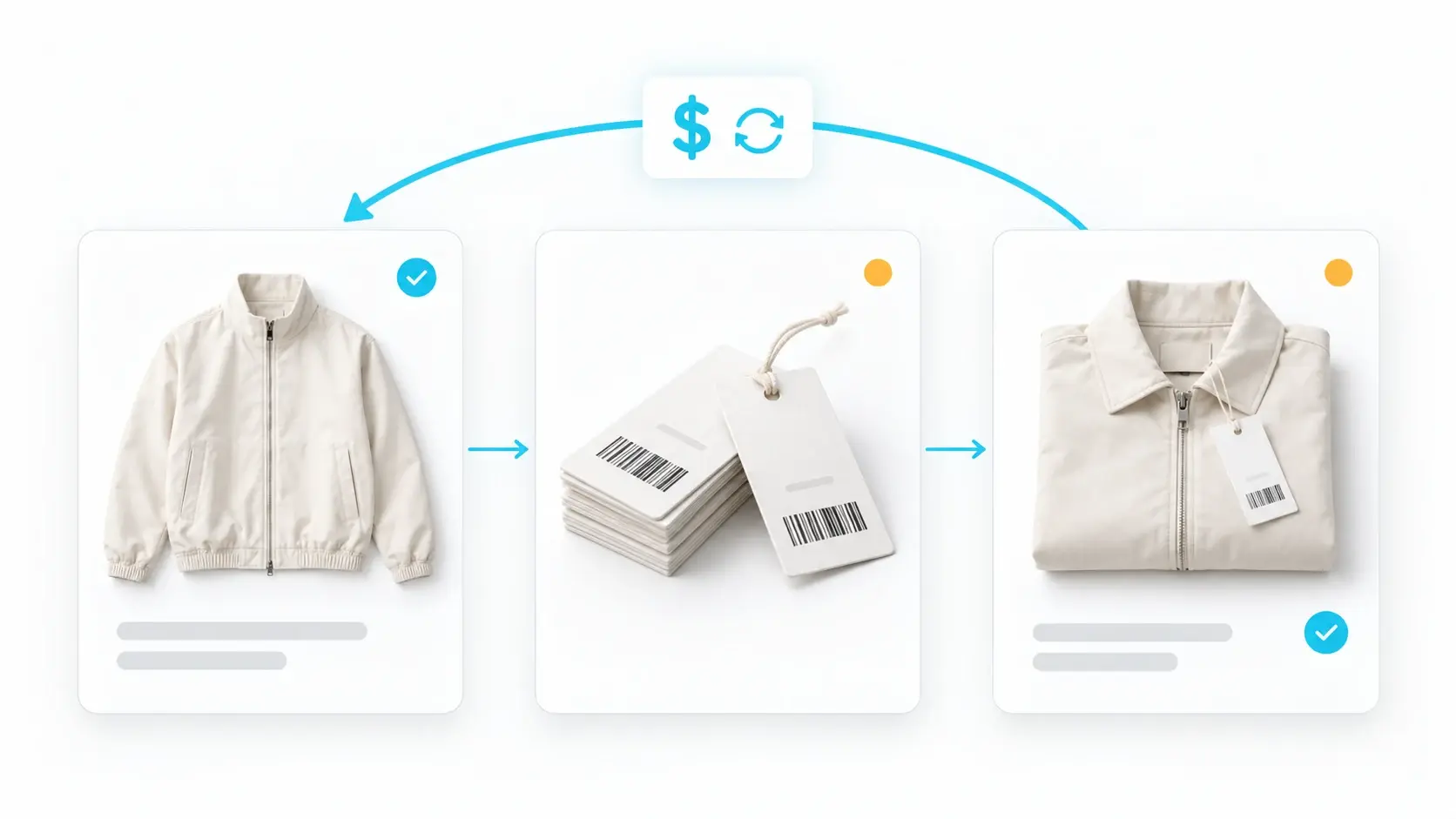
A redecision is a product or merchandising decision made again after teams believed it was final and began acting on it. Changing a price after labels have been printed is one example. Unlike normal iteration, a redecision reopens work that was already complete or underway.
Iteration is part of product creation. Teams test ideas, review samples, respond to feedback, and adjust their plans. The problem begins when a change reaches beyond the team making it and forces other people to revisit approved work.
What does a redecision look like?
Consider a pricing change made after products have been labeled.
The original price has been approved. Labels have been printed and applied. Teams have started preparing the information needed to sell the product. Then the business approves a different price.
Changing the price field is the easy part. The team must also:
- Identify the affected inventory.
- Determine which labels need replacing.
- Update selling information.
- Check the effect on margin and delivery timing.
The new price may be commercially sensible. Implementing it still means revisiting work that everyone considered finished.
Bailey, VibeIQ’s VP of Experience, uses this term for pricing decisions made after labeling and labeling decisions made after production handoff:
“We just redecide and we redecide at the wrong time.”
In her account, the disruption affected both the season being delivered and the team’s work on future seasons. The same people responsible for moving the next line forward were pulled back into correcting the current one.
Why do redecisions happen?
Product creation depends on connected decisions made before every detail is known. Three conditions make those decisions especially likely to be reopened.
Different decisions become final at different times
A product may still be in development even though its material, packaging, or artwork has already been approved for another team to use. Lead times and dependencies mean that each part of a product becomes fixed at a different point.
That is why a single “in development” status can be misleading. A change that seems simple to one function may disrupt work that another function has already committed to.
New information arrives after work begins
Sales feedback, revised costs, and customer requirements can challenge earlier choices. Sometimes a late change is a reasonable response to information that was not available when the original decision was made.
The issue is not whether teams should ever change course. It is whether they can weigh the benefit of the change against the work already underway, including the cost and timing of implementation.
Decisions move across disconnected teams and systems
A decision made during line review can affect merchandising, design, technical design, sourcing, and suppliers. Each function may keep a different version of the same product information.
Research on engineering changes describes how a change can spread through connected components, documents, and tasks. A product-line change behaves in much the same way: one small revision may trigger several coordinated updates.
Bailey gives the example of dropping a colorway that also appears in print artwork. If the print team was not in the meeting, the decision creates work they may not yet know about.
Is there evidence that late changes affect suppliers?
Yes, although the available research does not establish a universal “redecision rate.”
An ILO report on purchasing practices found that more than half of the suppliers interviewed during its Phase 2 fieldwork had experienced changes to order specifications after agreement. That qualitative phase covered interviews at more than 25 factories, so the finding should not be read as an industry-wide apparel census.
Better Buying’s research on design, development, and calendar management also records supplier experiences in which changes undermined otherwise adequate production calendars.
Together, these findings support the underlying problem: approved details and planned timelines can change after suppliers have begun relying on them.
Redecision vs. iteration: what is the difference?
Normal iteration
Happens during an expected period of exploration. Teams compare options, review samples, and refine a product before they commit dependent work.
A redecision
Reopens a choice that was expected to be settled. Its consequences depend on what has already been approved, ordered, printed, or produced.
The same label change can be routine before artwork approval and disruptive after labels are applied. The change itself is not the only issue; timing determines the commitments around it.
A necessary redecision may still be the right business choice. The aim is to avoid preventable reversals and to understand the full impact of changes that cannot be avoided.
How can teams reduce costly redecisions?
Teams can reduce rework by making commitments and dependencies visible before approving a change.
- Record the decision.
Capture the approved choice, its rationale, owner, and scope. Make it clear which options are provisional and which decisions other teams can act on. - Identify the work already in motion.
Check the affected products, teams, suppliers, materials, and completed tasks. - Evaluate the trade-off.
Compare the benefit of changing course with the cost, time, and operational consequences of doing so. - Agree on the response.
Decide whether to make the change now, narrow its scope, or apply it to a future delivery. - Confirm execution.
Verify that every affected team has received and implemented the update. Changing a digital record does not replace a physical label.
A shared product workspace can preserve the context behind a decision and reduce manual reconciliation. It cannot replace clear ownership or coordination with the people responsible for execution.
The cost of a redecision depends on what the original decision has already set in motion. When that work is visible, teams can make a more informed choice about whether a late change is worth it.
Frequently asked questions
What is a redecision in merchandising?
A redecision is a merchandising decision made again after it was expected to be final, often after other teams have acted on it. Examples include late changes to pricing, labeling, colorways, or product specifications.
Are all late product changes mistakes?
No. New information can justify reopening an approved decision. The important step is to compare the expected benefit with the downstream work and commitments the change will affect.
What makes a redecision expensive?
A redecision can require teams to revise documents, replace materials, reconcile product information, adjust schedules, and divert people from other products or seasons.
How can teams prevent redecisions?
Teams cannot prevent every redecision, but they can reduce avoidable ones by recording decisions, showing dependencies, assessing downstream impact before approval, and confirming that every affected team has carried out the change.