
Skip to content
Visual Line Planning Software

Build your product line with creative and commercial context

Build seasonal apparel, footwear and consumer goods lines with imagery, prices and product details together. Give merchandising and design a shared view to shape the mix.

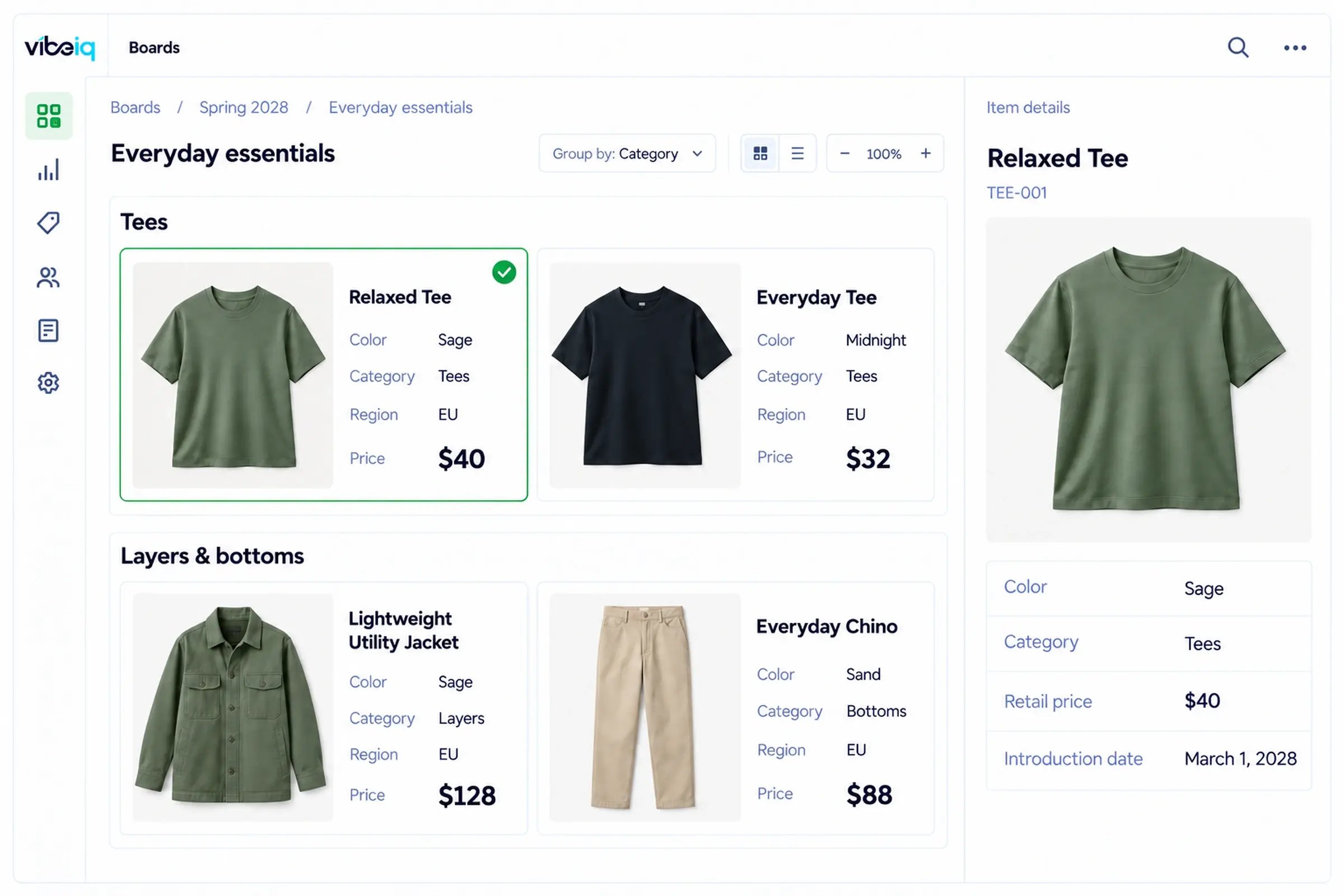
The Spring 2028 Everyday essentials lineboard in VibeIQ Boards, grouped by category, with the Sage Relaxed Tee selected and its item details showing color Sage, category Tees, retail price $40 and introduction date March 1, 2028.

Evaluate your line plan with product details in view

Compare your product line by category, color, price or delivery date to assess gaps and overlaps. Open a linked card to check the details behind each option.

Group and compare the assortment

Organize products by category, color, or price band to evaluate balance and identify gaps across the line.

The Everyday essentials lineboard grouped by category, then color: two tees in Sage and Midnight, the Lightweight Utility Jacket in Sage under Layers and the Everyday Chino in Sand under Bottoms, each with its retail price.
Products grouped by category and color.
The same four options regrouped by price band: the Everyday Tee and Relaxed Tee under $50, the Everyday Chino at $50–$99 and the Lightweight Utility Jacket at $100+.
Products grouped by price band.

Perspective

The picture is as important as the margin

Bailey Heckel, VibeIQ’s VP of Experience, on why product visuals and numbers have to live together.

Less rework. Earlier decisions.

Kizik logo
Line prep from 1 week to 1 day

Kizik reports reducing line-plan preparation for a key milestone from a week to a day by bringing product visuals and line information together before the review.

Vera Bradley logo
10% fewer SKUs before sampling

Vera Bradley used earlier visibility of its full assortment to identify over-assortment while the team could still remove unnecessary options before sampling.

Build your seasonal line plan before designs are finished

Start with carryover products and placeholders for new ideas. Set categories, target prices and key attributes, then develop selected placeholders into product records.

Start with placeholders

Define new product needs with categories, target prices, and key attributes before designs are finalized.

The Everyday essentials assortment in Plan with the Textured Tee added as a placeholder, a proposed option with no image yet, category Tees and an intended retail price of $48, and a Promote to product button.
Turn ideas into product records

Promote selected placeholders into product records, add imagery, and publish them to connected visual lineboards.

The Everyday essentials lineboard after the assortment was published and the board refreshed, with the new Textured Tee card added beside the Relaxed Tee and Everyday Tee.

Keep everyone working from the live line.

Update product details, drop options and publish your revised line plan. Refresh connected lineboards so merchandising and design can review the latest selection together.

Connect product line planning with your existing tools

Use VibeIQ alongside financial planning, creative and PLM tools, with product data exchanged through configured integrations.

Financial planning
Remains responsible for budgets, forecasts and commercial targets
Creative tools
Designers keep their creative authoring tools
PLM
Remains responsible for technical specifications and development

Common questions

What is visual line planning?

Visual line planning is the process of building and revising a product range using imagery alongside product attributes. Teams compare styles, colorways, prices, and timing to decide what the line needs and which products belong. Read the full guide to visual line planning.

How is VibeIQ different from a general-purpose visual board?

VibeIQ’s linked product cards connect imagery to editable product records, and generated lineboards use structured assortment data. Moving a picture changes its layout; changing a product attribute or publishing an assortment change updates the underlying information.

Can we start before every product is designed?

Yes. Create placeholders in Plan with the attributes you already know. Promote them into product records as they develop, then publish them into an assortment before using them in visual lineboards. What is a placeholder in line planning?

What commercial information can we review?

Configured attributes can include retail price, cost, category, price tier, and introduction date, alongside supported counts and summaries. Teams use that information to judge product choices. VibeIQ does not replace financial forecasting or inventory planning.

What happens when a product changes?

Edits to shared product information are reflected in connected product views. Assortment additions and drops require publication, while generated layouts may need refreshing. External system updates follow the configured integration.

Can VibeIQ identify gaps or duplicate products?

Teams can organize and inspect products by their attributes to assess coverage and overlap. Merchants and designers make the judgment about what is missing or unnecessary; this is visual evaluation, not automatic assortment optimization.

What is the difference between a line plan and visual line planning?

A line plan sets the structure of a season: categories, style counts, price points and delivery timing, often in a spreadsheet or planning tool. Visual line planning is where teams place actual products into that structure and review them as a set, with imagery and attributes side by side. Read more about line plans, or see the product line glossary.

What should apparel teams look for in visual line planning software?

Look for imagery linked to editable product records, placeholders for products that are not yet designed, and views that let teams compare category, color, price and delivery timing. Apparel and footwear teams should also check how styles and colorways are represented, how assortment changes are published, and how data is exchanged with planning and PLM systems.

How does visual line planning support fashion line planning?

Fashion line planning brings together seasonal direction, carryover styles, new product needs, price points and delivery timing. VibeIQ lets merchandising and design review those choices with product imagery and details together, then refine the line as options develop. See what good line planning looks like.

See how your team could cut rework.

Walk through your line planning process with us. See how VibeIQ could reduce rework and fit your team’s tools and workflow.