.svg)

A briefing for merchandising leaders
Spot assortment risk while you can still act
Which products overlap? Where are the gaps? What will a late change affect?
Explore six warning signs that your product line needs attention, and the questions to ask before more money and work are committed.
The problem behind the report
220 products sampled. 40 still to cut.
At one global footwear company, 220 products had already been sampled when the team needed to remove 40. The challenge was deciding which cuts would improve the assortment without creating new gaps.
Where was the line too heavy? Which products served the same need? What would be lost if one disappeared?
These are familiar questions in a line review. Answering them means seeing how products work together across categories, price points, channels and regions. A product can look defensible on its own and still add little to the overall line.
When that view is scattered across spreadsheets, decks and regional files, teams spend review time establishing what is current. Meanwhile, sampling, development and commercial commitments can continue around choices that still need scrutiny.
This report examines six warning signs to look for in your own product line, with examples from product teams and questions to bring into your next review.
Risk 01 | Range architecture
Strong products can still make a weak assortment
Every product may have a reason to exist. That does not mean the line has the right balance. An assortment can meet its total style count while carrying too many similar options, missing an important price point or leaving a regional customer need unanswered.
For example, several jackets might each earn approval on design, cost and margin. Viewed together, they could all serve the same customer at the same price, while the entry-level option is missing. Reviewing each jacket individually would not expose that imbalance.
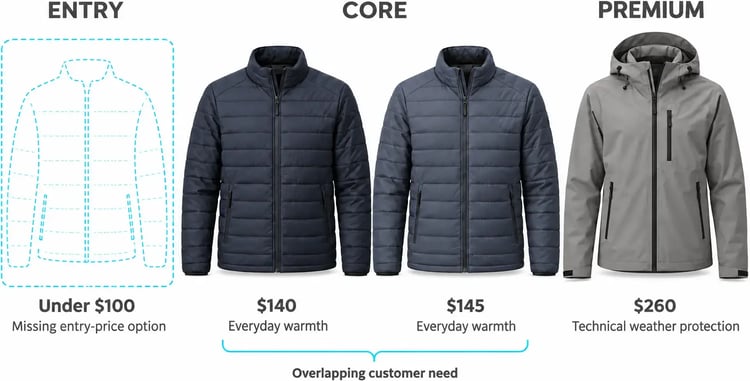
The warning sign
Teams can explain why individual products were approved, but struggle to show what each one adds to the line, where options overlap or which needs remain uncovered.
As those products advance, development effort and sample spend accumulate around the imbalance. If it carries through to buying, the business can commit inventory to overlapping options while leaving gaps in the offer.
Ask at your next line review
Which products serve the same need, where are we missing an option, and what should we keep, cut or change before committing further?
Risk 02 | Trusted product information
A recorded change can still leave teams out of date
A cost moves, a colorway changes or a style is cancelled. Someone updates the product record, but the line-review deck, regional assortment and selling materials may still show the previous version. Each team can believe it is working from the right information.
From the research
In one global fashion organization, a colorway change was recorded in PLM but did not reach the sales organization. Sales continued selling products the company no longer intended to produce.
The warning sign
Teams need to compare files, check messages or ask a colleague which cost, color, status or assortment version is current before they can make a decision.
The commercial risk grows when those checks are missed. Teams can assess margin using an old cost, prepare materials for a cancelled style or make customer commitments against an outdated offer.
Ask at your next line review
Take the last approved product change. Can every affected team see it in the information they use to make decisions and commitments?
Risk 03 | Handoff context
The product moves forward. The reasoning gets left behind.
A team can receive the correct product details and still lack the context to act on them. Why was this style kept? Which customer need does it serve? Was its approval conditional on a target cost, launch date or regional requirement?
From the research
Teams described approval documents and meeting notes being kept separately from product information. Details were exported for colleagues, while the reasoning behind the decisions remained in another file or with the people who attended the meeting.
The warning sign
The receiving team can see what was approved, but needs another meeting or a message to the original decision-maker to understand why it was approved and which conditions still apply.
Without that context, later choices can undermine the original decision. For example, a cost-saving material substitution could remove the performance feature that justified a product's place in the line. The change may look reasonable to the receiving team because the requirement was never carried forward.
Ask at your next line review
Could someone who missed the review explain why a product was approved, the role it serves and the conditions attached to that decision?
Risk 04 | Decision ownership
The meeting ends. Is the decision actually made?
Merchandising, design, planning and regional teams bring different priorities to a line review. When those priorities conflict, teams need to know who makes the final call, which requirements guide it and whether the outcome is approved or still under discussion.
From the research
Teams described the same choice being evaluated against different measures. Decisions made in meetings were later reopened or reversed, with approval status and rationale stored outside the shared product record. Preparing for the next meeting meant reconstructing the previous one.
The warning sign
A keep, cut or change decision returns to successive reviews without new information. Teams disagree about whether it was final, who can approve it or what must be resolved before work proceeds.
While the decision remains unsettled, teams may either pause necessary work or continue on an assumption. Both can become costly: deadlines slip, development proceeds on unapproved options, or completed work must be undone when the final call arrives.
Ask at your next line review
For each unresolved keep, cut or change decision, who has the final call, what must be resolved and when will the decision be confirmed?
Risk 05 | Change impact
A small product change can reopen a lot of work
Changing a color, material or delivery date may be the right decision. Its cost depends on what has already happened around the product. Samples may be underway, regional assortments agreed, photography scheduled or customer commitments made.
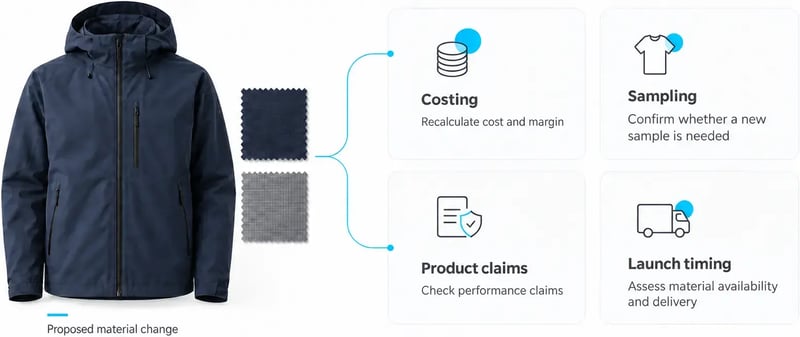
From the research
Teams described late design handoffs, last-minute merchandising changes and leadership decisions that reopened work. In one example, a review produced roughly 200 changes, requiring teams to work back through the process and manually update what had already been built.
The warning sign
A change is approved before anyone can identify the affected samples, assortments, teams and commitments. The full consequences emerge only when people start carrying it out.
An apparent improvement to one product can create unplanned sample costs, repeated work or delays elsewhere. Seeing those consequences before approval lets leaders weigh the benefit against the disruption and decide whether to proceed, limit the change or defer it.
Ask at your next line review
Before approving this change, what work must be repeated, which commitments are affected and is the expected benefit worth the cost and delay?
Risk 06 | Execution readiness
The decision is made. The next team still has to rebuild the line.
An approved assortment does not automatically give the next team what it needs to work. Before development, a regional review or sell-in can proceed, someone may still need to collect images, copy attributes, reformat a spreadsheet or build another presentation.
From the research
At one global footwear brand, development teams pulled product images and attributes from PLM and manually rebuilt them in PowerPoint for sample reviews. Notes from those meetings then had to be carried back into the process.
The warning sign
The next stage starts with copying, formatting and checking information the organization already holds. Each subsequent change triggers another round of manual updates.
This preparation consumes time needed to assess samples, resolve issues and prepare the line for market. Every reconstruction also creates an opportunity to omit a product, carry forward an old attribute or lose a review decision.
Ask at your next line review
What must the next team manually rebuild before it can act on this assortment, and how much of that work repeats after every change?
Put the findings to work
Test the risks against your own product line
Start with one category or regional assortment that is still taking shape. Bring the people making the decisions and those responsible for carrying them out. Use the information they work from today.
01. Look at the assortment together
Identify an overlap, a gap or a product whose role is unclear. Can the group judge it using the current view of the line? Note any missing information or conflicting versions that prevent a decision.
02. Follow one recent decision
Choose a keep, cut or change decision. Ask the receiving team to show what was approved, who approved it and why. Establish what work it affected and what they had to rebuild before they could act. Compare that with the original team's understanding.
03. Resolve the most consequential gap
Prioritize the issue most likely to affect the next sample, development or buying commitment. Agree what needs to change, name the person responsible and set a date to check that the affected teams can proceed.
Leave the review with one specific issue, one accountable owner and a clear next action before the next commitment is made.
Product line creation with VibeIQ
Bring your product line into one shared view
VibeIQ connects product visuals, commercial information and decisions as your line takes shape. See how your teams can assess the assortment together, decide what moves forward and keep changes connected across the views they use.
See VibeIQ in action