.svg)
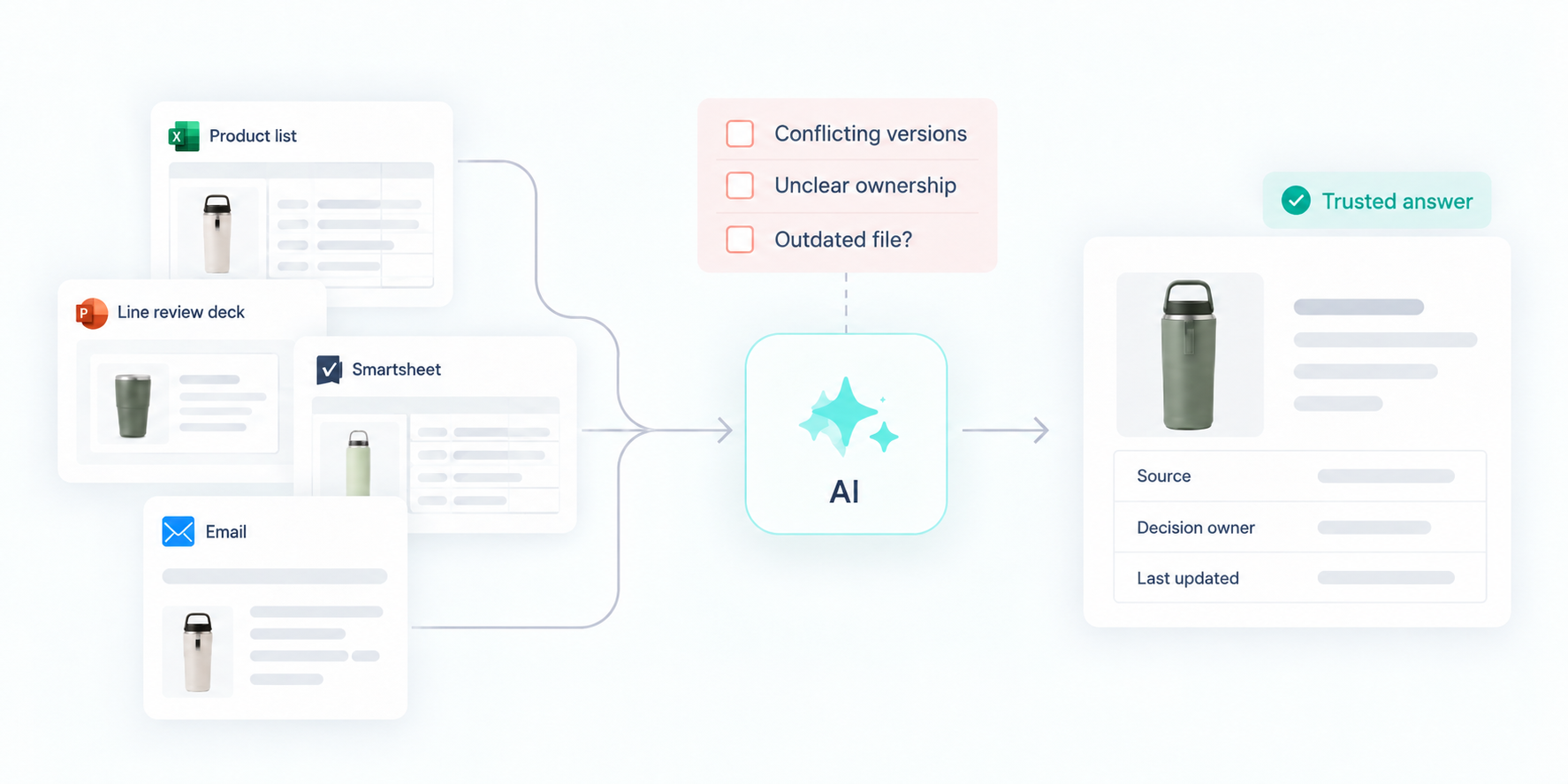
In short: AI governance starts with the information and decisions a system is allowed to use. If product choices live in competing spreadsheets, decks and email threads, AI can reproduce their contradictions faster. The board-ready story is whether management can explain what informed an output, who owns the decision and how anyone will know when it is wrong.
At a drinkware and lifestyle brand, leadership wants AI to mean “less data entry” and a smarter way to work. The same team describes product information spread across Excel, Smartsheet and PowerPoint, without an agreed version of the data in some workflows. I'd be more concerned about that second sentence than the first.
There is a temptation in transformation programs to start with a convincing demo: an assistant building sell-in presentations, a generative tool showing more designs, a roadmap packed with pilots. The demo isn't the problem. The missing test is whether those tools can survive contact with the way product decisions actually get made.
Why is disconnected product data an AI governance problem?
Because AI cannot know which version of a business decision is authoritative simply because it can read several versions. It may retrieve a stale file or put conflicting assumptions into a polished answer.
A housewares and personal care company described “disconnected systems” and “static data in different systems” as obstacles to both decisions and AI use. A luxury product leader described merchandising teams “defaulting to excel or Airtable” to capture changes. These are familiar operating habits, not failures discovered only after an AI rollout.
A product record is different from a product decision. Knowing an insulated cup exists is different from knowing whether it belongs in this season's line, which market has chosen it, or whether it was dropped at the last review. Those calls change as design, merchandising and planning work through the season.
An assistant that searches every file still needs to know which decision is current. Otherwise, it can make the work look connected without resolving the disagreement underneath it.
That is an AI liability in the operational sense: the business could rely on outputs it cannot adequately explain or defend. It is not proof that most companies face a legal claim or that every disconnected workflow creates an error.
What goes wrong when AI inherits unresolved assumptions?
An inaccurate input can influence which products get attention or how a team interprets a line decision. A fluent explanation is not necessarily a sound one.
NIST's AI Risk Management Framework identifies risks in inputs, data provenance and third-party components alongside the risks of the model itself. Access to a file does not establish that the file is current, approved or appropriate for the question.
A 2019 Science study found that a healthcare algorithm used spending as a proxy for medical need, encoding a serious inequity into a seemingly objective input. Consumer-goods systems are different, but the lesson about proxies travels: the number easiest to obtain may not represent the judgment a business actually wants to make.
For a merchandising assistant, that means a recommendation needs more than product attributes. It needs relevant line context and a way for the merchant to challenge its assumptions. Otherwise, an old decision can reappear dressed as a new insight.
Does connecting all the data solve AI governance?
No. Better-connected product context helps, but does not establish permission to use that information or prove an output is reliable.
A consumer-goods prospect worried that its designs might become part of an external model and leak. That is an intellectual-property and supplier-terms question. The right to use creative assets needs to be settled before they are exposed to an external model.
Clean product records don't settle those questions. They also don't prevent models from inventing details or people from trusting an answer too quickly. Connecting more systems can widen the consequences of a security or privacy failure if access is poorly controlled.
Governance therefore includes ownership, permissible use, supplier review, evaluation and human oversight. NIST treats these as continuing responsibilities, not paperwork to complete after a pilot succeeds.
None of this requires freezing every experiment until a multi-year data program is finished. The higher standard belongs at the point where an AI workflow starts influencing consequential decisions at scale.
What foundation should a board expect before AI scales?
Management should be able to name the business owner, explain the inputs and their origin, describe the decision AI influences, and show how failures will be detected. That's a more useful starting point than buying another model.
| Board question | Evidence management should show |
|---|---|
| What does AI do? | Use-case inventory, intended purpose and accountable business owner |
| What does it rely on? | Critical sources, owners, freshness, permitted uses and known gaps |
| Which decision is current? | A live, agreed line view and clear ownership of changes |
| What is it allowed to use? | Access controls, IP and supplier terms, security and privacy review |
| What happens when it is wrong? | Evaluation, human review, monitoring and a stop or correction path |
This isn't a job one piece of software can own. Legal, Security and Data have separate responsibilities; merchants still have to judge the commercial recommendation. PLM, planning, ERP and asset-management systems may each hold part of the record. Some consumer-goods businesses have no PLM at all.
VibeIQ's platform provides a live visual line plan and line boards based on that plan, helping teams see the full assortment and seasonal story together. It can contribute shared product-decision context to an AI-ready foundation. It does not replace enterprise AI governance, audit, compliance or model-risk management, nor the planning systems and PLMs a team already runs.
What belongs in the board's AI progress report?
Show business value and control coverage together. The number of pilots, licenses or demos is not sufficient evidence of either.
McKinsey's 2025 State of AI survey found that 47% of respondents whose organizations used generative AI reported at least one negative consequence. Fewer than one in five said their organizations tracked KPIs for generative-AI solutions. These are self-reported findings across industries, not an audit of consumer-goods companies.
Track outcomes close to the work: reconciliation time before a line review, repeat data entry, and the delay between a changed product decision and an agreed line. Pair them with evidence of named owners, documented critical inputs, completed evaluations and unresolved exceptions.
And show which experiments have been stopped. If a pilot saves time locally but creates more correction work elsewhere, the rollout case is not ready.
Even the claims made about AI need scrutiny. In 2024, the US Securities and Exchange Commission settled cases concerning misleading AI statements by two investment advisers. That is a sector-specific enforcement example, but the management question is universal: can the business substantiate what it says its technology does?
Where does product decision context fit in the AI strategy?
It is one part of the foundation, particularly when AI is expected to help teams build and sell a better line. The assistant needs to know what has already been decided, what is still open and which products are competing for a place.
For transformation leaders, the first improvement may be the working process rather than the model. A live line review is more useful than another exported presentation if teams still need to agree on the current assortment. The manual work behind line reviews is a sensible place to look for avoidable reconciliation.
But the line plan cannot protect a company's IP or independently validate a model. The point is to give enterprise governance a coherent decision process to govern.
FAQ
Frequently asked questions
What is AI governance in a consumer-goods business?
AI governance defines how AI is selected, used, tested and monitored, with clear responsibilities for each use. In consumer goods, that means controlling access to product information and deciding who can accept or challenge an AI recommendation.
Do we need to centralize all our data before using AI?
No. Controlled experiments can be useful before every system is reconciled. Before scaling an important use case, establish ownership, input quality, permitted use, evaluation and a way to catch mistakes.
What is an AI liability for a consumer-products company?
It is a potential operational, security, intellectual-property or legal exposure arising from AI use. Stale product data, unauthorized sharing of designs or unsubstantiated capability claims are risks to examine, not automatic evidence of a violation.
Who owns AI-driven merchandising decisions?
The business owner remains accountable for the commercial use case and when recommendations are accepted. Technology, data, legal and security leaders retain separate responsibilities for the system and its controls.
Can VibeIQ provide enterprise AI governance?
VibeIQ gives consumer-product teams a live visual place to review and decide on the line. That supports shared product context, but enterprise AI risk management, security, legal review and model evaluation remain separate responsibilities.
Take one AI idea in the next board pack and trace it backward. Who owns its inputs, and where was the product decision made? What would tell you the output was wrong? If finding those answers requires reconciling competing files, you have found the next investment to make before scale.
Want to see what a live, agreed line view could look like for your team?