
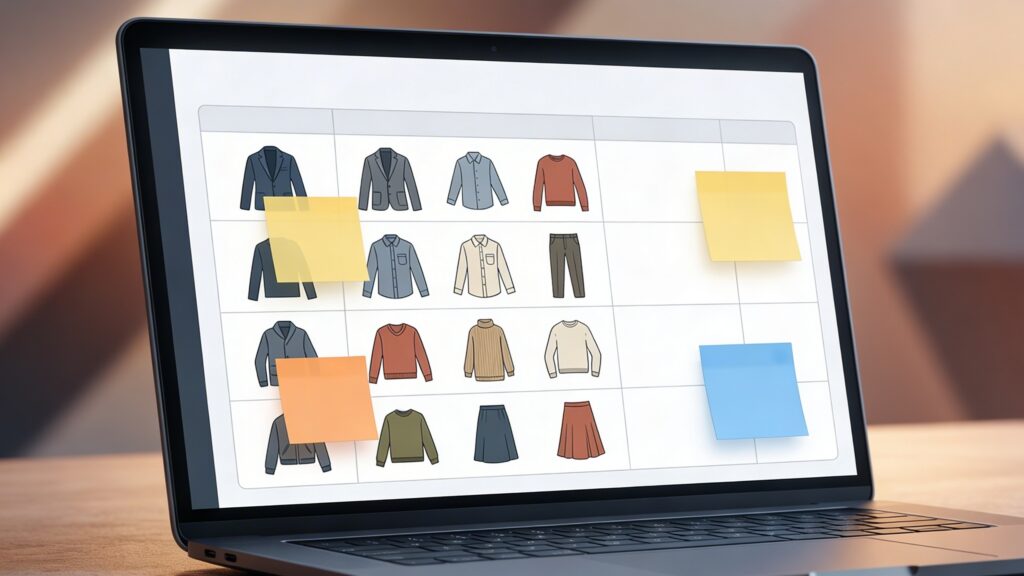
Retail doesn’t stand still. Consumer preferences shift. Trends accelerate. Market signals evolve week by week.
Yet in many organizations, the product line is still managed through static documents — spreadsheets and decks that capture a moment in time but struggle to adapt as reality changes.
And static tools were never meant to guide dynamic decisions.
What a Static Line Plan Falls Short On
Traditional line plans do an important job: they organize the assortment. But they weren’t designed to support live decision-making.
They typically lack:
- Real-time financial rollups as changes occur
- Attribute-level filtering to understand balance
- Embedded historical performance to guide choices
- Visual cohesion that reflects the line as it truly exists
To evaluate impact, teams often need to pause and rebuild the view manually.
To test alternatives, they duplicate versions.
To understand trade-offs, they rely on separate systems.
Instead of enabling agility, static plans create friction.
What a Living Assortment Enables
A living assortment changes the role of the line plan entirely. Rather than documenting decisions after they’re made, it becomes the place where decisions happen.
Within a dynamic environment, teams can:
- See financial implications update instantly as options shift
- Filter the assortment by attributes in real time
- Reference sell-through history alongside future concepts
- Model scenarios without recreating the plan
- Share a single, evolving view across functions
The line becomes interactive — not archival.
The Operational Impact for Retail and Apparel Brands
When the assortment is dynamic, the cadence of work changes. Review cycles shorten because teams don’t need to prepare static snapshots. Correction loops decrease because implications are visible earlier. Late-stage changes become less frequent because alignment happens sooner.
And margin confidence improves because financial impact is understood throughout planning — not discovered afterward.
A Strategic Shift for Retail and Apparel Brands
Moving from a static line plan to a living assortment isn’t about replacing systems built for development and execution.
PLM remains essential, but the shift is upstream.
It’s about modernizing the environment where product decisions are shaped — before they are locked into execution. Because in a fast-moving market, the line shouldn’t just be recorded. It should be able to evolve.
Get a demo of VibeIQ to see how teams can move toward a modern, digital assortment management and real-time line planning.