
There’s a moment every global merchant knows well.
You’re in a line review. Senior leadership is in the room. The conversation is about assortment, pricing, and margin — decisions that will shape millions of dollars in revenue and inventory commitments.
The slides look fine. The numbers seem reasonable. The visuals are mostly there.
And yet, there’s a quiet feeling in the back of your mind:
I’m being asked to decide — but I don’t trust what I’m looking at.
Nothing is obviously wrong. There’s no single red flag. But something feels incomplete. Disconnected. Like you’re seeing parts of the story, not the whole system.You’re not lacking data.
You’re lacking confidence in the picture.
The Weight of the Global Merchant Role
Global merchants carry some of the highest-stakes responsibilities in the organization.
Every decision you make ripples across:
- Inventory levels.
- Margin performance.
- Regional success.
- Customer experience.
- Long-term brand positioning.
You’re expected to see around corners. To balance creativity with commercial outcomes. To anticipate risk before it becomes reality.
In theory, you’re the strategic architect of the business.
In practice, you’re often making critical decisions using:
- Static decks.
- Partial data.
- Outdated visuals.
- Conflicting views from different teams.
And when the information itself feels unstable, even the best instincts start to feel shaky.
The Illusion of Being “Data-Rich”
Most merchandising teams assume the problem is lack of data.
So they invest in:
- More reports.
- More dashboards.
- More spreadsheets.
- More slides.
But global merchants aren’t actually short on data.
They’re drowning in it.
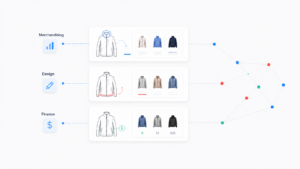
Product information lives in PLM.
Financials live in ERP.
Performance metrics live in BI tools.
Visuals live in design systems.
Regional inputs live in separate decks.
The issue isn’t access to information.
It’s the inability to see it together.
Global merchants are data-rich — but visibility-poor.
And without visibility, even the best data becomes noise.
The Blind Spots That Erode Trust
This lack of visibility in accurate line data creates blind spots that quietly undermine decision confidence.
Disconnected Product Data
PLM says one thing. ERP says another. Planning tools show something else. Attributes don’t always align. Updates lag. There’s no single version of the truth — just multiple approximations of it.
Missing or Outdated Visuals
Product images trail behind data. Colorways aren’t fully reflected. Variations are unclear. So decisions are made based on abstract rows in a table, not real products customers will actually see.
Financial Context Lives Somewhere Else
Margin lives in one system. Costs in another. Revenue projections in a spreadsheet. Merchants are forced to mentally stitch financial impact onto assortment decisions — across multiple screens and tools.
Fragmented Regional Views
Each region operates with its own deck, assumptions, and definitions of “the line.” What looks strong globally may be risky locally — but no one ever sees both perspectives at once.
Individually, these gaps feel manageable.
Together, they create a dangerous reality:
you’re making high-stakes decisions without ever seeing the full system.
The Real Risk Isn’t Uncertainty — It’s False Confidence
Here’s the subtle danger.
When product line visibility is poor, teams don’t stop making decisions. They still move forward. They still commit. They still approve lines.
But they do it based on:
- Partial truth.
- Outdated context.
- Static snapshots of a dynamic reality.
This creates false confidence — the belief that you’re seeing enough to decide, when in reality you’re not.
And false confidence is more dangerous than uncertainty.
It leads to:
- Late-stage surprises.
- Reactive changes.
- Expensive downstream fixes.
- Missed opportunities that only become visible in hindsight.
The biggest risk in merchandising isn’t making the wrong decision.It’s making the right decision for the wrong version of reality.
You Can’t Decide What You Can’t See
At its core, this isn’t a people problem. It’s not a skills issue. It’s not even a strategy issue.
It’s a visibility problem.
The product line doesn’t exist as a system today. It exists as:
- Rows in spreadsheets.
- Slides in decks.
- Metrics in dashboards.
- Images in folders.
Each format tells part of the story. None of them show the whole picture.
And when the line isn’t visible as a connected system — product, visuals, and financials together — decision-making becomes an exercise in educated guesswork.
What “Seeing the Full Picture” Actually Means
For global merchants, true visibility means something very specific.
It means being able to:
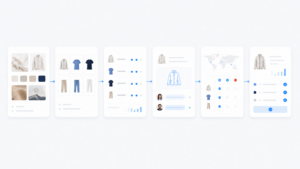
- See the entire product line in one place.
- With real-time product data.
- With accurate, up-to-date visuals.
- With financial metrics embedded directly into the same view.
- Instantly pivot by region, category, price tier, or margin band.
- Explore scenarios live.
- Spot risk before it becomes reality.
Not after the season launches.
Not after inventory is committed.
Not after performance reports roll in.
Before decisions are locked.
From Blind Decisions to Visual Intelligence
This is where the concept of visual intelligence becomes critical for modern merchandising.
Not just analytics.
Not just dashboards.
Not just reports.
But a visual system of record — where:
- Products are visible as real entities.
- Data is always current.
- Financial context is built in.
- Stakeholders share the same source of truth.
Visual intelligence turns the product line from a collection of disconnected artifacts into a living, navigable system.
It replaces blind spots with clarity.
Where VibeIQ Fits into Line Planning
This is exactly the shift VibeIQ is designed to enable.
VibeIQ gives global merchants:
- A single, visual source of truth for the product line.
- Real-time integration of product data and financial metrics.
- Dynamic visual views for every stakeholder.
- One shared environment for exploration, alignment, and decision-making.
Instead of guessing, merchants can finally see.
Instead of debating versions, teams align around reality.
Instead of reacting late, decisions happen early — with full context.
VibeIQ doesn’t just make line reviews easier.It makes them trustworthy.
The New Standard for Line Plan Decision Confidence
So how are global merchants supposed to decide when they don’t trust what they’re seeing?
They aren’t.
And they shouldn’t have to.
The future of merchandising isn’t about more data, more reports, or more presentations.
It’s about:
- Full visibility.
- Real-time context.
- Visual clarity.
- One shared system of truth.
Because when you can truly see the product line as it is — not as a static snapshot — you stop guessing.And you start making decisions you can actually stand behind.
Get in touch with VibeIQ to see how we can help give your merchandising teams greater confidence as they build and evolve your next line.