
There is a paradox at the center of modern merchandising that doesn’t get named often enough.
Many retail and apparel brands have made meaningful investments in the tools, data, and processes that support merchandising decisions. Planning systems have become more structured. Data availability has expanded. Forecasting capabilities have improved. AI is beginning to enter the workflow in multiple forms — from demand signal analysis to assortment optimization to pricing tools.
By most measures, today’s merchandising teams are better resourced than they’ve ever been.
And yet the core challenge of merchandising — determining which products deserve investment in the seasonal assortment, before the line is fully formed and before the market has confirmed demand — remains as difficult as it has ever been. For many organizations, it is getting harder.
Understanding why requires a clear-eyed look at where those investments are actually operating in the product creation process — and where the gap they haven’t closed continues to live.
The Core Challenge Has Always Been the Same
Despite how much the retail industry has changed, the fundamental challenge facing every VP of Merchandising remains consistent across organizations, segments, and seasons.
Merchandising requires committing resources — open-to-buy, development investment, production capacity — to products and categories before certainty exists about which of those commitments will pay off.
This was always true. What has changed is the environment surrounding it.
Trend cycles have compressed. Consumer preferences shift more quickly and less predictably than traditional merchandising calendars were designed to accommodate. Assortments have grown more complex — more categories, more channels, more global inputs, more variation within each product decision. And the financial consequences of misaligned investment — excess inventory, margin erosion, markdown pressure — have intensified.
The core challenge is the same. The stakes attached to it are higher.
Commitment Still Precedes Clarity
What makes this structurally difficult — regardless of how the planning environment evolves — is that the moment of commitment and the moment of clarity are separated by time.
Merchandising leaders must commit to assortment structure, category investment, and style counts before the line is fully formed. They must allocate open-to-buy before trend conviction is complete. They must decide which concepts deserve development investment while design is still evolving those concepts.
No tool, however advanced, eliminates that gap. What tools can do is improve the quality of the context available within it — the shared visibility, the cross-functional conviction, the historical pattern recognition that better decisions require. Or they can operate somewhere else entirely. And that distinction is where the paradox begins.
Where AI and Planning Investment Are Actually Operating
To understand why the core challenge persists despite real investment, it helps to map where different tools and capabilities operate across the product creation process.
Think of it in three phases.
Upstream — the creative and conceptual phase — is where AI is increasingly helping designers and merchants generate ideas, explore trend signals, and visualize concepts faster than ever. These tools accelerate exploration. They generate possibilities. But they largely operate outside the workflows where actual product decisions are made.
Downstream — the execution phase — is where the majority of planning and analytics investment has historically been concentrated, and where AI is now making the most visible gains. Demand forecasting is becoming more accurate. Assortment optimization platforms are improving how teams manage category performance. Pricing and inventory systems are becoming more responsive to real-time signals. These are genuine improvements. They make the execution of merchandising decisions more efficient and more data-informed.
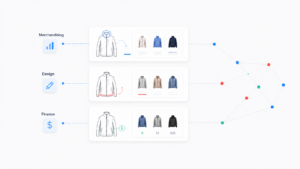
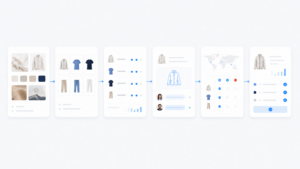
Midstream — the decision phase — is where merchandising, design, and product teams must evaluate the evolving line and commit: which products deserve investment, how the assortment should be structured, where development resources should go. This happens before the line is fully formed, before certainty exists, and before the downstream execution machinery has anything to act on.
This midstream phase is the most consequential moment in the product creation process. It is also the least supported. And it is where most planning and AI investments — upstream and downstream alike — do not operate.
The Decision Gap
The gap between what the early assortment decision moment requires and what most organizations currently provide at that moment is what we call the decision gap.
It is not a forecasting gap. It is not a supply chain gap. It is not a data gap in the traditional sense — most organizations have more data than they can effectively use.
The decision gap is a context gap. At the moment when merchandising leaders must commit to product direction, they are typically working from:
- Line plans that show the structure of the assortment but not its full visual and conceptual reality
- Historical performance data that exists in separate analytics platforms, requiring additional synthesis before it can inform current decisions
- Design concepts that are still evolving and distributed across disconnected tools
- Trend insights that have been analyzed independently of the actual product line taking shape
- Cross-functional inputs from teams working from different versions of the same information
This is the environment in which the most consequential merchandising commitments are made. And it is an environment that most planning and AI investments were never designed to improve.
More data flowing into that moment doesn’t automatically produce more clarity. More tools operating around it don’t automatically produce more confidence. The quality of the decision depends on the quality of the shared context available when the decision is made — and that context remains fragmented in most organizations today.
Three Costs That Originate Here
The decision gap produces consequences that are familiar to every merchandising leader — even when their origin in the decision process hasn’t been fully named.
Speed Cost. When the early decision moment lacks shared context and cross-functional conviction, decisions slow down or get made conservatively. Commitment arrives late. Development timelines compress. The window to scale the right opportunities narrows before conviction forms. The organization moves fast in execution — but too slowly to the right direction.
Operating Cost. Late alignment is expensive alignment. When misalignments between design direction, commercial targets, and feasibility constraints aren’t surfaced until the line review, rework follows. Samples are produced for concepts that don’t survive commercial review. Development resources flow toward products that will later be redirected. The cost of fixing things late is always higher than the cost of getting them right early.
Sell-Through. When early commitments are made with incomplete context, the assortment reflects those limits. Products advance that a fuller picture would have redirected. Genuine opportunities are underfunded because conviction arrived too late to build behind them. The gap between what each season was capable of delivering and what the organization actually captured shows up most directly in full-price sell-through — and in the markdown pressure that follows.
All three costs originate in the same place: the midstream decision moment. And all three remain addressable there — before commitment locks and the downstream execution machinery takes over.
Why AI Hasn’t Changed This — Yet
AI is entering the retail and apparel merchandising workflow in meaningful ways. The execution-side improvements are real, and worth pursuing.
But they share the structural limitation of the planning and analytics investments that preceded them: they operate after product direction has been set. AI that improves how accurately a team forecasts demand for a committed product cannot reach back and improve the decision to commit to that product in the first place. AI that optimizes in-season financial performance cannot correct the structural misalignments that were set in motion when the assortment was originally built.
The midstream decision moment — when the line is still forming and leaders must evaluate which concepts deserve investment — is not a moment that most AI tools currently enter. It happens before the data those tools depend on exists. It requires a different kind of support: not faster analysis of historical patterns, but a clearer, shared view of the product line as it is forming, in real time, across the teams responsible for shaping it.
The Gap Is Growing — and So Is the Cost of Ignoring It
If this structural gap has always existed, why is it becoming more consequential now?
Because the environment around it has changed in ways that amplify its impact on both sides.
As execution has become more efficient — through better planning systems, faster supply chains, and increasingly capable downstream AI — the organization’s ability to move quickly toward a committed direction has improved. That is an advantage when the direction is right. It is a compounding liability when it isn’t. The faster an organization can execute, the more costly early misalignment becomes. There is less time to course-correct.
At the same time, the volume and complexity of inputs flowing into the early assortment decision has grown. More data. More trend signals. More AI-generated analysis. Each has potential value. But more inputs without a shared environment in which to evaluate them together — in the context of the full, evolving product line — can increase the complexity of the decision without improving its quality.
And the competitive stakes have shifted. The brands that consistently win aren’t simply the ones that execute fastest. They’re the ones that get to the right product decision fastest — closing the decision gap before their competitors do, with greater confidence and less rework. Speed of execution is table stakes. Speed of relevance — how quickly your organization makes better assortment decisions, earlier — is where the competitive advantage is increasingly being built.
What Closing the Gap Actually Requires
For VPs of Merchandising, this points toward a question worth sitting with.
Most of the investment that has been made — in tools, in data, in process — has been concentrated in execution: how efficiently and accurately the organization manages the assortment after direction has been set. That investment is valuable and worth continuing. But it addresses a different problem than the one that most directly shapes merchandising outcomes.
The decisions that determine whether a season succeeds or struggles are made before development begins — in the midstream phase, when the line is still forming, when conviction is still building, and when the cost of getting direction right is still low enough to matter.
Closing the decision gap means building the environment that supports that moment: shared visibility across teams, real-time context that doesn’t require manual assembly, cross-functional conviction that builds progressively rather than arriving under deadline pressure at the line review. And AI that operates there — on the evolving product line, on the decisions still being made — rather than downstream of them.
The next article in this series examines the specific structural reason cross-functional alignment is so difficult to achieve early — and why addressing it requires more than better process or stronger relationships.
About VibeIQ
The merchandising leaders who feel this gap most acutely are usually the ones who have already done everything else right. The planning systems are in place. The analytics are running. The team is capable. And the early decision moment is still the hardest part of the process — fragmented, slow to align, and costly when it goes wrong.
VibeIQ is built for that moment. It’s the platform purpose-built for the midstream phase of product creation — bringing merchandising, design, and product teams together in a shared, AI-powered environment where concepts can be evaluated in the context of the full evolving line, alignment builds progressively, and the right assortment commitments can be made earlier and with greater confidence.
If the decision gap is a pattern you recognize in your organization, we’d welcome the conversation.