

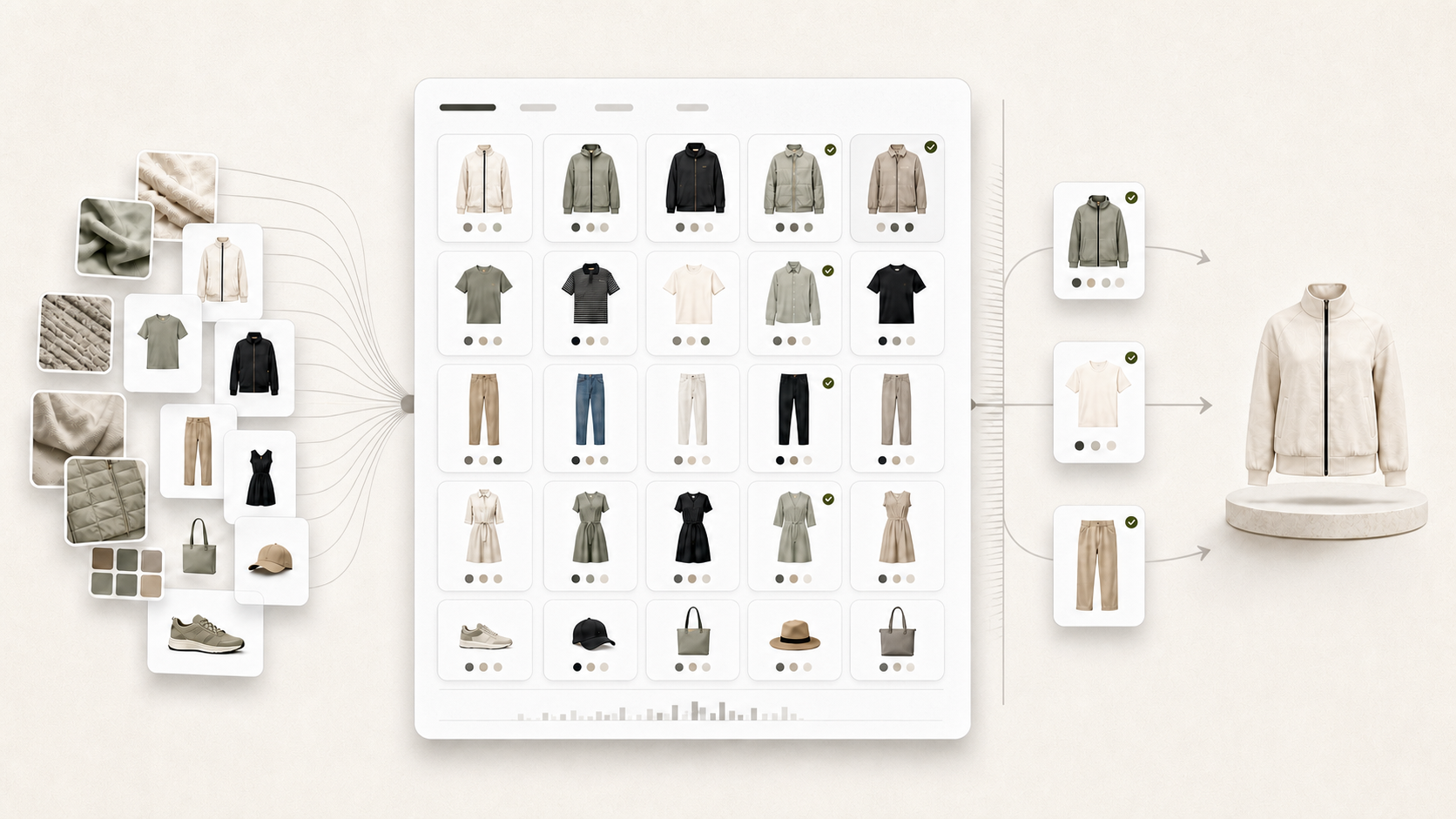
AI can help apparel teams generate more concepts, images, and analysis. But the bigger opportunity comes earlier: use the product line itself as a prototype, so teams can challenge weak assumptions before they become physical samples.
In August 2026, Harvard Business Review published “AI Makes Building Easy. Choosing What to Build Is Harder.” Its argument is deceptively simple: as AI makes it easier to build things, the difficult part moves upstream.
Researchers gave 33 NYU Stern students six hours to tackle complex New York City problems using AI-powered research, prototyping, and coding tools. Most had no engineering background, yet every team produced a functional prototype.
Technical execution was not what separated the strongest teams. The judging criteria emphasized problem definition and solution design. Teams still spent significant time debating what they were trying to solve, challenging assumptions, and deciding which direction deserved to move forward.
One of the article’s central observations was that the bottleneck is now upstream.
For anyone thinking about AI in apparel product development, that deserves attention. As AI makes concepts, analysis, images, and digital prototypes faster to create, the constraint increasingly becomes deciding which products deserve to become real.
Software teams can use cheap prototypes to expose weak assumptions earlier. Apparel has to go one step further: the learning needs to happen before the physical prototype exists.
The product line is already a hypothesis
Before a seasonal line becomes physical, a product organization has already made dozens of assumptions:
- These are the styles customers will want.
- These colors belong in the assortment.
- This is the right category balance.
- These products are differentiated enough from one another.
- These price points make sense.
- These regions will adopt them.
- This line can deliver the commercial plan.
Together, those assumptions form a hypothesis about what the market will want months from now. But many product organizations do not experience that hypothesis as one coherent thing. They experience it in pieces.
Creative concepts live in design tools. Product images sit on boards and in presentations. Line architecture lives in spreadsheets. Financial targets sit in planning systems. Regional feedback arrives through meetings, decks, and files. Product information becomes progressively more formal as development advances.
Everyone may be looking at part of the line without anyone continuously seeing the line itself.
That matters because the earlier a weak assumption becomes visible, the cheaper it is to change. At Vera Bradley, a VibeIQ customer, bringing the complete assortment together visually exposed far more over-assortment than the team had realized. They removed roughly 10% of SKUs before sampling.
The individual products had not changed. What changed was the team’s ability to see what it was collectively building.
That is what a useful prototype does: it turns assumptions into something concrete enough to question. In apparel, the product line itself may need to perform that role before the first physical sample is made.
AI creates more options, not more certainty
Much of the conversation about generative AI in apparel has focused on output: generating concepts faster, producing additional colorways, rendering another silhouette, building presentations, analyzing assortments, and summarizing consumer research.
Those capabilities are useful. They are also becoming broadly accessible.
A designer who once had time to explore 20 ideas may be able to explore 100. A merchant can request more analysis. A team can generate more variations against the same brief. The organization’s capacity to create possibilities can grow much faster than its capacity to decide among them.
That is not automatically an advantage.
The business still needs to determine which concepts belong in the line, which duplicate something already there, which satisfy the assortment strategy, which regions want them, which economics work, and which deserve scarce development capacity.
Point more generation at the same fragmented decision process and you may simply create more things to reconcile.
The scarce resource starts to shift. It is no longer access to another model capable of producing an image or an idea. It is context: the line, the merchandising strategy, financial targets, regional intent, customer feedback, margin constraints, product history, creative rationale, and the reasoning behind decisions already made.
That context allows a team, or an AI working alongside it, to answer the harder question:
What deserves to move forward?
A collaborative canvas is not enough
The HBR experiment surfaced another useful lesson. Teams working through separate AI conversations sometimes struggled with fragmented context and information overload. Participants found it easier to collaborate when they could see and respond to one another’s work.
Product organizations know this problem well. One team has a spreadsheet. Another has a presentation. Designers have their own files. Someone has recreated the assortment on a visual board. Regional feedback lives somewhere else.
Each representation may be useful. The connections between them are fragile.
Moving the work onto a collaborative canvas improves visibility, but product decisions require more than visibility. Imagine a merchant asks: Show me every pink product launching in November.
A physical board can display the products beautifully, but someone must still identify them manually. A collaborative whiteboard creates a shared visual space, but unless the underlying product information is structured, the board does not really know what it contains. A spreadsheet can probably filter the data, but the merchant then loses the visual context needed to understand the assortment being changed.
Product creation requires both halves at once.
Teams need to see, compare, arrange, and respond to a product while also understanding its attributes, timing, economics, regional adoption, relationships, and history. Otherwise, organizations must choose between seeing what they are deciding and knowing what they are deciding about.
Another perspective only helps if it arrives in time
The HBR article also recommends organizing around perspectives, not simply technical skills. That has a literal implication for a global apparel brand.
A global team may establish the assortment. Regional teams understand their markets. Planning understands the financial shape of the business. Design understands the creative intent. Merchandising understands the role each product needs to play.
All of those perspectives matter, but their value depends heavily on timing. If a regional team sees the line only after the assortment is effectively committed, the company may technically have gathered regional feedback. Economically, it arrived too late.
The answer is not simply to invite more people to a meeting. Their perspectives must be visible while the decision can still move.
If a region does not intend to adopt a product, the global team should see that signal while shaping the assortment. If merchants identify a category gap, it should appear in the same context as the products intended to fill it. If a product changes, teams should not have to wait for another deck, spreadsheet export, screenshot, or milestone meeting to understand the consequences.
This is what “debate before you build” looks like when building eventually means samples, factories, purchase orders, inventory, and freight.
Physical prototypes change the economics
One of the most useful ideas in the HBR article is that cheaper prototypes can serve a different purpose. Instead of being polished demonstrations created after a team believes it has the answer, they can expose disagreement and sharpen the problem earlier.
That works because software prototypes can increasingly be created quickly and discarded cheaply. Physical products are different. A sample occupies real development capacity. Materials may need to be sourced. A factory has to make it. Teams wait for it. Iterations have consequences.
That does not make prototyping less valuable. It changes where the organization should try to learn.
The goal is not to copy the software tactic literally. It is to carry over the intent:
Make weak assumptions and disagreements visible while they are still cheap to resolve.
For an apparel company, that means before sampling whenever possible: before a questionable SKU becomes a sample, a duplicated idea absorbs development work, regional disagreement becomes an inventory problem, or the organization discovers that a line reviewed product by product does not make sense as a whole.
The live product line can become that earlier decision prototype.
Uncertainty gets more expensive over time
Product organizations will never eliminate bad bets. Fashion is uncertain. Consumer preferences change. Forecasts miss. Creative ideas sometimes fail.
The opportunity is not perfect prediction. It is seeing uncertainty earlier.
There is a meaningful economic difference between realizing an idea is weak when it is a concept, a line item, a sample, a purchase order, or inventory sitting in a distribution center. The underlying product may not have become worse. It simply became more expensive to stop.
That makes the early product-creation window unusually important. Teams are still deciding what the line should contain, but those decisions determine where development effort, samples, inventory, and eventual markdown exposure accumulate later.
Yet in many companies, this part of the process is still coordinated through spreadsheets, boards, presentations, meetings, and institutional memory.
AI does not make that problem disappear. It increases the cost of ignoring it.
What should an AI strategy for apparel product creation do?
Design and merchandising leaders are increasingly being asked for an AI strategy. The obvious answers focus on generation: more concepts, faster imagery, more analysis, and more automated work.
But access to generation will not remain a meaningful differentiator on its own. Competitors will have increasingly capable models too. The more durable advantage lies in the context those models can use and the decisions an organization can make with them.
Three shifts matter:
- Generation is becoming abundant. Creating another possibility gets cheaper.
- Grounded context remains scarce. Product strategy, assortment, margins, regional intent, customer understanding, creative rationale, and decision history belong to the business.
- Decision quality becomes the constraint. The advantage goes to companies that can back stronger products earlier, stop weaker products sooner, and understand the consequences of changing the line while there is still time to act.
That requires more than another isolated AI assistant, creative tool, spreadsheet, or collaborative canvas. It requires a shared product decision environment where people and AI can work from the same live product line, with visual and creative context connected to structured product, assortment, and commercial information as the line evolves.
That is the emerging role of a product decision platform: not to help a company generate the greatest possible number of products, but to help it decide which products deserve to become real.
AI is making it easier to create almost anything. Deciding what is worth building is becoming the more important capability.