
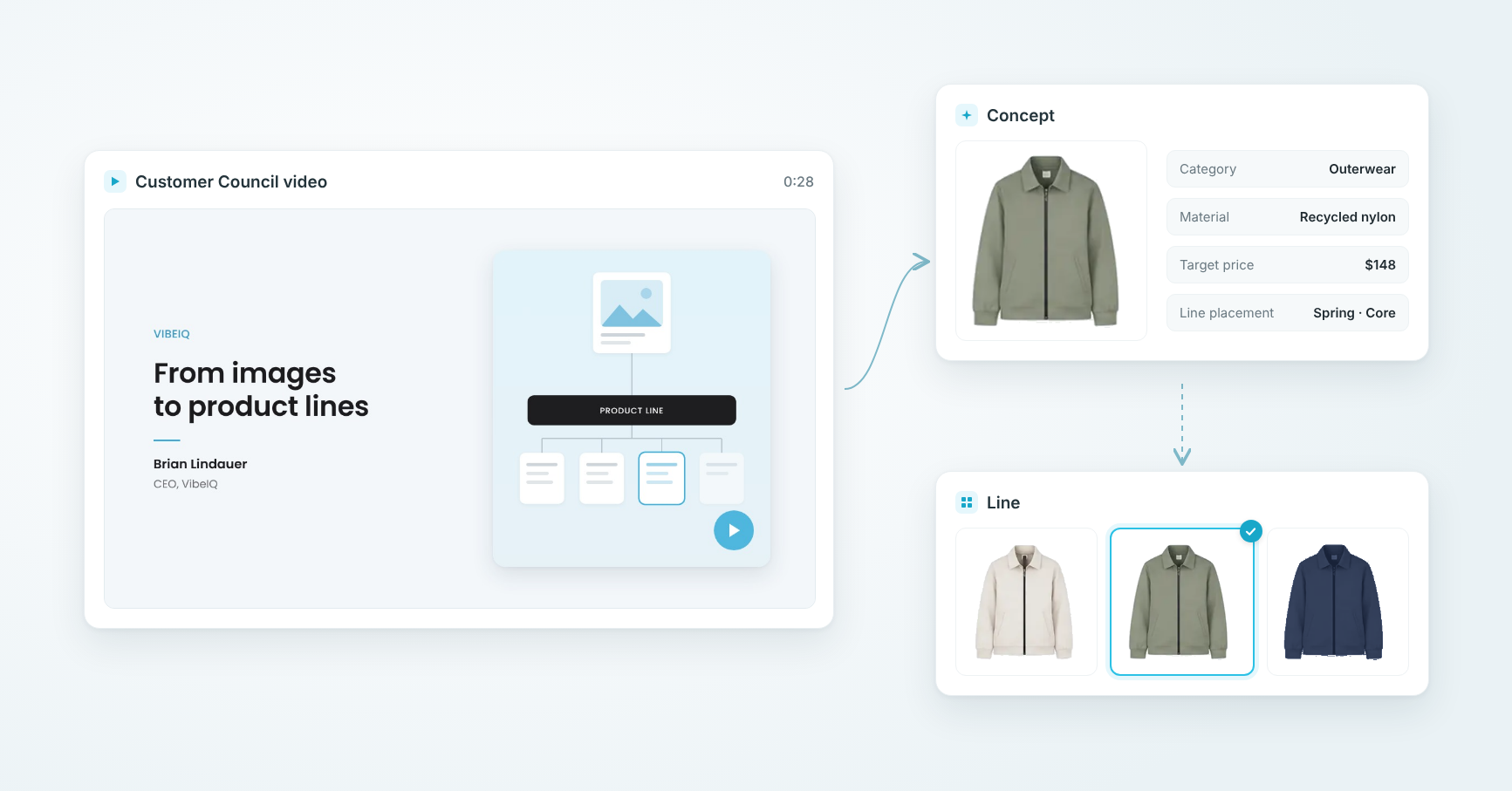
Generating another jacket concept is getting easier. Deciding whether it deserves a place in next season’s line still takes work.
Does it fill a gap or duplicate something already planned? Can it use materials the team has selected? Does it have a plausible path to the target price and margin? What would development need to turn it into a sample?
A convincing image doesn’t answer those questions on its own.
For merchandising, design and development teams, the opportunity in AI product design extends beyond producing more options. It includes helping people evaluate those options, understand their implications and carry the right information forward.
That requires a connection between the concept, the product and the line it might join.
At VibeIQ’s Customer Council, CEO Brian Lindauer described why that connection matters to the direction we’re building toward:
“We want to help you build products and product lines.”
Brian Lindauer, Co-Founder & CEO, VibeIQ
More concepts create more decisions
Faster concept generation can be useful. A designer can explore a different silhouette, test a color direction or communicate an idea that would otherwise take longer to illustrate. Teams can consider alternatives while there is still room to change direction.
But every additional concept enters a process with constraints.
There are limits on how many options the assortment can support, how much development capacity is available and how many samples the business wants to fund. Categories need a balance of price points, functions and newness. Markets may need different selections.
Generating ten more concepts doesn’t resolve those trade-offs. It gives the team ten more possibilities to assess.
Consider a merchant reviewing three new lightweight jackets. Each looks appealing individually. Together, they may serve the same customer, sit at the same price and compete for the same role in the assortment.
The useful question becomes: which option adds something the line needs?
Answering it requires seeing beyond the image.
A concept needs a place in the line
A product’s value depends partly on what sits around it.
A jacket might bring a missing price point into the range. It might complete an outfit, support a regional requirement or offer a reason to buy beyond an existing carryover. It might also repeat a silhouette the team already has covered.
That context should be available while the concept is being discussed.
When imagery sits separately from the assortment, people have to reconstruct the relationship. They pull up another spreadsheet, ask which styles are still active or check whether the latest review deck includes yesterday’s drops.
The concept may be new, but the information used to judge it may already be out of date.
Visual line planning helps make the set visible alongside the individual products. For AI-generated concepts, that surrounding context is especially useful: teams can compare new possibilities with the actual selection they are building.
The goal is to make it easier to explain why an option belongs, what it replaces and what still needs to be resolved.
Design intent needs to travel with the image
An image communicates a great deal about appearance. It rarely communicates everything the designer intended.
A fabric may have been chosen for its weight or hand feel. A detail may reference a previous product that performed well. A silhouette may respond to a specific brief, customer need or fit concern.
Some of that information lives in notes. Some sits on a mood board or in a material reference. Some exists only in the conversation that produced the concept.
If the image moves forward without those inputs, the next person has to interpret it.
That can mean asking questions the designer has already answered, making assumptions or developing a version that looks close but misses the original intention.
Keeping the brief, references and decisions connected gives the concept a more useful starting point for development. It also gives any AI involved more relevant information to work with.
A team’s own materials, palettes and previous products provide context that a standalone image cannot.
The handoff is where disconnected work becomes visible
Imagine the team adopts one of those jacket concepts and changes its fastening from a zipper to buttons.
The visual needs updating. So might the component information, construction notes, cost assumptions and review materials. Someone needs to identify which versions are affected and who needs to know.
If those pieces are maintained separately, a small design decision can create a substantial coordination task.
The problem becomes more difficult when the change happens after development has started. People may be working from different assumptions about what was approved, which detail changed or whether the original specification still applies.
This is why the handoff deserves as much attention as concept generation.
A useful workflow carries the decisions behind the concept into the work that follows. It gives people a way to understand the current product, the open questions and the changes that affect their responsibilities.
Otherwise, time saved creating the first image can be consumed reconstructing its meaning later.
Earlier information supports better judgment
Commercial and development questions do not all need final answers at the concept stage.
Teams may not yet know the exact cost, the final supplier or every construction detail. Treating an early estimate as a confirmed fact would create its own problems.
But uncertainty can still be made visible.
A material assumption can be recorded. A target price can remain in view. A development question can be attached to the option that raised it. A concept can be compared with something the business has made before.
That gives people a basis for deciding what to investigate next.
Perhaps the jacket deserves a sample. Perhaps the team should simplify a detail first. Perhaps it duplicates another option closely enough that development effort would be better spent elsewhere.
The value comes from making those judgments with more relevant information, earlier in the process.
AI can support that work when its suggestions are grounded in the team’s context and people can review the assumptions behind them.
Measure the progress beyond the picture
A generated image is an easy output to count. Progress toward a product requires a broader view.
Can the merchant understand why the concept belongs in the assortment? Can the designer preserve the intent behind it? Can development see what is known and what still needs a decision? When something changes, can the affected teams understand the impact?
Those are useful tests for any investment in AI product design.
At VibeIQ, they inform our direction as a platform for product line creation: connecting creative work with the commercial context and product information needed to move it forward.
The Customer Council discussion explored work in development, including closer connections between concepts, items and specifications. Brian’s point was about the purpose of that work.
The image is a starting point. The opportunity is to help teams turn it into a product they understand, can evaluate and can confidently decide to develop.