
Design collaboration at apparel and footwear brands rarely happens in one platform. They combine creative tools, whiteboards, 3D software, AI design tools and PLM, and the gap is usually where design and merchandising create and decide together.
Designers sketch in one tool, share mood boards in another, review fit in a third and send decisions to PLM. Merchandising, meanwhile, works in spreadsheets and line review decks. Every handoff between them is a chance for creative intent, colorway decisions and feedback to get lost.
“Right now, every CAD update, color addition, or image change triggers a full manual rebuild across decks and Excel. That’s where the real cost sits: the repeated cycles that slow us down and pull time away from segmentation, SKU discipline, and upstream planning.”
Director of merchandising at a footwear brand
This guide explains the main kinds of design collaboration tools, compares eight options that apparel, footwear and accessories brands use and lists the questions worth asking before you choose.
The main kinds of design collaboration tools
- Creative tools are where design work is made: sketches, flats, prints and artwork.
- Whiteboards are flexible spaces for research, mood boards and workshops.
- 3D design tools create digital garments and samples, so teams can review fit, drape and materials before physical samples.
- AI design tools turn sketches, prompts and references into concept imagery and product visuals quickly, and some now extend into technical designs and selling content.
- PLM and PLM-connected boards manage development, specs and suppliers once products move forward. Some PLM vendors add visual boards, but those boards only show products already set up in PLM.
- Product line creation platforms connect design to the line itself from the first brief, so designers and merchants create, review and decide on the same products before anything goes to PLM.
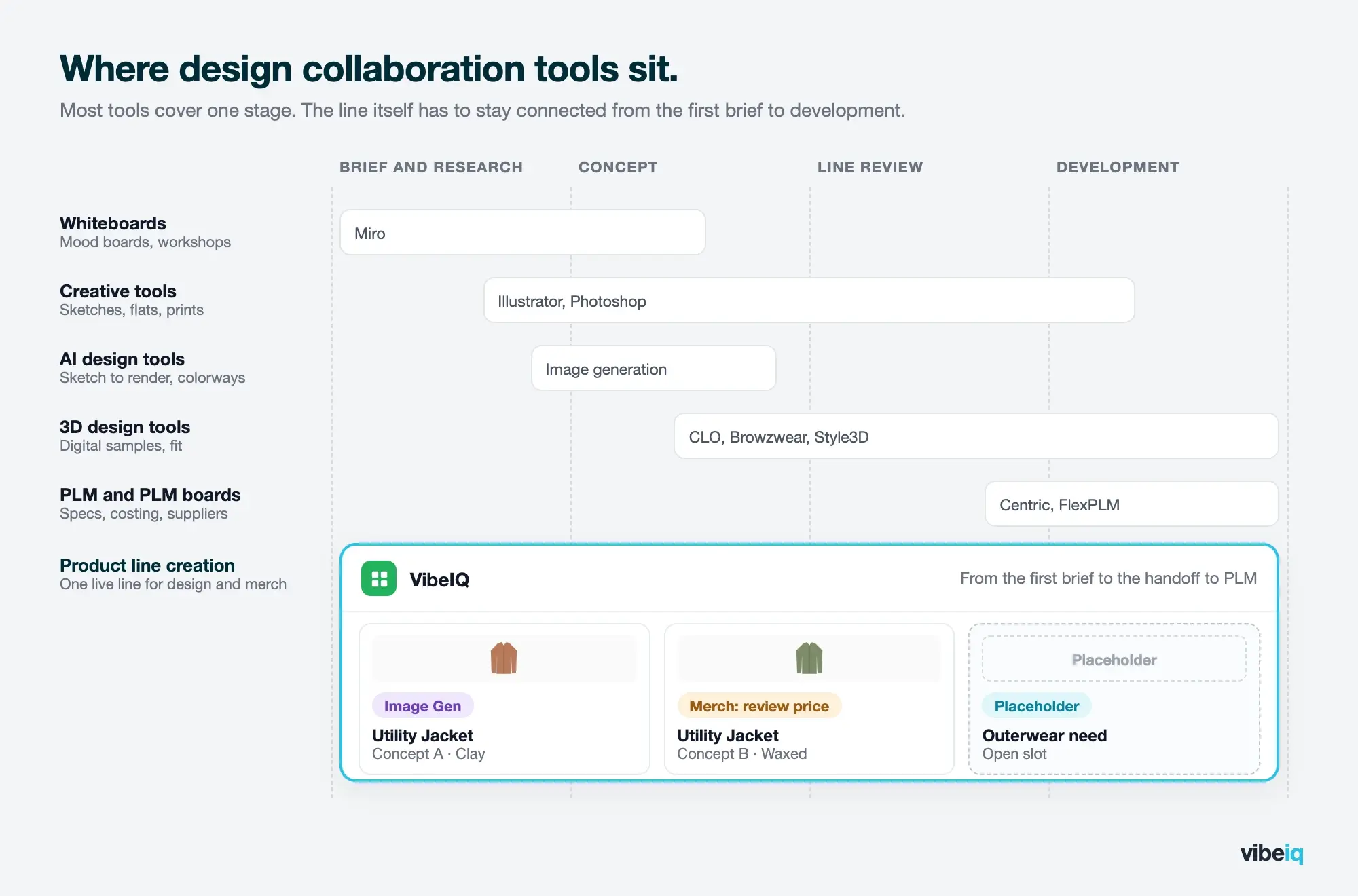
8 tools at a glance
Vendor details are taken from each company's own website and announcements in November 2026. Features change often, so confirm current capabilities with each vendor.
The tools in more detail
Adobe Illustrator and Photoshop
Illustrator and Photoshop remain the standard tools for fashion sketches, technical flats, prints and artwork. They are where design work is made rather than where the line is reviewed, so files usually get exported into boards, decks and PLM.
Best for: creating the design work itself.
Browzwear
Browzwear is a 3D apparel design and development platform. VStitcher creates garments using physics-based simulation and real fabric data, AI models test sizing and drape across the size run, and Stylezone lets buyers, designers and vendors collaborate around the same 3D asset. Browzwear also integrates with PLM, ERP and factories.
Best for: apparel teams reducing physical samples and speeding up fit approvals.
Centric Boards
Centric Boards run on product data held in Centric PLM and other connected systems, such as planning and ERP. Centric Visual Concept Boards give design teams whiteboarding on PLM data, alongside the Visual Assortment Board and the Omnichannel Showroom Board, with 2D and 3D images.
Best for: brands standardized on Centric PLM that want visual boards on products already set up there.
CLO
CLO is 3D garment design software. Designers build digital samples using pattern blocks and CLO's AI Studio, review assortments with realistic drape and colorways, and send production-ready specs to factories through CLO-SET. CLO says more than 8 million designers use it.
Best for: design and development teams standardizing on 3D garments.
Miro
Miro is a visual workspace used for whiteboarding, mood boards and workshops across many industries, and it lists ASOS and ULTA Beauty among its retail customers. Out of the box, its boards aren't tied to your product records. Some fashion groups build that link themselves: at Miro's Canvas 26 event, J.Crew Group described a "Digital Atelier" that pulls PLM data into Miro boards, built with Miro and ServiceRocket, with writing decisions back to its systems still in progress.
Best for: early creative exploration and cross-team workshops.
Raspberry AI
Raspberry AI is a design platform for fashion, apparel, footwear, and home brands. Designers use it to build moodboards, explore fabrics, turn sketches into renders, iterate designs, generate technical designs and visualize products on-model, and to produce lookbook, wholesale and campaign imagery. It's a design and visual content tool rather than a place where merchandising builds or decides the line.
Best for: designers and creative teams that want fast concept visuals and selling and marketing imagery.
Style3D
Style3D offers AI and 3D software across the fashion workflow: Style3D AI for design inspiration and renders, Style3D Studio, Style3D Fabric and Assyst CAD for 3D development and patterns, and Style3D Cloud for sharing and managing 3D assets with teams and partners.
Best for: brands and manufacturers building a combined AI and 3D development workflow.
VibeIQ
VibeIQ is a product line creation platform with AI design built in. With Image Gen, designers generate concepts from briefs, sketches, flats and mood boards, render sketches, explore colorways, materials and prints, create on-model and lifestyle visuals, and edit and finish results in Design Studio. Every concept sits on a product in the live line, where merchants review it on visual boards against the rest of the assortment and the plan's targets.
The difference from PLM-connected boards is timing. In VibeIQ, the boards, the line and the history of every decision exist before PLM, starting from a brief or a placeholder for an open need. Only the products the team approves move into PLM for development.
Best for: design and merchandising teams that want to create and decide on the line together, from the first brief and before PLM.
What to compare
- Where the work starts. Ask whether you can start before a product exists, from a brief, an open need in the line plan or a placeholder, or only once products are set up in PLM.
- Connection to the product line. Ask whether a concept on a board is linked to a product record or is just an image. Linked concepts carry through to line reviews and sell-in without being rebuilt.
- Merchandising feedback while you design. Check whether merchants can review concepts against the assortment, price points, gaps and targets as designs evolve, or only at a scheduled review.
- Design depth. Compare the AI design tasks each tool supports, how much control designers have over edits, and where results are saved.
- End-to-end claims. Several AI tools now say they go from concept to market or from sketch to production. Ask which steps happen on shared product records, whether merchandising works in the same place, and how a tool that builds a collection from a prompt knows what the line actually needs: gaps, price points and margin targets.
- Colorways and assets. One style can run across many colorways and materials, and in footwear across sizes, widths and regions. Look for imagery and details attached to each colorway rather than stored as loose files.
- Fit with your existing tools. Designers should keep working in the tools they know. Check how each platform takes in work from creative and 3D tools, and how chosen products move into PLM.
“It is never left to the designer to even change a Pantone number, because we’re using the chips directly out of Vibe.”
Kristina Funck, Design Director, Xero Shoes
What makes VibeIQ different
Plenty of tools can generate a concept. What's rare is creating it in the same place the line is being built, with merchandising working alongside you.
- Design tools that hold their own. AI concept generation, sketch to render, colorway, material and print variations, on-model and lifestyle visuals, and edit and finish in Design Studio, with results saved to your library and the product.
- It starts at point zero. Boards and line plans can begin with a brief or an open slot in the plan, carrying a target price and margin, before a single product exists. Concepts become products as the line takes shape, not after it's been handed to PLM.
- A live line, with merchandising in the room. Designers create against the current line while merchants review, comment and make changes in the same view. The line is measured against the plan's targets as it changes, so design and merchandising see the same gaps at the same time.
- One shared data model. Every concept, colorway and image sits on the same product records used for line planning, line reviews, sell-in and the handoff to PLM. That's what makes VibeIQ the only AI-native platform purpose-built to connect product creation and merchandising around one evolving product line.
- Flexible by design. Designers keep working in Adobe and 3D tools where they need them, and teams can start with the workflow that matters most, then connect the rest of the line over time.
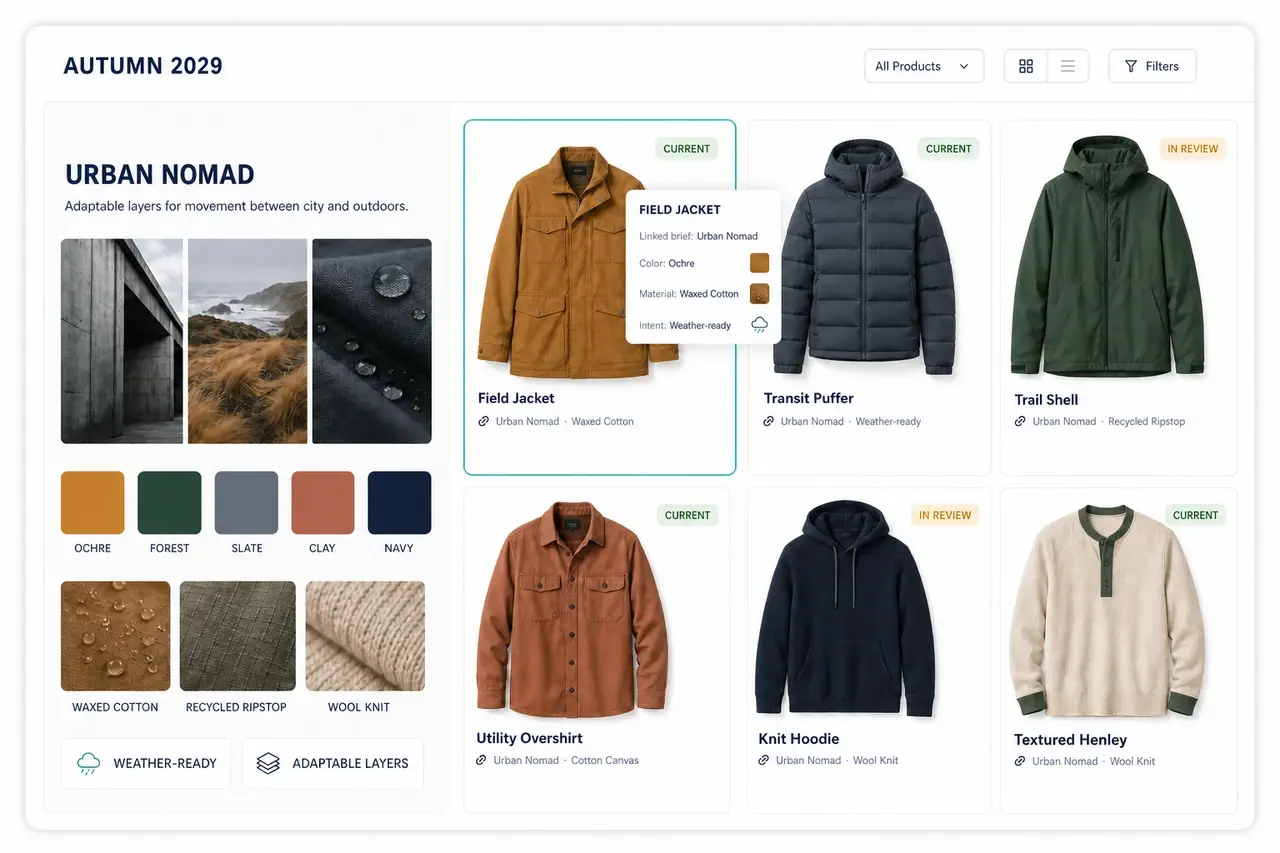
Read more on keeping creative intent intact from mood board to line sheet and where design time actually goes.
“They’re able to focus on the actual design work, the conversation around that work, and how they want to convey the idea.”
VP of Design, Agron, official licensee for adidas
Kizik gets back four weeks every seasonal cycle.
Vera Bradley replaced printed CAD boards and individual Illustrator files with one live view of the assortment, then cut 10% of SKUs before sampling.
Frequently asked questions
Is a whiteboard enough for design collaboration?
For early ideas, often yes. Once concepts need to be compared against the line, priced and handed to development, a whiteboard that isn't connected to product data means a lot of copying between systems.
Can we use an AI design tool and VibeIQ together?
Yes. VibeIQ has AI design built in, but some teams also use specialist AI or 3D tools for particular tasks and bring selected work into VibeIQ to review against the line.
What is the difference between 3D design tools and design collaboration platforms?
3D design tools such as CLO, Browzwear and Style3D create and review digital garments, fit and materials. Design collaboration platforms are where teams review concepts together and decide what moves forward. The two work together: 3D tools make the garment, and collaboration platforms decide whether it makes the line.
Does PLM handle design collaboration?
PLM is strong once a product moves into development. It's less suited to the fast, visual back-and-forth between design and merchandising earlier in the season, before products exist as records, and PLM-connected boards share that limit because they only show products already in PLM.
How do footwear brands manage design collaboration across colorways?
Keep imagery, materials and key details on each colorway record, so every review, line sheet and presentation pulls the current version instead of a copied file.
Put your next design review to the test.
Bring a brief, sketch, concept or current line. We'll show how your team could create, iterate and decide on it with the whole line in view.