
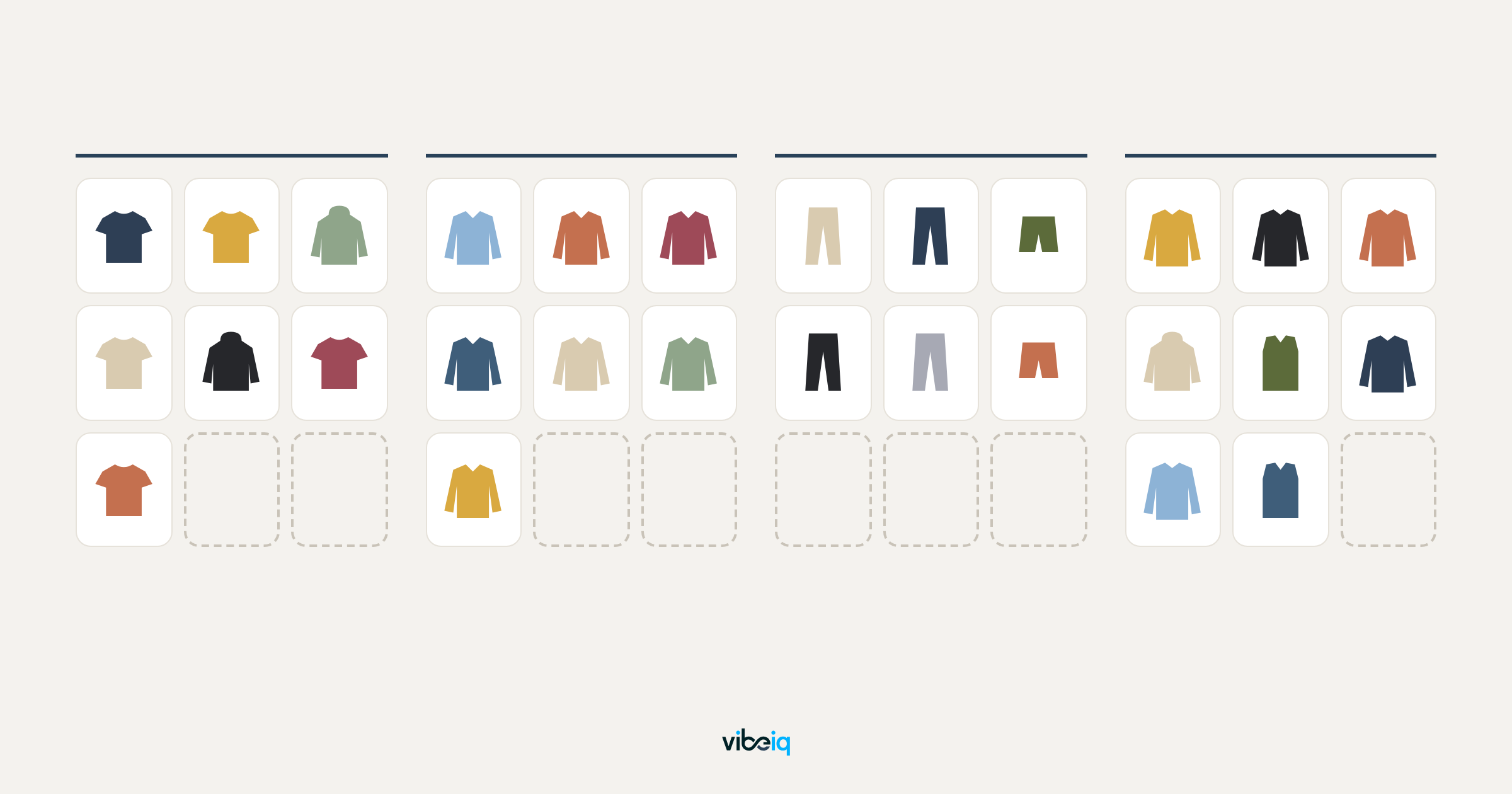
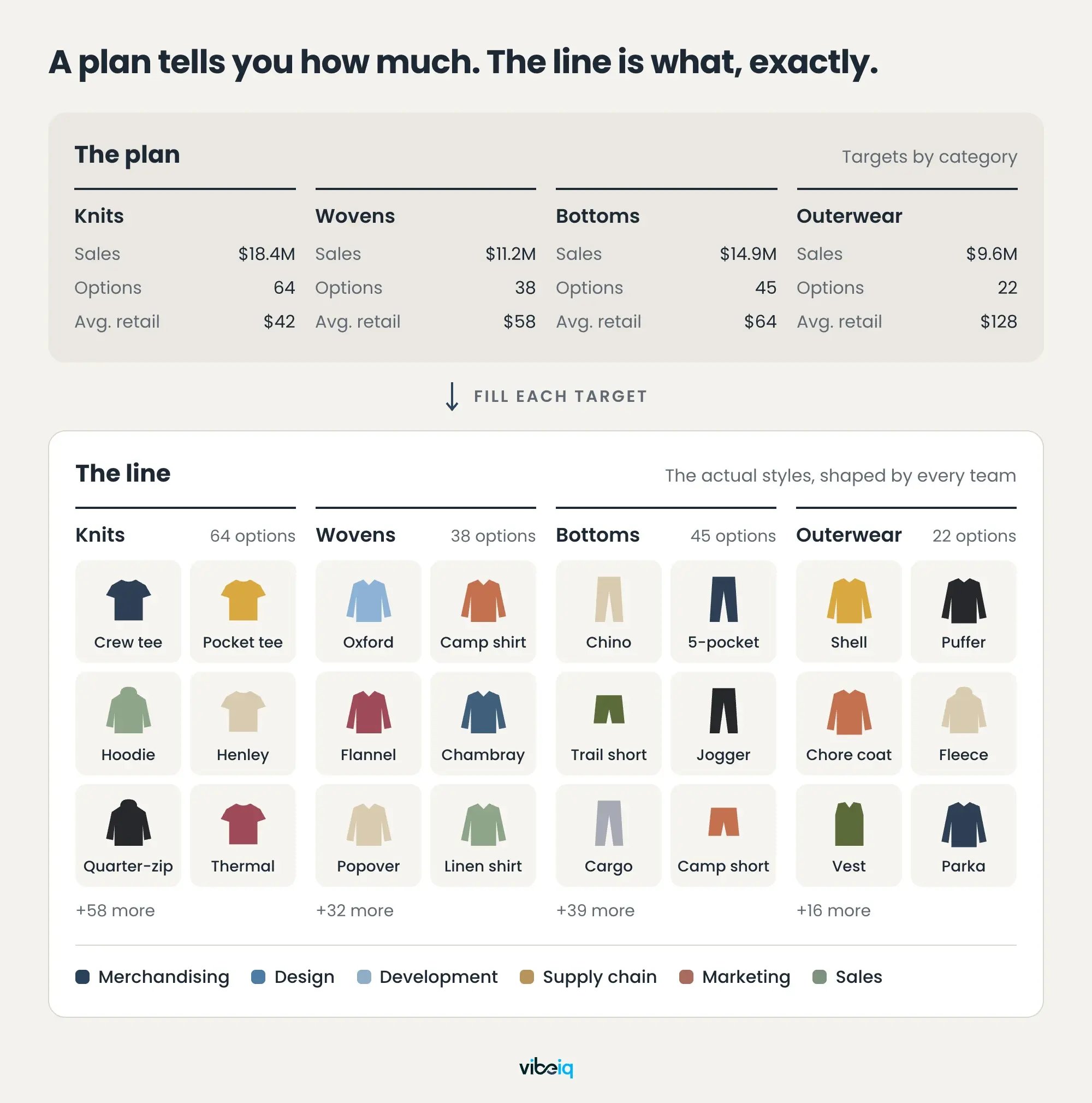
A merchandise financial plan can tell you that knits need 64 colorways at a $42 average retail. It can't tell you which 64.
That second job, deciding the actual products, is where most of a season's work happens. Merchandising, design, development, supply chain, marketing and sales all shape it. It changes week to week, and it rarely lives in one place.
Planning and line building often get grouped together, as if the line were the plan with pictures added. They are different kinds of work. Treating them as one is how teams end up with a plan that's right and a line that's wrong.
The plan says how much. The line says what, exactly.
A plan is top-down and numeric. It sets sales, option counts and average retail by category. Planning usually owns it, and the business revisits it at set points in the calendar. (For a closer look at what goes into one, see What is a line plan?)
The line is the set of real styles and colorways that fill those targets. It's visual, iterative and cross-functional. A merchant adds a placeholder, design proposes three options for it, development flags that one needs a new fabric platform, and a regional team asks for a lighter version. Each of those is a decision about the line, not the plan.
The plan hands over targets. Building the line is how a brand meets them with products people will buy.
The line has five versions, not one
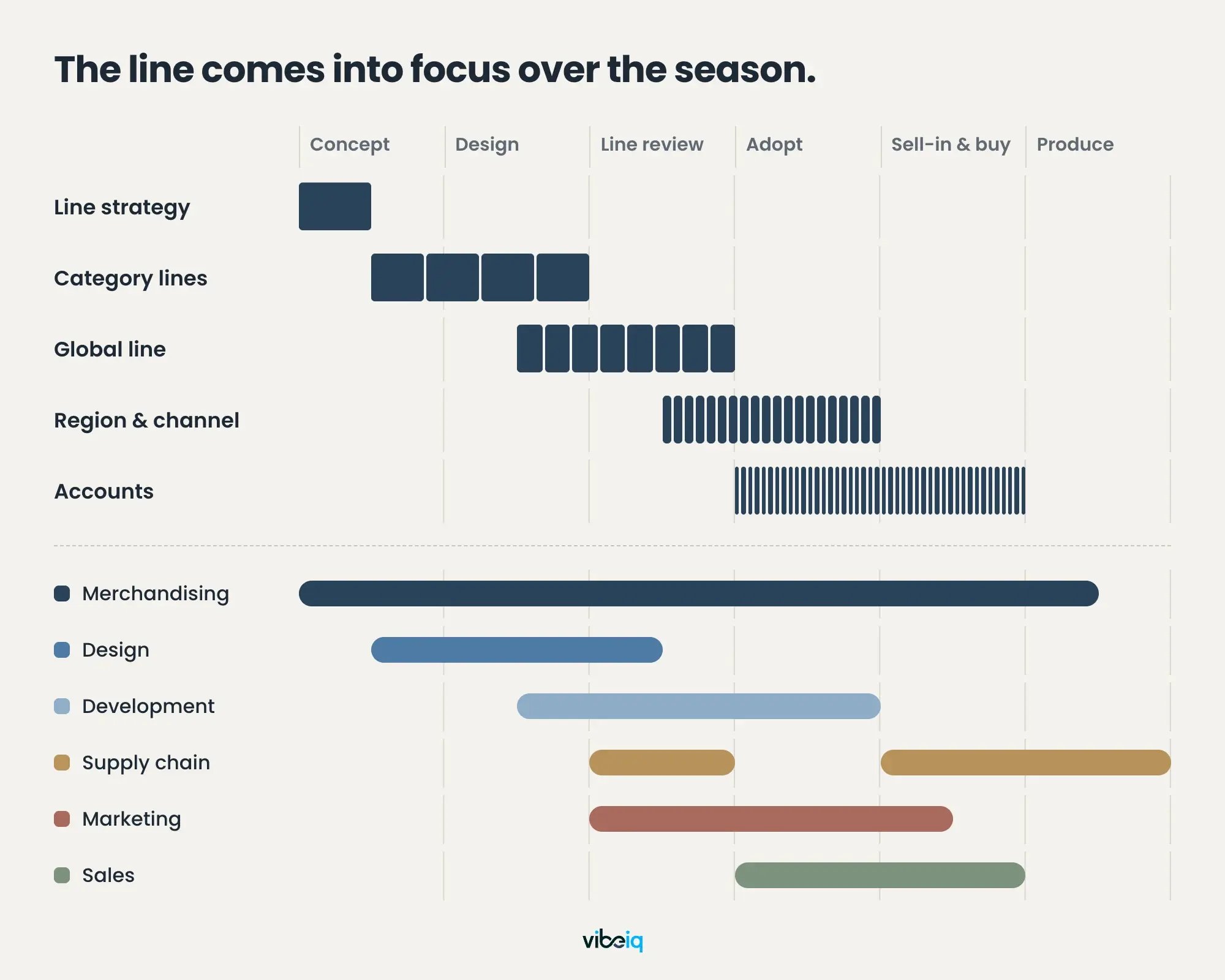
"The line" is really a series of versions that come into focus over the season, each more specific than the last:
- Category lines, worked through concept and design.
- The global line, set at line review.
- Region and channel lines, shaped during adoption.
- Cluster assortments, settled before the pre-buy.
- Account lines, presented at sell-in and finalized at the buy.
Each version inherits from the one before and adds detail. One strategy becomes a handful of category lines, then a global line, then dozens of regional and channel versions, then hundreds of account assortments. When those versions are rebuilt by hand in separate files, every change upstream has to be repeated downstream. (We've written about the cost of rebuilding regional assortments.)
Teams join and leave along the way. Merchandising stays with the line from strategy through production. Design is most active early. Development picks up as the global line takes shape. Supply chain checks lead times early and again as orders land. Marketing and sales come in as the line heads to market.
Every version has fourteen decisions to get right
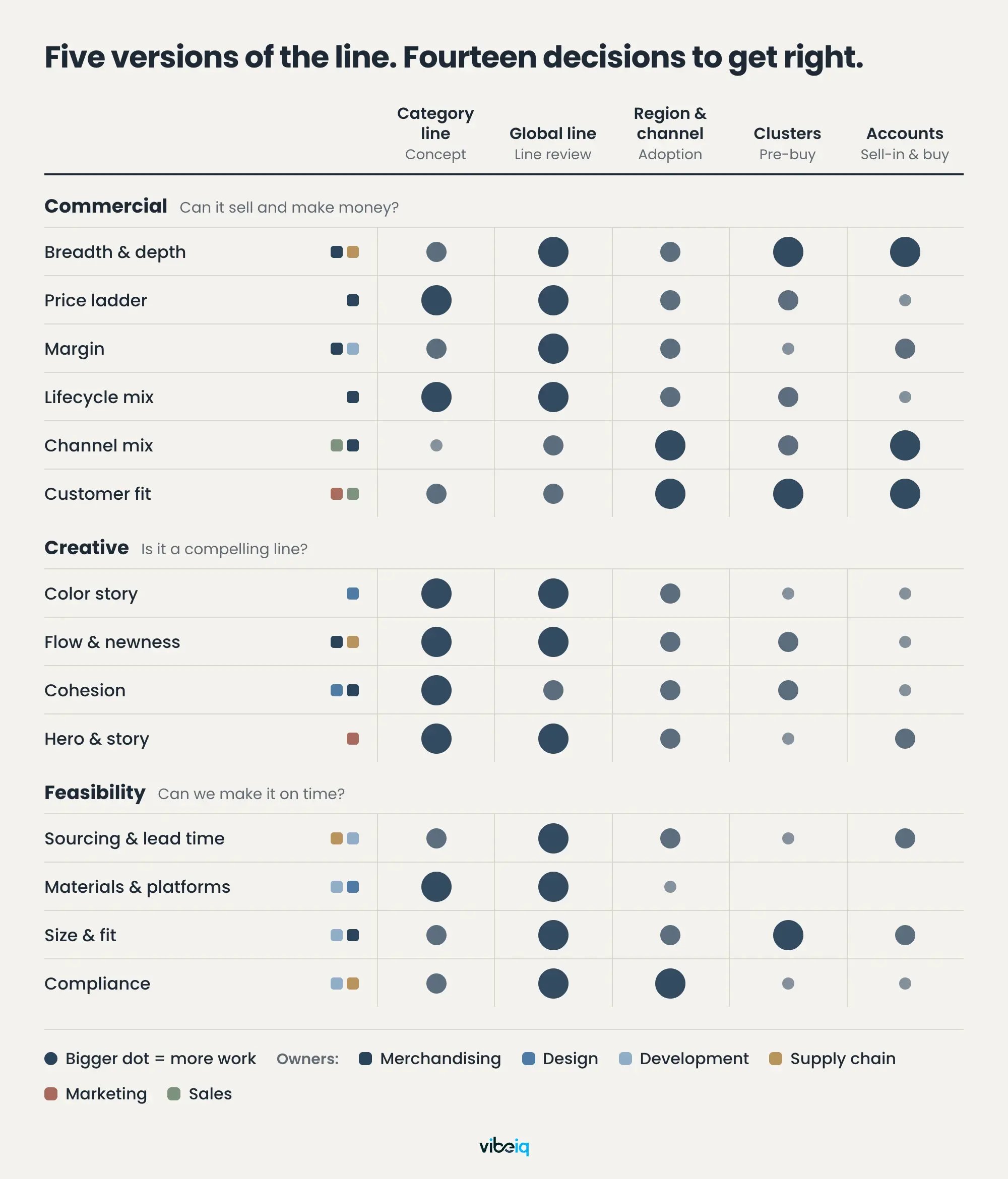
At each version, the line has to hold up against a set of decisions. We group fourteen of them into three families:
- Commercial: can it sell and make money? Breadth and depth, price ladder, margin, lifecycle mix, channel mix and customer fit.
- Creative: is it a compelling line? Color story, flow and newness, cohesion, and hero products and story.
- Feasibility: can we make it on time? Sourcing and lead time, materials and platforms, size and fit, and compliance.
The weight shifts by version. Category lines lean on creative decisions like color story and newness. The global line works almost everything at once. Account lines are mostly commercial: breadth, channel mix and customer fit.
No single team owns a whole family. Margin needs merchandising and development. Flow and newness needs merchandising and supply chain. Size and fit needs development and merchandising. A plan sees the commercial decisions, and only at the top level.
Six teams, six ways of looking at the same line
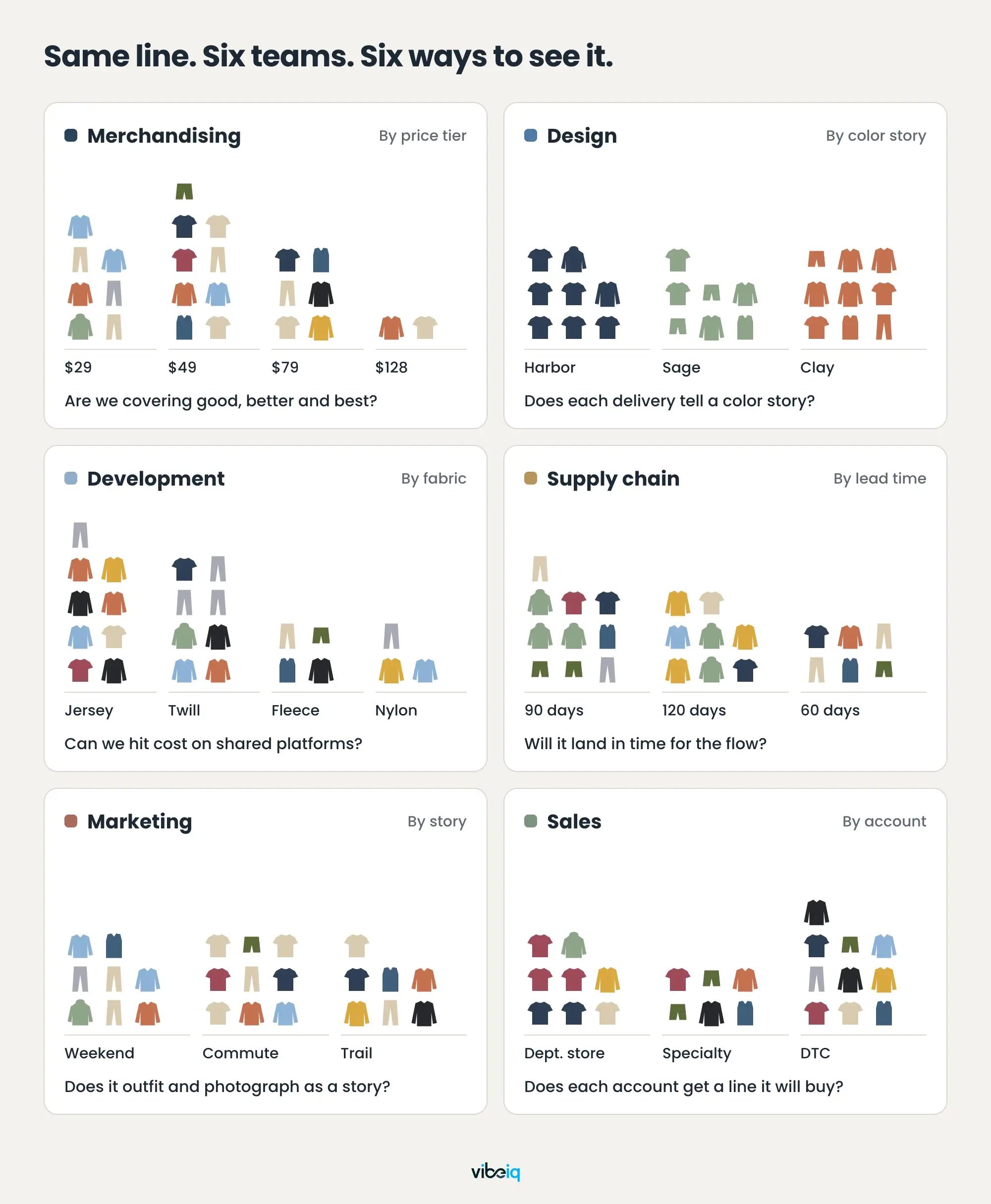
The same 24 styles look different depending on who's asking:
- Merchandising groups them by price tier: are we covering good, better and best?
- Design groups by color story: does each delivery hold together?
- Development groups by fabric platform: can we hit cost on shared platforms?
- Supply chain groups by vendor lead time: will it land in time for the flow?
- Marketing groups by story: does it outfit and photograph well?
- Sales groups by account: does each account get a line it will buy?
When each team keeps its own copy in a spreadsheet, a deck or a board, every change has to be made several times and the copies drift apart. The line needs to be one shared set of products that each team can view its own way.
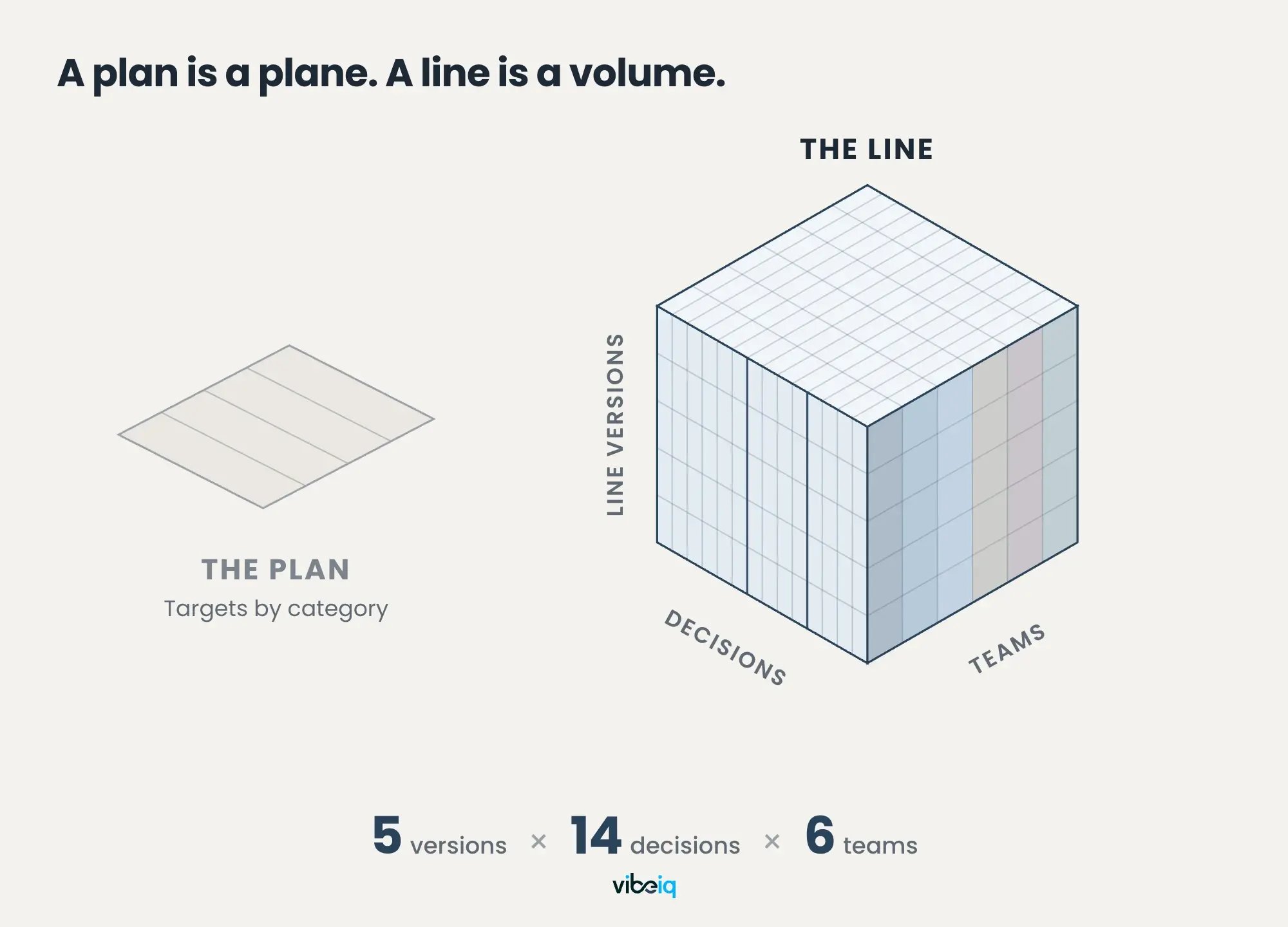
A plan is a plane. A line is a volume.
Put those together and the difference is clear. A plan is a flat surface: targets by category. The line has depth: five versions, fourteen decisions and six teams. That's 420 combinations of version, decision and team, all moving over the same season.
This is why planning tools stop short of the line, however good they are. They hold the targets well. They weren't built to carry products, imagery, attributes and decisions across every version and every team.
What line building needs
Brands that treat line building as its own job tend to look for the same few things:
- One current view of the line, measured against the plan's targets as it changes.
- Products, not rows. Imagery, attributes and options on every item, so merchandising, design and development discuss the same thing.
- Views for each team over the same data, rather than copies.
- Versions that inherit from each other, so a regional change doesn't mean rebuilding the line by hand.
The payoff shows up early in the season. With a shared visual assortment, Vera Bradley identified over-assortment earlier and cut 10% of SKUs before sampling. Kizik cut milestone prep from about a week to a day or less. New Balance gets regional feedback to its global teams 12 weeks earlier.
Where VibeIQ fits
VibeIQ is a product line creation platform. Planning sets the targets; VibeIQ is where the plan becomes the product line. Merchandising, design and development shape the line, create the products and develop them in one place, with every version measured against the plan and synced to PLM.
If your teams are still rebuilding the line in spreadsheets and decks every time something changes, it's worth seeing what visual line planning looks like when every version works from the same products.