You already have a planning tool. You already have a PLM. So when VibeIQ enters the conversation, the first question on almost every call is the obvious one: Where does this actually fit? Is it just a fancy way to surface data you already have, or another source of truth to maintain?
Those are the right questions to ask. VibeIQ doesn’t replace anything in your stack. It governs the part of the process your stack doesn’t govern today. And leaving that part ungoverned gets expensive fast: late cuts pile up, teams overdevelop, regional misalignment takes hold, margin starts to slip, and weaker products survive in the line longer than they should.
MFP vs. PLM: Three Zones, One Gap
When you follow the lifecycle of a line, three distinct zones start to emerge. First comes the financial plan. Your Merchandise Financial Planning (MFP) tool defines the targets: how much to buy by category and the open-to-buy available. It draws the box: room for twenty-five styles, a set budget, and a margin target to hit.
The last zone is the system of record. Once a product is approved, PLM records its BOMs, specs, costs, approvals, and compliance details, and becomes the official source of truth for what gets made.
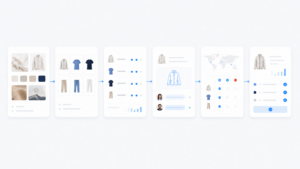
Between those two sits the part most teams forget to name: the decision window. This is where the line actually gets built. Where forty potential ideas get narrowed down to twenty-five. Where a carryover gets cut, a new color gets added, and a regional merchandiser pushes back because what sells in EMEA doesn’t always sell in North America. Where the team sees the assortment side by side and makes the hard calls on what stays, what goes, and what still needs work.
Naming those zones is the easy part. The hard part is deciding what goes in the box, what comes out, and what the line ultimately becomes. And that’s the work no system owns. So teams improvise, piecing the process together across whatever tools they have open. It’s where most of the line’s value gets created, and where a lot of it quietly gets lost.
Why Your PLM Software Can’t Own This
PLM is designed to record and manage the approved product, and its rigidity is not a flaw — it’s the point. A system of record should be auditable and locked down, because it holds the official product truth.
The decision window is the opposite. Nothing is settled yet. The work is moving fast, and half the room still disagrees. Force that phase inside a record-keeping system and the system starts working against you: it’s built to freeze decisions, not to let them stay in motion. So teams do what they always do: make the decision somewhere else, then hand the outcome to PLM to record.
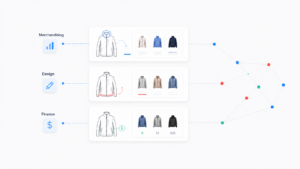
You can see it happen in any line review. Nobody opens PLM to decide what stays and what goes. They export the product data and decide elsewhere, in a board or deck where the team can finally see everything side by side. The cuts get debated and made there, and days later someone re-enters the survivors into PLM so the record matches.
Why Your Merchandise Planning Software Can’t Own It Either
Merchandise planning establishes the financial framework: it tells you there’s room for twenty-five styles and the margin they need to deliver. And planners aren’t bystanders. They’re in the room, and their judgment shapes what the line becomes.
What the planning tool doesn’t give them is a shared, visual place to resolve the tradeoffs: seeing the full assortment together, capturing what each region plans to carry, and weighing a carryover against a trend. It defines the boundaries of the decision. It doesn’t host the decision itself.
Here’s what the gap looks like in practice. The women’s category is planned for twenty-five styles with a 60% IMU target. Good — the number is clear. The hard part is everything that number doesn’t decide.
The proven carryover still sells, but it’s a season old and holding a slot newness needs. The new trend piece is exciting and unproven. EMEA wants two more colorways North America won’t touch. Every one of those calls moves the 60% — the carryover protects margin, the newness risks it, the extra colorways add cost the buy has to absorb.
Those are the tradeoffs that decide whether the final twenty-five are the right twenty-five, and the planning tool can’t make them with you. It grades the test; it doesn’t take it. So the work moves where it always does: to a deck, a meeting, or a spreadsheet off to the side.
System of Record vs. System of Decisions
PLM is your system of record, the single source of truth for the approved product. VibeIQ is your system of decisions, where the line gets built, argued over, cut, and aligned across regions before it becomes that record.
This is what matters if you’ve invested in PLM. A system of record is only as good as the decisions going into it; the clearer and more aligned those decisions are, the more valuable your PLM becomes. VibeIQ’s job is to make sure the record reflects the decision the team actually agreed on.
The Decision Layer Before PLM: Where It Fits in Your Stack
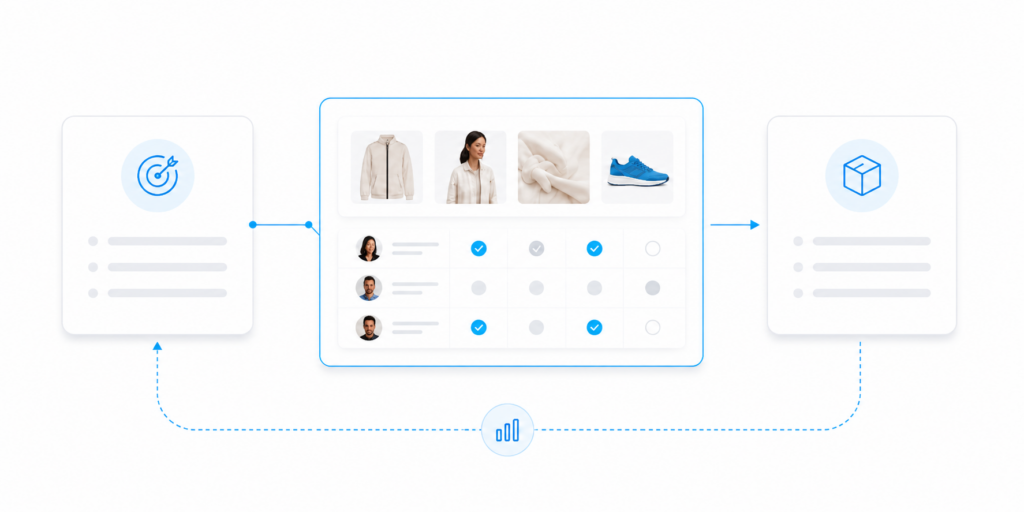
Picture the decision window at the center, with the inputs and systems around it feeding in. VibeIQ connects planning targets with designs and assets from Figma, Adobe, and your DAM, giving the team one visual workspace in which to build and align the line. Once the decisions are locked, they flow into the systems built to execute them: PLM, ERP, wholesale, and B2B.
It isn’t a competing source of truth. It’s where the decision gets resolved before it becomes fixed in the record, replacing the spreadsheets and side threads that nobody owns.
Proof: It Runs Alongside What You Already Have
One global footwear brand runs VibeIQ alongside its existing PLM, DAM, and planning systems. The PLM stays the system of record; VibeIQ is where the global merchandising line plan gets built and aligned with regional intent-to-assort. The point isn’t to add another tool in the stack. It’s to make sure PLM receives decisions that are already resolved, not still being argued. No rip-and-replace, no second source of truth. The payoff is fewer late cuts, regional input that arrives before the buy, and a record that reflects a decision the team made together.
So, Do You Need It If You Already Have PLM?
The question has it backward. You don’t need a decision layer instead of PLM. You need one because you have PLM, and the decisions feeding it still happen in spreadsheets and decks that no system governs.
Planning sets the target and PLM records the result, but the line truly takes shape in the window between them. Right now that window is held together by decks, spreadsheets, and meetings — and that’s not just messy, it’s expensive. It’s where rework begins, where regions align too late, and where weak decisions get recorded in PLM as truth.
That’s the gap VibeIQ closes: a shared, visual workspace where teams can resolve product and assortment tradeoffs before they become part of the record.
See where the decision layer fits in your stack.