
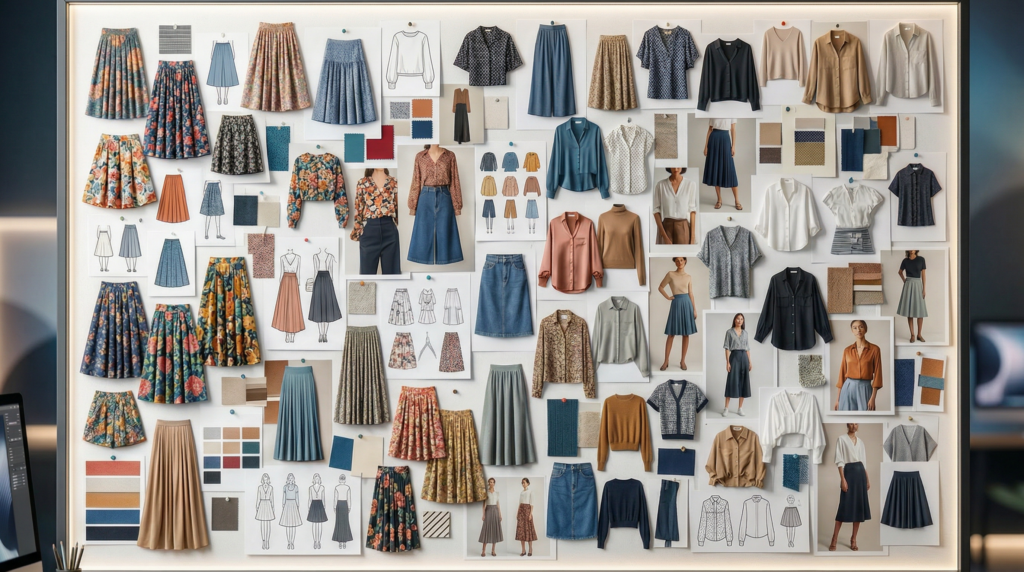
Your team is producing more concepts than ever. AI tools have made generation faster, cheaper, and more expansive — more visual directions explored, more trend signals synthesized, more creative surface area covered earlier in the season. By the upstream metrics of creative output, the process has genuinely improved.
And yet the assortment decisions that follow — which concepts advance, which get cut, which make it to market in a form that can actually succeed — feel as difficult as they ever did. The line review is still a negotiation. Alignment between design and merchandising still arrives later than it should. The season still starts with less shared conviction than the commitments it requires.
That gap — between accelerated creative output and unchanged assortment outcomes — has a specific cause. And understanding it changes how design leaders think about where AI creates real leverage in the product creation process.
Three Phases. Two of Them Covered.
The product creation lifecycle has three distinct phases. Understanding where AI is active — and where it isn’t — is what explains the gap between improved creative output and unchanged assortment outcomes.
UPSTREAM
AI-accelerated concept generation, trend exploration, visual development. Increasingly capable. Well-served.
MIDSTREAM
Where teams determine which concepts deserve investment. Where commitment locks. Where the season is made or constrained. Ungoverned.
DOWNSTREAM
Forecasting, pricing, supply chain. AI is active here too — but product direction has already been set.
Upstream, AI has become genuinely powerful. Generative image tools, trend synthesis platforms, and AI-assisted concept development have accelerated early-stage creative work in ways that were not possible two years ago. Design teams can explore more directions, visualize more options, and iterate more rapidly than the conventional creative process allowed. This is real value. It is worth building on.
Downstream, AI is increasingly active as well. Demand forecasting, pricing optimization, supply chain planning — these systems are improving how retail organizations operate once product direction has been set.
Midstream is different.
The midstream phase is where merchandising, design, and product teams determine which products deserve investment in the seasonal assortment. It is where creative exploration stops being exploration and becomes commitment — where style counts are confirmed, development resources are allocated, sourcing capacity is reserved. It is where the decisions that determine what a season is capable of achieving are actually made.
And it is the phase that AI has not yet reached.
Not because the technology isn’t capable. Because no AI tool currently on the market was built to govern that moment. Generative tools start fresh with every interaction — no assortment history, no view of the evolving line plan, no institutional memory of what worked two seasons ago. They were designed to produce. The midstream phase requires something fundamentally different.
It requires evaluation.
Generation and Evaluation Are Not the Same Problem
This is the distinction that matters most for how design leaders think about AI investment — and it is worth holding precisely.
Generation thrives on volume, variation, and possibility. The goal is to expand the creative field — to surface directions that conventional exploration might not have reached, to push the range of what’s being considered. AI is genuinely well-suited to this. The upstream acceleration generative tools provide is real, and it is valuable.
Evaluation requires context. Not inputs like style references or trend signals — context. The kind that only exists inside a specific organization, built up across seasons and decisions and commercial outcomes that generative tools have no access to.
To evaluate which concepts are right for the assortment, a design leader needs to understand how a concept fits within the line as it’s currently evolving — where it differentiates, where it creates redundancy, how it compares to what has and hasn’t worked in past seasons, how it aligns with the commercial strategy merchandising is building in parallel. None of that lives in a generative AI tool. It lives in the institutional knowledge, historical data, and cross-functional context that most organizations have never brought into a shared environment.
Generative AI tools produce outputs that are visually coherent, stylistically relevant, and creatively compelling. That is what they were designed to do. They cannot tell you whether the concept they just produced is the third variation of something your assortment already has too much of — or a genuinely differentiated opportunity the line is missing.
THE DISTINCTION WORTH HOLDING
They generate. They do not evaluate. This is not a criticism of generative AI — it is a precise description of what it was designed for, and what it was not. Generation and institutional context are simply different problems. As AI becomes more central to the design process, confusing one for the other leads to a predictable outcome: more concepts, and no better mechanism for determining which of them deserve investment.
What Happens When You Accelerate Generation Without Governing Evaluation
If your team is already using generative AI tools — or about to invest more deeply in them — it’s worth understanding what upstream acceleration actually produces when the midstream phase remains ungoverned.
More concepts enter the consideration set. Faster, and more cheaply than before.
But the capacity to evaluate those concepts — the design leadership attention, the merchandising input, the cross-functional alignment required to determine what advances — does not grow with them. That capacity is constrained by time, by organizational bandwidth, and by the absence of a shared environment where evaluation can happen efficiently and in context.
When concept volume grows faster than evaluation capacity, the process responds in predictable ways. The signal-to-noise ratio declines — strong concepts compete for attention alongside weaker ones without a clear shared view of how each fits the evolving line. Decision-making becomes more reactive — teams default to what looks good in isolation, what feels safe, what has worked before. The line review becomes the moment where volume finally meets reality, but by then significant creative investment has already been made, and eliminating concepts is costly in every sense.
Faster generation without a governed evaluation environment doesn’t produce better assortments. It produces more unresolved decisions competing for the same constrained organizational attention.
The decision gap — the structural absence of a shared environment where design and merchandising teams can evaluate concepts in context and align around them early — doesn’t close when generative AI accelerates the upstream phase. In most cases, it widens.
The Phase Where Creative Judgment Actually Lives
Here is what this means for how design leaders think about their own role — and the role of AI in supporting it.
The most valuable thing a design leader does is not generate concepts. It is exercise judgment about which concepts are right — and build the organizational conviction to act on that judgment before commitment locks.
That judgment is irreplaceable. It draws on experience, taste, commercial awareness, and a view of the brand’s creative identity that no AI system can replicate. And it is precisely the judgment that the current AI investment landscape is not designed to support.
Supporting creative judgment at the evaluation stage requires something fundamentally different from what generative tools provide. It requires an environment where that judgment can be applied in context — where the full product line is visible, where historical assortment decisions are accessible, where the commercial strategy taking shape in merchandising is not a separate document but a visible part of the same picture.
When that environment exists, AI can do something genuinely useful: not generate more concepts, but help design and merchandising leaders evaluate the ones they have — surfacing where a concept differentiates or creates redundancy, identifying patterns across the assortment that aren’t visible when concepts are reviewed individually, helping cross-functional teams build shared understanding faster than the conventional sequential process allows.This is AI in service of the full midstream phase — supporting concept generation in context, evaluation against the evolving line, cross-functional alignment, and the commitment decisions that follow. Not AI applied to the upstream phase to produce more options. AI applied to the definition, direction, and decision stages where the decisions that determine what a season achieves are actually made. And it is a fundamentally different capability than most design organizations are currently building — or evaluating.
The Question Worth Asking Before the Next AI Investment
For design leaders making or evaluating AI investments — or building the internal case for where AI creates the most strategic leverage — the framing question worth applying is direct:
THE GOVERNING QUESTION
Which phase of the product creation process does this tool actually govern? Upstream, midstream, or downstream? If the answer is upstream, the value may be real. But if the midstream phase remains ungoverned — if design and merchandising teams are still coming to alignment late, if concepts are still being evaluated in isolation from the full line, if the moment when exploration becomes commitment is still happening without shared context — then upstream investment is accelerating a process that still bottlenecks in the same place.
The midstream phase is where product seasons are made or constrained. It is where the quality of the decisions made determines what the assortment is capable of achieving. And it is the phase that, in most retail and apparel organizations, no existing system — AI or otherwise — was built to govern.
The organizations that build toward governing that phase are the ones building toward a structural advantage. Not in creative output. In creative outcomes.
About VibeIQ
The midstream phase of the product creation process — where teams evaluate concepts, align around the assortment, and commit to which products deserve investment — is where the most consequential decisions in product creation are made. It is also the phase that AI, as currently deployed in most retail and apparel organizations, has not yet reached.
VibeIQ is built specifically for that phase — governing all three stages of the midstream arc. It brings merchandising, design, and product teams together in a shared environment — alongside product visuals, historical assortment data, and commercial context — where AI supports concept generation in context, evaluation against the full evolving line, and the alignment and commitment decisions that follow. Definition. Direction. Decision. The full phase, not just one moment within it.
If your organization is asking where AI creates real leverage in the product creation process, that’s a conversation we’re built for.