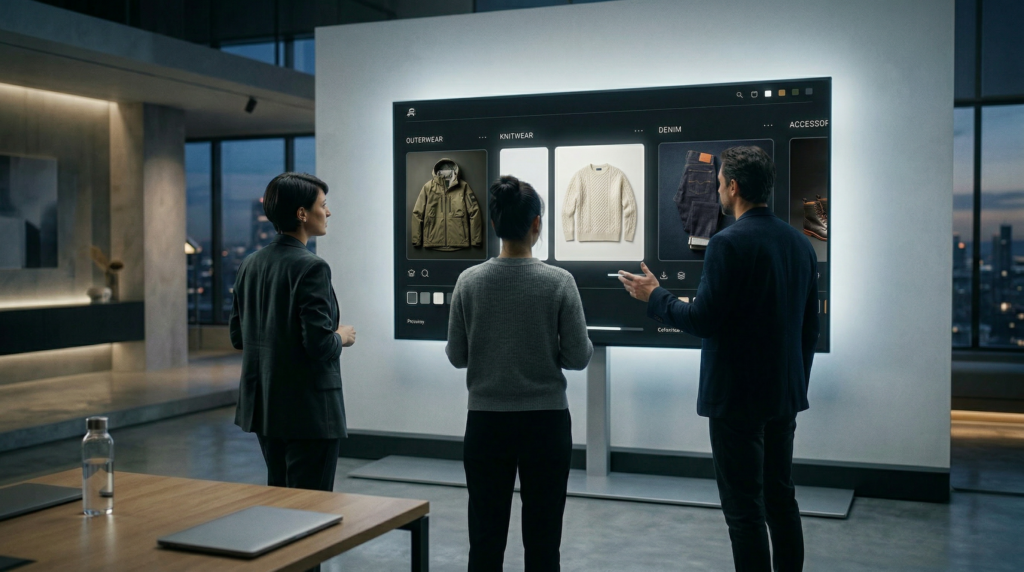
Leadership teams at retail and apparel brands review the product line multiple times before development begins. These reviews are among the most consequential moments in the product creation process.
In the room — or across the line review meeting — leaders are making decisions that directly determine:
Which concepts move forward and receive development investment
Which products are removed or deprioritized from the assortment
Where production capacity and development resources will be committed
How the line ultimately takes shape for the season
These are capital allocation decisions. The choices made here determine what the business is capable of bringing to market — and how much of the available revenue opportunity it is positioned to capture.
But despite the weight of these moments, many leaders are making them without a complete view of the line they are being asked to govern. The issue is not expertise. It is not effort. It is visibility — or more precisely, the structural absence of it.
Visibility is the specific way the decision gap — the ungoverned phase between creative exploration and operational commitment — manifests in the line review room. And when visibility is incomplete, the decision gap stays open longer than it should, costing organizations time, investment efficiency, and sell-through performance that cannot be recovered downstream.
Why Product Line Visibility Is a Revenue Variable, Not a Process One
It is tempting to frame visibility as an operational convenience — a matter of having better tools or more organized meetings. That framing understates what is actually at stake.
Strong product decisions depend on context. Leaders do not evaluate individual products in isolation. They evaluate how each product fits within the broader assortment. That evaluation requires a simultaneous view of:
How categories balance across the line as a whole
How new concepts interact with proven performers already in the assortment
How emerging trends are represented — or underrepresented — across the line
How pricing, positioning, and style work together at the full-line level
Without that full-line view, the quality of individual decisions degrades — not because leaders are less capable, but because strong assortment decisions are inherently relational. They depend on understanding how each choice affects every other. That understanding requires seeing the whole picture, not a curated summary of it.
This is also where the structure of the product creation lifecycle becomes directly relevant. Upstream, organizations have more tools than ever generating more inputs: more concepts, more trend signals, more design variations. Downstream, execution systems are increasingly sophisticated at optimizing what happens once product direction is set. But the decision phase in the middle — where those inputs must be evaluated together and translated into confident commitments — requires the clearest view of the evolving line. And it is precisely the phase where most organizations have the least visibility.
Context Is What Decisions Run On
A product concept rarely succeeds or fails on its own merits alone. Its value within the assortment depends on context: what else is in the line, what is already proven, what gaps the season needs to fill, and how the concept interacts with the pricing and positioning architecture around it.
A silhouette that looks strong in isolation may be redundant when viewed alongside three similar products already in the line. A trend category that appears underweighted in a spreadsheet may be well-represented when seen visually across the full assortment. An incremental update that feels safe in a deck may be exactly the kind of conservative bet that quietly caps the season’s revenue potential.
None of these judgments are available to leaders evaluating products individually or through partial views. They require the ability to see the full line — with visuals, attributes, historical context, and current direction visible together — at the exact moment the decision must be made. When that context is missing, decisions become harder to make and easier to misjudge. Not dramatically. Quietly. Product by product, meeting by meeting, season by season.
Why Leaders Often Can’t See the Line Clearly
The information required to evaluate the product line clearly does not typically live in one place. It is distributed across systems that were not designed to work together and are rarely synchronized at the moment decisions are required.
Product visuals reside in design systems. Line plans are managed in spreadsheets. Historical performance data sits in analytics platforms. Review materials are assembled into presentation decks — often by teams working against a deadline — that pull selectively from each of these sources.
Each of these tools contains genuinely useful information. None of them shows the full picture of how the product line is forming. And because the line continues to evolve between the moment materials are prepared and the moment leaders review them, even the most carefully assembled deck is already a partial record by the time the meeting begins.
This fragmentation is not a new problem. But it is an intensifying one. As AI tools accelerate the upstream generation of concepts, trend signals, and design variations, the volume of inputs that must be synthesized before a decision can be made is growing. More outputs from more disconnected tools do not produce a clearer picture. They produce a more complex version of the same fragmented one — with the added burden of evaluating which AI-generated inputs are worth incorporating and which are noise. Leaders are left making high-stakes capital commitments using information that is scattered, static, and often already out of date.
Snapshots Replace Reality
Line reviews are built around static materials. Teams export spreadsheets. They create presentation decks. They assemble visual boards that summarize the current state of product concepts. These materials represent real work and genuine effort. But they share a fundamental limitation: they are snapshots. They capture the product line as it existed at the moment the materials were prepared — not as it exists at the moment decisions are being made.
Between preparation and review, the line keeps moving. Concepts are added or dropped. Attributes are revised. Categories shift as design intent evolves and early feedback shapes direction. By the time leaders sit down to evaluate the materials in front of them, those materials may no longer reflect the actual state of the assortment.
Most experienced leaders know this. Many have developed an instinct for the gap between what a deck shows and what is actually happening in the line. But knowing the gap exists and having a way to see past it are different things. And as long as the review process depends on static materials assembled from disconnected sources, the gap between the picture in the room and the reality of the evolving line will persist — regardless of how much effort goes into preparing the materials.
AI-generated outputs face the same limitation when they exist outside a shared environment. A trend analysis from last week, a set of concept variations generated in an isolated design tool, a demand projection from a separate platform: each becomes its own snapshot at the moment it is produced. Leaders are left synthesizing a collection of separately-timed snapshots rather than seeing a single, current view of the evolving line.
How Limited Visibility Delays and Distorts Decisions
When leaders cannot see the evolving product line clearly, two predictable patterns emerge. Both cost revenue. Neither is the result of poor judgment. Both are the rational response to incomplete information.
Hesitation and Mis-Commitment
The first pattern is hesitation. When leaders cannot fully understand how a decision will affect the broader assortment, they delay commitment while seeking more clarity. They ask for additional analysis. They request revised concepts. They defer decisions to the next review cycle. Each delay is individually reasonable and collectively expensive: every week the decision gap stays open is a week in which production windows narrow, development timelines compress, and the organization’s ability to fully scale the right products diminishes.
The second pattern is mis-commitment. When decisions cannot be postponed further, leaders tend to favor products that appear defensible within the limited context they can see — products that feel familiar, that align with historical performance, that can be justified with the information currently on the table. They move forward not because they are the strongest available opportunities, but because they are the most legible ones given the picture at hand.
Meanwhile, emerging opportunities — concepts whose potential depends on seeing how they interact with the full assortment — remain underdeveloped or are removed from consideration entirely. The result is not simply slower decision-making. It is systematically misaligned investment: resources flowing toward the familiar and away from the genuinely promising.
Both patterns compound all three structural costs. Hesitation increases time-to-market cost by compressing the window available to scale the right products. Mis-commitment inflates operating cost through rework, late changes, and inefficient use of development resources. And both produce assortments that are more conservative than the opportunity warrants — generating the sell-through shortfalls and markdown pressure that appear months later in the financial results, long after the line review that originated them.
Why This Problem Is Intensifying for Enterprise Brands
Product lines have grown significantly more complex over the past decade. Brands manage more categories, more variation, and more global inputs than they did when many of their current review processes were designed. The number of teams contributing input into assortment decisions has expanded. Consumer data sources have multiplied.
Each of these developments adds information that is potentially valuable. Together, they have made the product line substantially harder to evaluate clearly — particularly when the tools and processes used to conduct that evaluation have not kept pace with the complexity they are being asked to manage.
Complexity Amplifies the Visibility Gap
The more complex the assortment, the more the visibility gap costs. With simpler product lines, experienced leaders can often compensate for fragmented information through accumulated intuition and institutional knowledge. With larger, more varied assortments across multiple categories and geographies, that compensation becomes increasingly unreliable.
AI is accelerating the complexity problem from multiple directions simultaneously. More concept variations are generated in less time. More trend signals are surfaced more frequently from more sources. The volume of inputs that must be synthesized before a confident decision can be made is growing faster than most organizations’ capacity to synthesize it.
When AI operates across disconnected tools, each producing its own outputs in isolation, it adds volume to an already complex picture without adding the shared view that would make that volume useful. The tools multiply. The clarity does not. The decision gap that lives between creative exploration and operational commitment stays open longer, costing more with each passing week.
The difference is not the sophistication of the AI. It is the context in which it operates. AI that works across isolated tools produces isolated outputs. AI that operates within a shared, live view of the evolving product line — where visuals, attributes, historical assortments, and team inputs exist together — can do something fundamentally different: give leaders the context that confident assortment decisions actually require.
Visibility Is the Prerequisite for Speed of Relevance
The competitive consequence is direct. Speed of relevance — how fast an organization can bring the right product to the right consumer at the right moment — is determined by how quickly the decision gap closes. And the decision gap cannot close while the leaders responsible for closing it are working from an incomplete picture of the line they are being asked to govern.
An organization cannot commit earlier to the right products if it cannot see the full assortment clearly enough to know which products those are. It cannot scale conviction into production capacity and inventory investment if that conviction is still forming against a fragmented view. It cannot build the cross-functional alignment that confident commitment requires if merchandising, design, and product teams are evaluating different versions of the same line.
Visibility is not one element of a better decision process. It is the foundation on which everything else in the decision phase rests. Without it, speed of relevance remains out of reach — not because the organization lacks execution capability or market awareness, but because the shared context needed to commit confidently is not available at the moment it is most consequential.
Closing the visibility gap is not a tool selection problem. It is a phase governance problem. The decision phase requires a governing system that makes the evolving product line visible to the teams responsible for it — live, shared, and complete — at the exact moment decisions must be made. That is what allows the decision gap to close on the timeline market opportunity actually demands. And it is what the brands building durable speed-of-relevance advantages have figured out that their competitors have not.
The Strategic Consequence
When leaders cannot clearly see how the product line is evolving, the decision gap stays open. Confidence forms more slowly. Investment becomes more cautious. Opportunities that could have been scaled aggressively are introduced with limited conviction. Revenue potential is constrained long before a single unit goes into development — and long before anyone in the organization recognizes that the constraint has already been set.
The issue is not leadership capability or product expertise. Both may be strong. The issue is the structural absence of a clear, shared, current view of the product line at the exact moment decisions must be made.
That absence will not be resolved by assembling better decks, running more frequent reviews, or adding more AI-powered tools to the existing fragmented landscape. It requires governing the decision phase directly: bringing the right information together in a shared environment where the teams responsible for assortment decisions can evaluate the line as it actually is — and commit with the confidence that revenue performance ultimately depends on.
What the Deck Doesn’t Show
Most leaders who run or attend line reviews carry a version of the same quiet knowledge: the deck in the room is not the full picture. The line has moved since the materials were prepared. There are interactions between products that the spreadsheet doesn’t surface. There are emerging opportunities that require seeing the whole assortment to evaluate — and the whole assortment is not what anyone in the room is looking at.
That gap between the picture in the deck and the reality of the evolving line is not a meeting preparation problem. It is a structural consequence of a definition, direction, and decision sequence that has no governing environment — where concepts are developed in design tools, direction is established in review meetings, and decisions are made against a picture that was already incomplete when it was assembled. The information required to commit confidently is distributed across systems that were never designed to produce a shared view, and the cost of that fragmentation doesn’t appear until months later in sell-through results and margin reports.
The decisions made in that gap, with that incomplete picture, determine what the season is capable of achieving before execution ever begins. They set the ceiling on revenue. They determine how much of the market opportunity is actually captured. And they are made, at most organizations, every single season — in rooms where the most consequential variable is the one no tool is currently showing.
VibeIQ is the platform where the definition, direction, and decision sequence happens in one place — where concepts are explored, the line takes shape, direction builds as it develops, and teams make decisions with confidence against a shared, live view rather than a static deck. If your organization is ready to examine what the line review room is actually missing, that is where the conversation starts.