Most retail and apparel brands are investing in the same places. Faster concept generation. Smarter forecasting and demand planning. Tighter execution timelines. And most are still running into a version of the same problem: assortments that don’t quite reflect the season they set out to build, creative investment that doesn’t fully convert, calendars that start compressed and finish under pressure.
The instinct is to go faster. To generate more options earlier, execute more efficiently later, and close the gap between what the brand imagines and what reaches the market through speed alone.
But the brands that are consistently winning on product relevance aren’t just moving faster. They’re building a different kind of advantage — one that lives in a specific phase of the product creation process that most organizations have never governed: the phase where design and merchandising come together to determine which concepts are actually worth building, before development begins.
That phase is where the competitive gap is forming. And the advantage it produces — what we might call the speed of relevance — is the one that faster downstream execution alone cannot replicate.
This piece is about what that advantage looks like when it’s being built: what changes for the assortment, for the team, for the relationship between design and merchandising, and for the competitive position of the brand.
The Line Review Becomes a Confirmation, Not a Confrontation
In most product creation processes today, the line review is where alignment begins — under pressure, at the moment when the cost of misalignment is highest.
By the time both teams share a complete view of what the assortment is becoming, significant creative investment has already been made. Development timelines are already constrained. The cost of meaningful change is already high. And the dynamic that follows is familiar: creative work defended against commercial judgment, positions that formed independently colliding in a compressed window, decisions made under pressure that get revisited later.
When design and merchandising teams share a common environment earlier — working together through the phases where concepts are generated, evaluated, and committed to — that dynamic inverts.
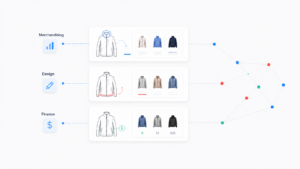
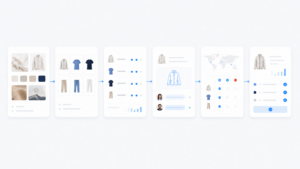
Design and merchandising teams work through the full midstream phase — Definition, Direction, and Decision — in a shared environment that connects all three stages into a governed arc. This is what most product creation processes are missing: not just better collaboration in one stage, but a connected environment where creative and commercial context accumulates across all three, from the first concept through the final commitment.
THE MIDSTREAM PHASE — GOVERNED BY VIBEIQ ACROSS ALL THREE STAGES
STAGE 1
Definition
AI-accelerated concept generation and exploration. Design teams build creative options faster and with greater range.
STAGE 2
Direction
Design and merchandising evaluate concepts together — in context, against the full evolving line and commercial strategy.
STAGE 3
Decision
The assortment is confirmed with shared conviction and full-line context before development and sourcing begin.
Across all three stages, the work is visible to the same teams, evaluated against the same context, and shaped by the same commercial and creative inputs — continuously, rather than assembled under pressure at fixed review points. The difficult conversations — about which concepts to prioritize, where to reduce exposure, which commercial targets are shaping the line — happen earlier, with more time and less pressure to work through them well.
By the time the line review arrives, it is not the moment when those conversations begin. It is the moment when a shared view of the assortment, built progressively across all three midstream stages, is formalized and carried into development.
For design leaders, this changes the character of the line review entirely. The work is no longer being defended. It is being confirmed. And the difference in what that feels like — for the design leader, for the team, for the relationship with merchandising — is not incremental. It is structural.
Concepts Are Evaluated in Context, Not in Isolation
The way concepts get evaluated shapes everything that follows. And in most organizations today, the evaluation environment is fundamentally limited — not because the people doing the evaluating aren’t talented, but because they are working without the context that good evaluation requires.
Concepts are presented individually, or in curated groupings, without a view of how each fits within the full evolving assortment. Without that view, even skilled evaluators default to what they can see: how a concept looks, how it compares to what came before. The more important questions — does this fill a genuine gap in the line? Does it create redundancy? Does it support or complicate the commercial strategy taking shape in parallel? — are difficult to answer without a complete picture.
When the decision gap closes, those questions become answerable at the moment they matter most.
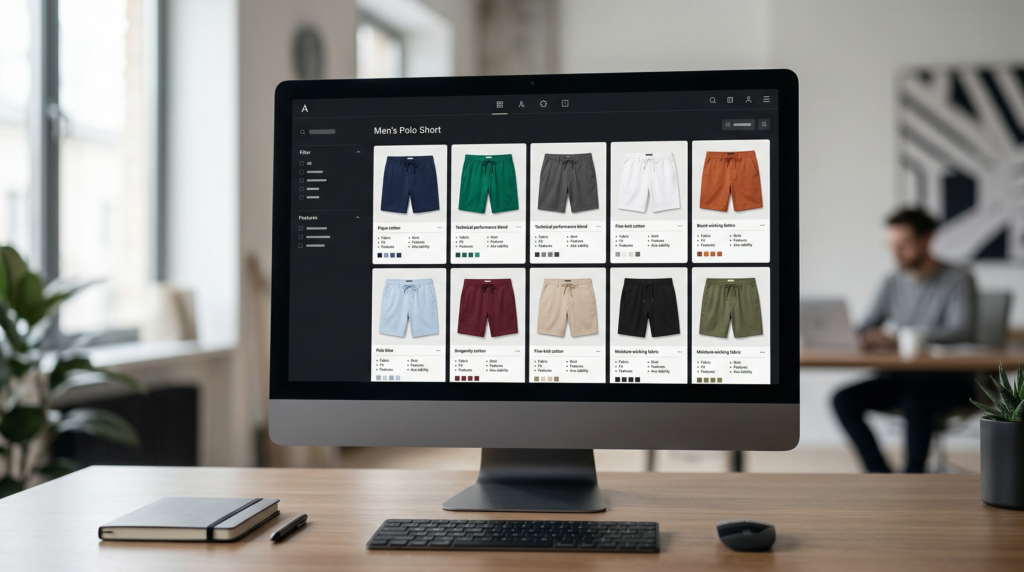
Design and merchandising teams work from a shared environment that brings product visuals, commercial context, and historical assortment data together in a single view. Concepts are evaluated not just on individual strength, but on how they interact with the full line as it takes shape. Redundancies surface before significant development investment has been made. Gaps in the assortment become visible while there is still time to address them deliberately rather than reactively.
For design leaders, this changes the character of creative development itself. The creative judgment a design leader has spent a career building can be applied in context — against the full line, in conversation with commercial reality — rather than exercised in isolation and defended later. Concepts advance because they have been evaluated properly. And the work that advances reflects what the brand is actually capable of, not just what the process could accommodate under constraint.
Creative Investment Converts More Reliably — and the Team Feels It
One of the quietest costs of the decision gap is the creative investment that doesn’t convert. Work that doesn’t survive the line review. Concepts that advance but are so reduced in scale by the time they reach development that their potential is largely unrealized. Creative energy invested in directions that merchandising was never going to commit to — not because the work wasn’t strong, but because the commercial context that would have shaped it differently wasn’t visible early enough.
Over time, this pattern does something to a design team. Gradually, and rarely named directly, talent calibrates to what survives the process. Designers stop making the work that won’t make it through — not as a conscious decision, but as a learned response to a process that consistently filters ambition and rewards familiarity.
When the decision gap closes, that pattern changes — and the reversal is felt before it is measured.
Because creative direction is shaped with shared commercial context from the start, the work that advances into development does so with genuine conviction behind it. It has been evaluated properly — scrutiny applied early enough to be constructive rather than eliminative. Concepts that advance deserve to advance. And the team knows it.
That knowledge changes the experience of doing the work. Designers stop calibrating to the ceiling the process sets, because the ceiling is no longer set by what the process can accommodate. It is set by what the brand is actually capable of. Creative ambition becomes productive rather than costly. And over time, it rebuilds the creative culture that the decision gap had quietly been eroding.
For a design leader, this may be the most personally meaningful change that closing the decision gap produces. Not just better assortments — but a team making the work it came to make.
Speed of Relevance Becomes a Competitive Capability
In a compressed calendar, the organization that moves quickly with genuine conviction behind its decisions has a different kind of advantage than the one that simply moves quickly.
The first produces assortments that reflect deliberate, well-evaluated choices — developed with shared confidence, positioned to perform at full price. The second produces assortments that reflect the decisions that could be made under constraint — familiar, incremental, defensible — executed faster than before.
Speed of relevance — the rate at which an organization can close the decision gap, moving from concept to committed assortment with the conviction those commitments require — is what separates these two outcomes.
When the midstream phase is governed, speed and decision quality stop being in tension. They become reinforcing. Design and merchandising share a continuously updated view of the evolving assortment — building progressively rather than assembled under pressure at fixed review points. Decisions that once required extended negotiation at the line review are made earlier, with less friction, because the context for making them has been accumulating all along.
AI operating in the midstream phase accelerates this further — surfacing patterns and trade-offs, connecting creative options to historical context, compressing the time required to build shared understanding between design and merchandising. It does not generate more work for the process to absorb. It improves the quality and speed of the decisions that determine what makes it through.
The Fastest to Relevant Wins
The product creation process has three phases: upstream, where concepts are generated; midstream, where teams determine which concepts deserve investment; and downstream, where execution happens. Most organizations are investing in making upstream faster and downstream smarter. Very few are governing the midstream phase — the moment when exploration becomes commitment, where the decisions that determine what a season is capable of achieving are actually made.
That is where the competitive gap is forming.
The brands that govern the full midstream phase — that move through Definition, Direction, and Decision with shared context, progressive alignment, and AI-supported decision clarity at every stage, before development locks — are building speed of relevance as a structural capability. They are not just moving faster. They are consistently bringing more relevant product to market, earlier, with greater conviction behind the decisions that get them there.
The brands that invest only in faster generation upstream and smarter execution downstream will move faster through a process that still bottlenecks in the same place. More concepts, executed more efficiently — and still losing ground to organizations that have figured out how to govern the phase that determines which concepts are worth executing at all.
And the window for building that advantage first is not indefinitely open. The organizations that govern the midstream phase now — that build the shared environment, the AI-supported evaluation capability, and the cross-functional alignment process that speed of relevance requires — will be significantly harder to displace once that capability compounds across seasons.
What Building Toward This Looks Like
For design leaders, the shift described in this piece is not a vision to admire from a distance. It is a direction to build toward — and the path toward it is more concrete than most conversations about product creation transformation suggest.
It starts with the decision gap. Naming it precisely, understanding its costs, and making the case internally for why closing it is the leverage point that addresses all three costs simultaneously. Speed Cost, Operating Cost, and Sell-Through Risk all originate in the decision gap. All three remain addressable before commitment locks. And all three begin to resolve when the midstream phase is governed.
VibeIQ is the platform built specifically for the midstream phase — bringing merchandising, design, and product teams into a shared environment where product visuals, historical assortment data, and commercial context are visible together across all three stages: Definition, Direction, and Decision. It is the only platform that governs the full arc from concept exploration through assortment commitment — with AI supporting better decisions at every stage, before development begins.
For design leaders ready to move from understanding the problem to building toward something different, the Designer’s Guide to closing the decision gap is where that conversation goes deeper.
About VibeIQ
The decision gap is not closing on its own. The tools and workflows that create it were built for other purposes — and the organizations that wait for the problem to resolve without actively governing the midstream phase will continue to pay its costs, season after season.
VibeIQ is the platform purpose-built to govern the phase where those costs originate — bringing design, merchandising, and product teams into a shared environment where the right product decisions get made earlier, with greater confidence, and with the AI support those commitments deserve.
The brands building toward speed of relevance are building it now. If that’s the conversation you’re ready to have, we’d like to have it with you.