
The volume of AI entering the retail and apparel market right now makes prioritization genuinely difficult. New tools arrive at pace. Existing platforms are being repositioned under an AI banner. Internal stakeholders surface pilots and proofs of concept that each make a credible case for why this particular application deserves priority.
Most technology leaders in this environment are not struggling to find AI investments to evaluate. They’re struggling to find a consistent basis for comparing them — not just on implementation complexity or integration requirements, but on the more consequential question of where in the product lifecycle a given AI investment actually creates business leverage.
That question doesn’t have an obvious answer yet. The tools are arriving faster than the strategic thinking about where they belong. What follows is a framework for cutting through the noise — not a vendor evaluation rubric, but a way of locating AI investments on the map of the retail product lifecycle, assessing what they actually improve, and identifying where the highest-leverage gap in your current portfolio remains unaddressed.
The Three Evaluation Questions
Every AI investment in the retail product lifecycle can be assessed against three questions. The answers, taken together, reveal both the value and the limitations of any given investment — and they make the comparison across investments significantly more precise.
Question 1: Where in the product lifecycle does this AI operate?
Map the investment against three zones of the retail product lifecycle:
Upstream — creative exploration. AI operating here is helping teams generate concepts, explore trends, and accelerate the early creative process. It operates before any product decision has been made.
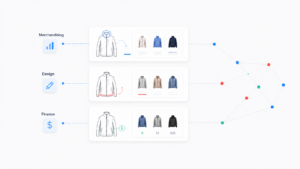
Midstream — product decision. AI operating here is helping teams navigate the definition, direction, and decision phases: the sequence where merchandising, design, and product development explore options, converge on assortment direction, and lock the products that deserve investment. This is the moment when product direction is set — and where commitment becomes expensive to reverse.
Downstream — operational execution. AI operating here is improving forecasting, pricing, supply chain planning, and replenishment. It operates after product direction has been committed to.
Most current AI investments in retail and apparel land clearly in the upstream or downstream zone. The midstream zone remains largely unaddressed.
Question 2: What does this AI operate on?
There is a meaningful difference between AI that operates on isolated inputs — a single prompt, a single design file, a single data feed — and AI that operates on shared product context: the full assortment, historical product decisions, evolving attributes, and cross-functional team inputs accumulated over time.
AI operating on isolated inputs can accelerate a specific task. AI operating on shared product context can improve the quality of the decisions that determine what those tasks are working toward. The distinction is not about the sophistication of the underlying model. It is about the richness and governance of the environment in which AI operates.
Evaluate each investment on this dimension: is it operating on isolated inputs, or is it operating on a governed, shared product context connected to the broader decision environment?
Question 3: What does this AI improve — output speed or decision quality?
This is the most important question, and the one most AI vendor pitches are least equipped to answer clearly.
AI that improves output speed makes existing workflows faster. It reduces the time required to produce a design variation, generate a forecast, or draft a product specification. These are real efficiency gains — in service of decisions being made elsewhere, decisions that the AI may not be reaching at all.
AI that improves decision quality changes the basis on which consequential choices are made. It helps teams evaluate more options in context, identify risks and opportunities earlier, and commit to direction with greater confidence and shared alignment. These improvements are harder to demonstrate in a pilot. They are significantly more valuable in production.
Push every AI investment evaluation past the output speed question and into the decision quality question. If the investment cannot articulate a clear mechanism by which it improves the quality of a specific, consequential decision in the product lifecycle — it is an efficiency investment, not a decision leverage investment. Both have value. They are not equivalent.
Applying the Framework Across the Lifecycle
With the three questions as a lens, the current landscape of AI investment in retail and apparel comes into sharper relief.
Upstream AI investments — generative design tools, trend analysis platforms, AI-assisted concept exploration — typically score as follows: they operate in the upstream zone, on isolated inputs, and they improve output speed. They are genuine productivity investments for creative teams. They do not improve the quality of the product decisions that will eventually determine which of their outputs gets invested in.
Downstream AI investments — AI-enhanced forecasting, pricing optimization, supply chain planning — operate in the downstream zone, often on rich and well-governed data sets, and they improve both output speed and, in some cases, operational decision quality within their domain. Their limitation is the one this series has established: they are optimizing on the output of product decisions they had no part in improving.
Midstream AI investments — AI operating within the governed environment where the definition, direction, and decision phases happen, on shared product context, to improve assortment decision quality — are the category most conspicuously underrepresented in current retail AI portfolios. They are also the category with the highest decision leverage: operating at the moment that sets the ceiling for everything downstream, on shared context that makes AI genuinely useful rather than merely fast. And because they produce structured data — audit trails, aligned assortment decisions, evolving product attributes — that flows naturally into downstream systems, they reduce the integration complexity the overall AI architecture would otherwise accumulate.
The Decision Leverage Principle
The framework above points toward a principle worth making explicit, because it should anchor how technology leaders prioritize AI investments across the retail product lifecycle.
Decision leverage is highest closest to the moment where consequential, high-stakes, hard-to-reverse choices are made.
In retail and apparel, the seasonal assortment commitment is that moment. Which products get developed. How development resources are allocated. Which concepts get cut and which get invested in. These choices are made months before a unit is sourced or a forecast is run, and they are made in a compressed window of cross-functional alignment that, once closed, is expensive to reopen.
AI that improves decision quality at that moment — by helping teams evaluate more options with greater context, surface patterns from historical assortments, and align faster around the products most likely to succeed — creates leverage that compounds through every downstream system in the stack. Better assortment decisions produce better inputs for forecasting. Better inputs for forecasting produce better supply chain plans. Better supply chain plans reduce inventory risk and markdown pressure.
AI that operates upstream or downstream of that moment creates value within its zone. It does not create the same compounding leverage. The efficiency gains stay local. The decision quality gains are bounded by the scope of the decisions the AI is actually reaching.
This is the principle that should anchor the AI investment prioritization conversation: not where can we implement AI most quickly, but where in the product lifecycle does AI create the most decision leverage — and have we invested there yet? The brands that answer that question earliest, and govern the definition, direction, and decision phases accordingly, will build a compounding advantage. The fastest to relevant wins. Not just the fastest.
The Governance Corollary
There is a governance dimension to the decision leverage principle that matters for technology leaders specifically.
AI investments that operate in isolation — upstream creative tools disconnected from product data, downstream optimization systems disconnected from early assortment decisions — each require their own integration, governance framework, and maintenance overhead. As the portfolio of disconnected AI point solutions grows, the governance burden compounds.
AI embedded in a governed environment at the midstream decision moment creates a different architecture. It operates on structured product data already connected to the broader stack. It produces outputs that flow naturally into downstream systems rather than requiring custom integration. And it creates an audit trail for the most consequential decisions in the product lifecycle — a governance asset and a compounding data advantage over time.
The governance corollary to the decision leverage principle: AI investments closest to the consequential decision moment, operating on shared product context, are not just higher-leverage. They are lower governance complexity in aggregate — because they reduce the number of disconnected AI point solutions the organization needs to manage, integrate, and maintain.
Using This Framework
The three questions — where does this AI operate, what does it operate on, and what does it improve — are designed to be usable in the context of an actual AI investment conversation, not just as an abstract strategic lens.
Bring them into the next vendor evaluation. Apply them to the AI investments already in the portfolio. Use them to map the current AI architecture against the full structure of the retail product lifecycle and identify where the highest-leverage gap remains unaddressed.
For most retail and apparel organizations, that exercise will surface the same finding: significant AI investment at both ends of the product lifecycle, and a conspicuous absence at the midstream decision moment where the leverage is highest and the governance gap is most consequential. The final post in this series describes what the stack — and the business outcomes — look like when that gap is filled.
VibeIQ is the governed environment purpose-built for the definition, direction, and decision phases of the retail go-to-market process — where AI operates on shared product context at the moment of highest decision leverage.