
There is a conversation that happens in most retail and apparel organizations at the start of every season. The calendar is tighter than last year. The expectation — from leadership, from merchandising, sometimes from the board — is to move faster. To produce more, decide sooner, commit earlier. To find ways to compress the creative process without losing what matters.
As a design leader, you are often the person that expectation lands on.
And the tools most frequently offered as a response are AI tools — platforms that accelerate concept generation, surface trend signals more quickly, and expand creative output earlier in the season. In a compressed calendar, faster production feels like the right answer.
It is the understandable answer. It is not the right one.
Because the pressure a compressed calendar creates is not a production problem. It is an evaluation and alignment problem. And faster production into an ungoverned evaluation environment doesn’t relieve that pressure. It intensifies it — adding more concepts to a consideration set that already lacks the shared context and organizational alignment those decisions require.
What Calendar Compression Actually Takes Away
When go-to-market timelines shorten, the most visible structural elements of the process tend to survive. Production deadlines remain. Line reviews still happen. Development handoffs still occur on schedule.
What disappears is subtler — and more consequential.
The space between those fixed points shrinks. And that space is not inefficiency. It is the conditions under which good product decisions actually form.
It is the time for a concept to be genuinely considered — not just reviewed at a fixed checkpoint, but evaluated progressively in the context of how the full line is taking shape. It is the time for design and merchandising to build shared understanding around a creative direction, rather than presenting to each other under deadline pressure and recalibrating after the fact. It is the time for ideas to be refined in response to cross-functional input — while there is still room to act on that input constructively, before positions have hardened and development timelines have locked.
When that space is compressed, the creative process doesn’t simply move faster. It changes in character.
Decisions that should be deliberate become reactive. Alignment that should build progressively gets forced at the last possible moment — when the cost of acting on it is highest. Creative work that deserved more considered evaluation gets cut or carried forward without it. And the design leader who should be exercising creative judgment is instead managing a process that is too compressed to support that judgment well.
The result is not a faster version of a strong process. It is a structurally different process — one that is less likely to produce the assortment clarity that strong products require, and more likely to produce the outcomes that cautious, time-constrained decisions consistently produce.
The Problem Isn’t Speed. It’s the Decision Gap.
Here is the reframe that matters most for design leaders navigating calendar pressure.
The creative process slows — and outcomes suffer — not because design teams can’t move fast enough. It is because the conditions required for confident product decisions don’t exist early enough in the process.
The Decision Gap
The structural absence of shared context, clarity, and decision support at the exact moment when merchandising, design, and product teams commit to which products will exist in the seasonal line. These decisions determine what a season is capable of achieving. Speed pressure is a symptom of the decision gap — not the cause. Addressing one without addressing the other produces the same structural problem at higher velocity.
When the decision gap exists — when design and merchandising teams are working from different views of the evolving line, building their perspectives in parallel, and coming to alignment only at fixed review points — the compressed calendar makes everything worse. The time that was never adequate for genuine shared evaluation becomes even less so. The alignment that was always arriving late arrives later still.
But addressing speed pressure without addressing the decision gap doesn’t resolve any of this. It produces the same structural problem at higher velocity.
What Happens When AI Responds to the Wrong Problem
This dynamic is directly relevant to how design leaders think about AI — and specifically about AI tools that are presented as a response to calendar pressure.
The instinct is logical: if the challenge is moving fast enough to meet review deadlines, then tools that accelerate creative output address the problem. And in terms of upstream generation, they do. Concepts that once took days can be produced in hours. Visual directions that required extensive research can be synthesized quickly.
But in the context of a compressed calendar and an ungoverned midstream phase, that acceleration produces a specific and predictable consequence: more concepts enter a consideration set that already lacks adequate evaluation capacity. The volume of creative work requiring alignment grows. The decision gap doesn’t close — the pressure on it increases.
The three costs that originate in the decision gap don’t ease when generative AI accelerates the upstream phase:
Speed Cost
Timeline compression from late misalignment. Development windows narrow. The season starts behind.
Operating Cost
Rework, redundant sampling, creative energy that doesn’t convert. Resources spent on work that doesn’t survive.
Sell-Through Risk
Assortments built without shared conviction carry more inventory risk. Products don’t perform at full price.
All three costs accelerate alongside the concept volume, because the structural condition that produces them remains unchanged. Faster generation into a broken evaluation environment is not a solution to calendar pressure. It is a more expensive version of the same problem.
The Goal Worth Building Toward: Speed of Relevance
If speed is the wrong goal — or rather, the incomplete one — what is the right goal for a design leader navigating compressed calendars and organizational pressure to move faster?
The answer requires separating two things that are consistently conflated in conversations about speed in retail and apparel: moving fast, and bringing the right products to market.
Relevant Product
The right product, for the right consumer, at the right moment. Relevance is a decision quality outcome — not a speed outcome. The organization that consistently makes better product decisions earlier consistently brings more relevant product to market. Speed follows from that. It doesn’t precede it.
Speed of relevance is how fast your organization can close the decision gap — moving from concept to committed assortment with the conviction those commitments require. It is not the same as generating concepts faster. It is not the same as compressing timelines. It is the rate at which your organization can make better product decisions, earlier, with the shared context those decisions need.
When speed of relevance improves, all three costs respond simultaneously. The Speed Cost declines because alignment builds progressively rather than arriving late. The Operating Cost declines because concepts that advance have been properly evaluated — rework reduces, development resources convert more reliably. The Sell-Through Risk declines because the assortment was built with genuine conviction rather than forced under time pressure.
This is the outcome worth building toward. Not faster generation — faster alignment, grounded in better decisions, made earlier.
Why Speed of Relevance Requires a Different Kind of AI Investment
Reaching speed of relevance as an organizational capability requires addressing the right phase of the product creation process — the midstream phase, where design and merchandising teams determine which concepts deserve investment and build the shared conviction to act on that determination.
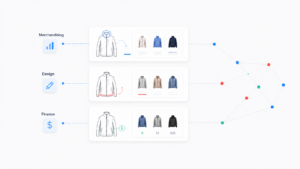
That phase is not served by generative AI tools, which are built for the upstream generation phase. It is served by a different kind of AI capability: one that operates on the full context of the product line — product visuals, historical assortments, commercial data, and the cross-functional inputs of both design and merchandising — and helps teams evaluate and align around the evolving assortment rather than simply producing more work for it to absorb.
When AI operates in that environment, it accelerates the right thing. Not concept volume — alignment. It compresses the time required to build shared conviction, surfaces where concepts differentiate or create redundancy, and connects creative options to commercial context. It creates the conditions for confident decisions, made earlier. And in a compressed calendar, confident decisions made earlier are exactly what relieves the pressure that faster generation cannot.
For design leaders, this distinction has a direct implication for how AI investments are evaluated — and how the case for them is made internally. The question worth asking is not “how much faster can we generate?” It is “how much faster can we align — with the context and conviction those commitments require?”
That question points to a different capability. And building toward that capability is what transforms speed from a pressure the organization is under into an advantage it has.
What This Changes for Design Leaders
The speed problem in retail and apparel is real. The calendar pressure is real. The organizational expectation to move faster is real — and for design leaders, it arrives with force and frequency.
But the organizations that are actually building speed as a structural advantage are not doing it by finding ways to produce more, faster. They are doing it by governing the phase of the product creation process where speed and quality have always been in tension — and eliminating that tension at its source.
When design and merchandising teams share a continuously updated view of the evolving assortment — when AI supports evaluation and alignment in the midstream phase rather than generation in the upstream phase — the organization can move quickly without sacrificing the quality of the decisions that drive what ends up in the market.
That is speed of relevance. And for a design leader navigating a compressed calendar, it is the only version of speed that actually delivers what the pressure demands.
About VibeIQ
Calendar pressure won’t ease. But the way design leaders respond to it can change.
VibeIQ is built for the midstream phase of product creation — where merchandising, design, and product teams evaluate concepts in shared context, build alignment progressively, and commit to the assortment with the conviction those decisions require. When the decision gap closes, speed of relevance improves — and the costs that compressed calendars currently accelerate begin to resolve.
If you’re building the case internally for a different approach to how your organization makes product decisions, we’d like to be part of that conversation.