AI is entering the retail and apparel merchandising workflow — and for many organizations, the conversation about where and how to apply it is already underway.
Some brands have made meaningful investments in AI-powered tools for demand forecasting, inventory optimization, and pricing. Others are earlier in that evaluation, exploring where AI creates genuine value versus where it generates noise. And for most VPs of Merchandising, the question is not whether AI is relevant to their function — it clearly is — but which AI investments will actually move the needle on the outcomes they’re accountable for.
The first three articles in this series established a framework for thinking about that question. The product creation process has three phases: upstream, where AI is accelerating creative exploration; downstream, where AI is improving execution efficiency; and midstream — the definition, direction, and decision phase — where the decision gap lives and where assortment outcomes are most directly determined. The decision gap produces three compounding costs: Speed Cost, as late conviction narrows the window to scale opportunity; Operating Cost, as misalignment forces rework across functions; and sell-through pressure, as commitments made without full context produce assortments that underperform at full price.
What hasn’t yet been examined is where AI sits in relation to that framework — and why the answer matters for every AI investment decision a merchandising leader is making right now.
Where AI Is Creating Value in Merchandising Today
Before examining where AI falls short for merchandising decisions, it’s worth being precise about where it is creating genuine value — because the limitations of current AI investment are not an argument against AI. They are an argument for applying it more precisely.
For organizations that have invested in AI-powered merchandising tools, real improvements are emerging across the downstream phase of the product creation process.
Demand forecasting. AI is helping merchandising teams generate more accurate demand projections by identifying patterns in historical sales data, in-season signals, and external market indicators that traditional forecasting methods miss. Better forecasts improve inventory planning and reduce the risk of significant over- or under-commitment at the buy stage.
Inventory and assortment optimization. AI tools are helping organizations evaluate category and SKU performance with greater granularity — identifying where the assortment is overextended, where it has gaps relative to demand, and where consolidation or expansion would improve financial performance.
Pricing and promotion. AI is improving how organizations manage pricing and promotional activity in-season — making those decisions more responsive to real-time sell-through signals and competitive dynamics.
Supply chain responsiveness. AI is helping organizations respond more quickly to demand shifts by improving visibility into supply chain constraints and opportunities.
Each of these applications delivers genuine value. Each makes the execution side of merchandising more efficient, more data-informed, and more responsive. And each shares the same structural characteristic: it operates after product direction has been determined.
The Structural Limitation Most Organizations Haven’t Named
The AI tools that are currently delivering value in retail and apparel merchandising are, without exception, downstream of the most consequential moment in the product creation process.
Demand forecasting improves how accurately the organization predicts demand for products that have already been committed to development. Assortment optimization improves how the organization manages a line that has already been structured. Pricing and inventory tools improve how the organization manages financial performance against a committed assortment.
None of these tools operate at the midstream phase — when merchandising leaders are evaluating the evolving product line and deciding which concepts deserve investment before development begins.
This is not a design flaw in those tools. They were built for the problems they solve, and they solve them well. But it does mean that the AI investments most organizations are making in merchandising are concentrated in a fundamentally different part of the process than the one that most directly shapes the outcomes those investments are trying to improve.
AI that helps a merchandising team forecast demand more accurately cannot reach back and improve the decision to invest in the products being forecasted. AI that optimizes an assortment’s financial performance cannot correct the structural misalignments that were set in motion when that assortment was originally committed to. AI that improves markdown timing cannot recover the margin lost when development resources were allocated to the wrong products months earlier.
These tools manage consequences. They do not improve the decisions that created them.
And the costs they’re managing — the Speed Cost of late conviction, the Operating Cost of misalignment and rework, the sell-through pressure of commitments made without full context — all originate upstream of where these tools operate. In the midstream phase. Before development begins.
The Midstream Moment AI Isn’t Reaching
The moment that most directly shapes merchandising financial outcomes — and that current AI investment is largely not reaching — is the midstream decision phase. It is when the product line is still forming and concepts are still evolving. When merchandising must evaluate which concepts are strong enough to warrant development investment. When cross-functional alignment across design, product development, and planning must be built around a shared view of the evolving line. And when commitments must be made before certainty exists about which of them will pay off.
This is the moment where, as the previous articles in this series have explored, line planning falls short of what it should be, cross-functional alignment is hardest to achieve, and the gap between available information and required context is widest. It is also the moment where AI has the greatest untapped potential for retail and apparel merchandising — and where the least investment has been made.
Why the Midstream Phase Is Hard for AI to Reach
If the midstream decision phase is where AI could create the most value in merchandising, why haven’t most AI tools been designed to operate there?
The answer is structural — and understanding it clarifies what a different kind of AI investment would need to look like.
Most AI tools are built on structured, historical data. Demand forecasting models are trained on past sales patterns. Assortment optimization tools analyze historical category performance. Pricing systems respond to current sell-through signals. These data sets are well-defined, consistently structured, and available in sufficient volume to train effective models.
The midstream decision phase is different. At that stage of the process, the data that downstream AI tools depend on doesn’t yet exist. There are no sales patterns for products that haven’t been developed. There is no sell-through history for concepts that are still evolving. The information that exists — evolving product visuals, partial line plan data, emerging design direction, cross-functional inputs from multiple teams — is unstructured, incomplete, and distributed across disconnected tools and environments.
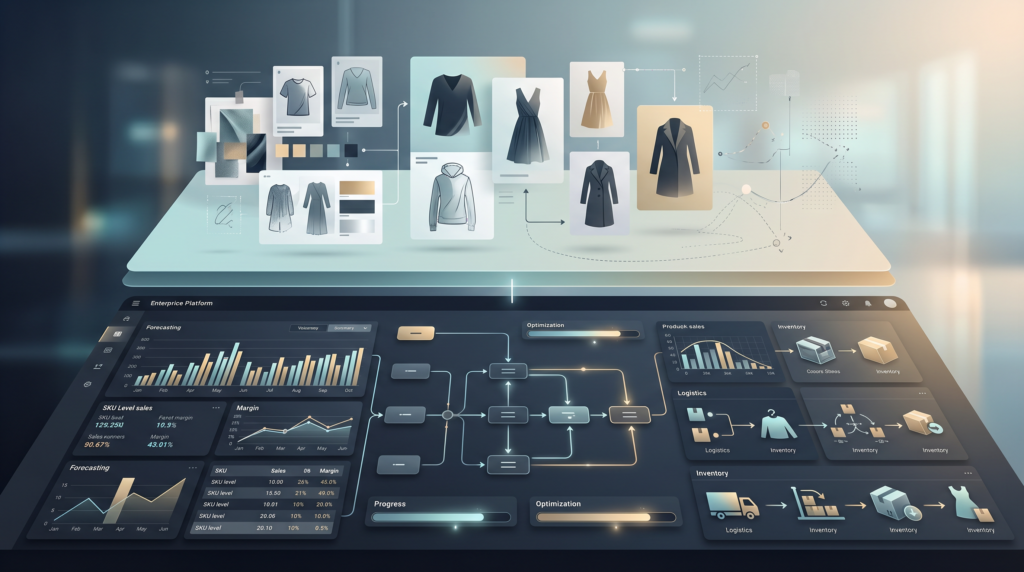
Building AI that operates effectively in that environment requires a different foundation. It requires a shared midstream environment where product visuals, attributes, historical assortment data, commercial context, and cross-functional inputs exist together — continuously updated and accessible to the teams making decisions — so that AI can operate on the full context of the evolving line rather than on isolated data points.
Without that foundation, AI cannot meaningfully improve the midstream decision. It can generate trend reports. It can surface demand signals. It can produce analysis that informs individual inputs to the decision. But it cannot help merchandising and cross-functional teams evaluate the evolving assortment together and build the shared conviction that confident early commitments require.
What AI Applied to the Midstream Phase Could Change
For VPs of Merchandising, understanding the structural limitation of current AI investment is not an argument for pessimism about AI. It is an argument for precision about where AI investment should be directed next.
AI that operates within a shared, real-time view of the evolving product line — with product visuals and attributes, historical assortment context, in-market sales data, and cross-functional inputs visible together — can do things for the midstream decision that current tools cannot.
It can help merchandising leaders evaluate how new concepts fit within the evolving line — surfacing redundancies and gaps that are difficult to see when concepts are evaluated in isolation or through the fragmented picture most organizations work from today. It can connect emerging concepts to historical performance patterns — helping teams identify which directions have consistently created value and which have consistently underperformed. It can surface the cross-functional context that alignment requires — giving merchandising, design, and product development teams a shared information environment from which to build conviction together rather than assembling alignment from disconnected views after the fact.
The result is not AI that replaces the judgment of experienced merchandising leaders. It is AI that gives those leaders the context and shared visibility their judgment actually requires — earlier in the process, when the cost of acting on better information is lowest and the financial leverage is highest.
Rethinking the AI Investment in Merchandising
For VPs of Merchandising evaluating AI investments — whether that evaluation is already underway or just beginning — the most important question is not which AI tools are most technically sophisticated.
It is where in the product creation process those tools operate.
AI that improves execution downstream of the assortment decision is valuable and worth pursuing. The forecasting accuracy, inventory efficiency, and margin management improvements it delivers are real. But these tools address the consequences of midstream decisions — they don’t improve the decisions themselves.
AI that improves the quality and timing of the assortment decision at the midstream phase — before development begins, when the line is still forming, and when all three costs are still addressable at once — is where the greater and more fundamental opportunity lives.
The competitive dimension of that distinction is sharpening. The brands that are investing in midstream AI now are not just reducing rework and improving assortment quality in the near term. They are building the organizational capability to close the decision gap faster than their competitors — to get to the right product, earlier, with greater conviction, season after season. Speed of relevance — how quickly an organization can make better assortment decisions — is becoming a durable competitive advantage. And the brands that build it first, by governing the midstream phase, are the ones most likely to hold it.
For most retail and apparel organizations, the midstream AI investment hasn’t been made yet. For merchandising leaders who feel the compounding cost of late decisions and incomplete context every season, it may be the most consequential investment available — and the one with the clearest path to outcomes that execution-side AI alone cannot reach.
About VibeIQ
If you are currently evaluating AI investments in merchandising — weighing vendor claims, building a business case, or trying to distinguish genuine capability from noise — the framework this piece describes offers a useful filter: where in the process does this tool actually operate?
Most of what’s being pitched to merchandising teams right now operates downstream. It improves execution against decisions already made. That value is real, and those tools deserve evaluation on their own merits.
But the midstream phase — where the definition, direction, and decision happen, where all three costs are still addressable, and where the decision gap either widens or closes — is where VibeIQ operates. It is the platform purpose-built for that moment: a shared, AI-powered environment where merchandising, design, and product teams evaluate the evolving line together, build conviction earlier, and commit to the right assortment before development begins.
If that’s the capability you’ve been looking for — and haven’t yet found in the tools you’ve been evaluating — we’d welcome the conversation.