
Every CIO and CTO in retail and apparel is fielding AI pitches right now. The volume is high. The claims are large. And the pattern underneath most of them is remarkably consistent.
AI layered onto PLM. AI integrated into demand forecasting. AI added to supply chain planning and pricing optimization. AI tools for designers to generate concepts and explore trend directions faster. Each pitch arrives with a compelling demonstration, a set of efficiency metrics, and a credible case for why this particular application of AI will improve this particular part of the product lifecycle.
Most of those cases are defensible. Some of those investments will deliver real returns. But there is a question that almost none of those pitches are designed to answer — and it is the question that should be driving the AI investment conversation in retail and apparel organizations right now:
Is AI being invested in where it creates the most business leverage? Or is it being invested in where it is easiest to demonstrate, easiest to measure, and easiest to bolt onto systems that already exist?
For most organizations, the honest answer to that question reveals a significant misalignment between where AI investment is concentrated and where it creates the most value.
The Pattern of AI Investment in Retail
To understand where the misalignment lives, it helps to map AI investment against the actual structure of the retail product lifecycle.
Upstream, AI is accelerating the creative process. Generative tools help designers produce concept variations faster. Trend analysis platforms surface emerging signals earlier. Visual exploration tools compress the time from inspiration to initial concept. These investments are visible, demonstrable, and genuinely useful to the creative teams using them.
Downstream, AI is improving operational performance. Forecasting systems are more accurate. Supply chain planning is more responsive. Pricing optimization is more dynamic. These investments are measurable, often significant, and directly connected to operational KPIs that technology leaders and business stakeholders can track.
Both categories of investment are real. Both are producing returns. And both share a critical characteristic that is easy to overlook when evaluating them in isolation: they are operating entirely on either side of the moment where the product decisions that determine their inputs are made.
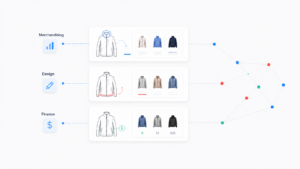
Upstream AI accelerates the generation of concepts before any decision has been made about which concepts deserve investment. Downstream AI optimizes the execution of a product strategy after that strategy has already been committed to. Neither is reaching the definition, direction, and decision phases — the sequence where merchandising, design, and product teams explore options, converge on direction, and lock the assortment — where the decisions that set the ceiling for everything downstream are actually made.
That phase is, today, the least AI-supported moment in the retail product lifecycle.
Why AI Bolted Onto the Wrong Part of the Stack Improves the Wrong Thing
The CIO or CTO who has been through several cycles of enterprise technology investment recognizes this pattern. It is not unique to AI.
When new technology is introduced into an organization, it tends to follow the path of least resistance — attaching to systems that already exist, workflows that are already structured, and problems that are already measurable. This produces real improvement in the systems it touches. It also tends to reinforce the existing architecture rather than address the gaps within it.
AI is following the same path in most retail and apparel organizations. It is being bolted onto PLM, forecasting, and supply chain systems because those systems are already structured, already governed, and already generating the data that AI needs to operate. It is being added to upstream creative tools because those tools are already in use and AI demonstrably accelerates the workflows they support.
What AI is not doing — in most organizations — is operating in the gap between those two ends of the stack. The definition, direction, and decision phases remain structurally unsupported. And because they remain unsupported, they remain ungoverned — producing no structured data, no audit trail, and no context on which AI could meaningfully operate even if it were introduced there.
This is the compounding problem. AI cannot improve a decision-making process it has no visibility into. And a decision-making process that generates no structured data will never give AI the context it needs to be useful. The gap in the stack and the gap in AI investment are the same gap — and they reinforce each other.
The Distinction That Changes the AI Investment Conversation
There is a meaningful difference between AI that generates outputs and AI that improves decisions. It is worth being precise about what that distinction means in practice — because it is the distinction that separates AI investments that create durable business value from AI investments that create impressive demonstrations without proportional returns.
AI that generates outputs operates on inputs it is given, produces something faster or at greater volume than was previously possible, and returns that output to the user. Generative design tools work this way. So do AI-assisted trend reports, automated spec drafts, and most AI features currently being added to upstream creative software. The output is real. The speed gain is real. The connection to the quality of the product decisions those outputs eventually feed is indirect at best.
AI that improves decisions operates differently. It requires a governed environment where the relevant context — product visuals, attributes, assortment structure, historical decisions — is organized and accessible. Within that environment, AI can help teams evaluate trade-offs, identify risks and opportunities, surface patterns from past assortments, and move from exploration to commitment faster and with greater confidence. The output is not just faster work. It is better decisions — decisions that are more likely to produce assortments that perform.
That is a categorically different kind of AI investment. And it is only possible in the part of the stack where the decisions are actually being made.
The AI Governance Implication
There is a governance dimension to this argument that matters specifically for CIOs and CTOs — and it is one that the current pattern of AI investment is quietly making worse.
AI point solutions that operate in isolation — upstream creative tools disconnected from product data, downstream optimization systems disconnected from early assortment decisions — create a growing layer of AI investment that each requires its own integration, its own governance framework, and its own maintenance overhead. Each individual investment may be defensible. The aggregate architecture they produce is not.
As that layer of disconnected AI point solutions grows, the governance burden on the technology organization grows with it. More integration touchpoints. More data quality dependencies. More vendor relationships to manage. More AI outputs flowing into downstream systems without any structured connection to the decisions that should be informing them.
AI embedded in a governed environment at the definition, direction, and decision phases creates a fundamentally different architecture. It operates on shared product context rather than isolated inputs. It produces outputs — evaluated concepts, aligned assortment decisions, structured product attributes — that flow naturally into downstream systems rather than requiring custom integration. And it creates an audit trail for the most consequential decisions in the product lifecycle, which is both a governance asset and a compounding data advantage over time. That is a simpler, more governable AI architecture — and it is only achievable by investing at the point of highest leverage.
Reframing the AI Investment Question
The retail and apparel organizations that will get the most durable value from AI investment over the next several years are not necessarily the ones making the largest investments. They are the ones making the most precisely targeted ones.
That precision requires a clear-eyed view of where in the product lifecycle AI creates the most leverage — not where it is easiest to implement or most straightforward to demonstrate. It requires a willingness to look past the impressive upstream demos and the measurable downstream efficiency gains, and ask a harder question: where is the moment that determines the quality of everything downstream, and is AI reaching it?
For most retail and apparel organizations, that question leads to the same place: the definition, direction, and decision phases, sitting ungoverned between upstream creative tools and downstream systems of record — and now, increasingly, surrounded by AI investments that are improving everything around them without touching them.
The next post in this series offers a concrete framework for evaluating AI investments in the retail product lifecycle against exactly that standard — and for identifying where the highest-leverage gap in your current portfolio remains unaddressed.
VibeIQ is the governed environment where the definition, direction, and decision phases happen — bringing AI into the part of the retail stack where decision leverage is highest, operating on shared product context to improve assortment decisions before development and sourcing commitments are made.