Enterprise retail and apparel organizations have built sophisticated technology stacks. Upstream, creative and merchandising tools support concept development and trend exploration. Downstream, PLM, ERP, demand forecasting, and supply chain systems govern execution at scale. Both ends of the stack have received significant investment. Both are, in most organizations, reasonably mature.
What sits between them is a different story.
The definition, direction, and decision phases — when merchandising, design, and product teams explore concepts, converge on assortment direction, and lock the products that deserve investment — are the most consequential and least governed moment in the retail go-to-market process. They happen across disconnected point solutions and informal workflows. They produce no structured data, no audit trail, and no system of record. And they set the ceiling for the performance of every downstream system in the stack.
This is the gap that most retail AI investment has not reached. And closing it is where the most valuable AI opportunity in the retail technology stack currently sits.
What follows is a concrete picture of what changes — operationally, architecturally, and competitively — when that gap is filled and AI is finally operating at the moment that determines everything downstream.
What Changes Operationally
The most immediate change when the gap is filled is visible in how cross-functional teams work during the early stages of the product creation process.
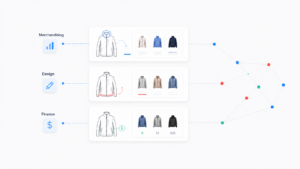
Today, in most organizations, concepts are developed in one set of tools, direction is evaluated in another, and feasibility is assessed separately. The moment of alignment — when all three functions need to agree on which products move forward — happens across disconnected views of an evolving assortment that no single tool captures in full. Teams are converging against different versions of reality, often without access to historical assortment context or structured product data.
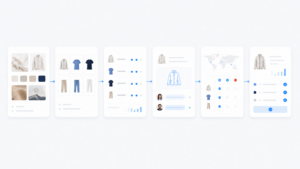
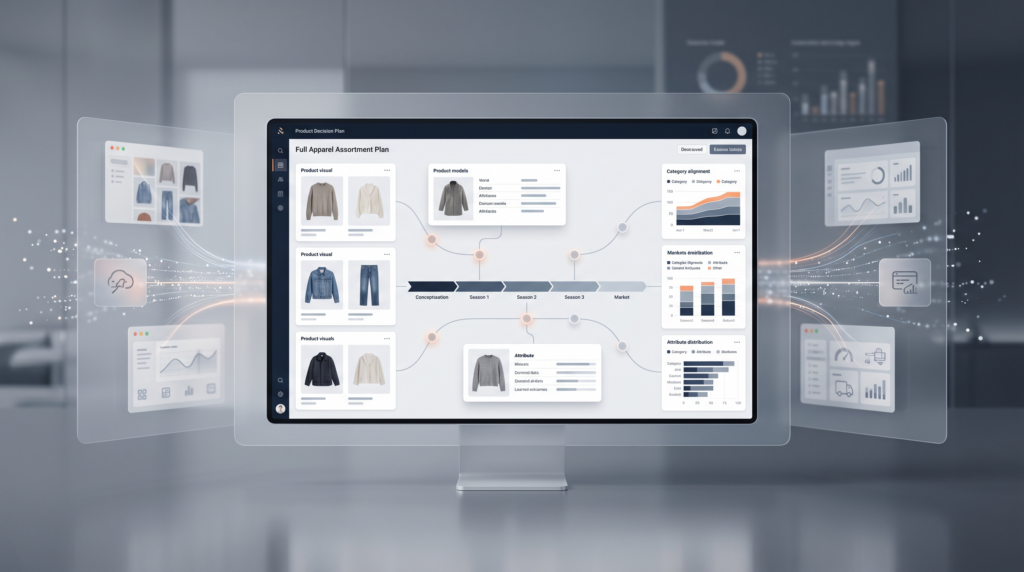
When the gap is filled, the definition, direction, and decision phases happen within a single governed environment. Concepts are created in the same space where assortment direction is evaluated. Alignment happens against a shared view of the full line rather than competing versions of it. And the moment when exploration becomes commitment is visible and intentional — rather than something that happens gradually across informal conversations, leaving no record of how the organization arrived at the direction it committed to.
The operational consequences are significant. Product direction gets set earlier, with greater cross-functional confidence. Concepts that would have survived into development — generating sampling costs and rework cycles — get identified as misaligned or redundant when the cost of changing direction is still low. For enterprise retail and apparel organizations, moving the effective point of alignment earlier in the process has direct and measurable impact on development timelines, sourcing commitments, and the inventory risk that accumulates downstream.
What Changes for the Technology Stack
From a technology architecture perspective, filling the gap does something that most AI investments in the retail stack do not: it creates a system of record for the most consequential and previously ungoverned phase of the product lifecycle.
That system of record changes the stack in several ways. First, it creates structured product data at the point where product direction is actually being set — not after the fact, when products enter PLM, but during the exploration and alignment phase when the decisions that determine which products enter PLM are being made. That data — product visuals, evolving attributes, concept comparisons, directional choices — flows forward into downstream systems with context that was previously lost at the handoff.
Second, it closes the governance blind spot that has persisted in the retail technology stack for as long as the gap has existed. Technology and data leaders gain visibility into how early product decisions are being made, on what basis, and by whom. The audit trail that downstream systems depend on but could never trace back to its origin now exists.
Third, it simplifies the overall AI architecture. Rather than a growing layer of disconnected AI point solutions — each operating on isolated inputs, each requiring its own integration and governance framework — the organization has AI operating in a shared, governed environment connected to the full context of the product line. That is a fundamentally more governable AI architecture, and it reduces the integration and maintenance overhead that disconnected point solutions accumulate over time.
What Changes for AI — Over Time
This is where the argument moves from operational improvement to compounding strategic advantage — and it is the dimension most underappreciated in current AI investment conversations.
Most AI tools in the retail product creation process operate without memory. Each interaction starts from the same place. A generative design tool that helps a team explore concepts today has no connection to the concepts explored last season, the assortment decisions that followed, or the downstream outcomes that resulted. The AI is fast. It is not, in any meaningful sense, learning.
AI operating within a governed product decision environment is categorically different. Because it operates on structured product data accumulated over time — visuals, attributes, assortment history, past decisions and their downstream outcomes — it becomes progressively more precise and more useful with each season. It can surface patterns across seasons, identify early signals of concept viability, and help teams evaluate new assortments against the full history of what the organization has tried and learned. This is not AI that generates faster outputs from the same starting point every cycle. It is AI that improves decisions — and the improvement compounds because the data that makes it possible is being generated and governed in the same environment where the work is happening.
What the Business Outcomes Look Like
The technology architecture argument leads directly to a business outcomes argument — and it is worth making explicitly, because it is the argument that connects the technology investment to the broader organizational conversation about why it matters.
When AI is operating at the definition, direction, and decision phases with full product context, the downstream outcomes that retail and apparel organizations care most about improve — not because the downstream systems changed, but because what feeds them did. Three costs that originate in the ungoverned decision phase, and compound every season it goes unaddressed, become addressable: the Speed Cost of late-stage direction changes that disrupt development timelines and sourcing commitments; the Operating Cost of development resources allocated to products that get cut after sampling costs are incurred; and the Sell-Through Cost of assortment misalignment that accumulates as inventory risk and markdown pressure in-season.
These are not speculative outcomes. They are the predictable downstream consequences of improving the quality of the decisions that every downstream system depends on. The leverage point is the gap. The business case follows from filling it.
The Starting Point for Technology Leaders
The retail and apparel organizations that will build the most durable AI advantage over the next several years are not necessarily the ones with the most AI investment across the stack. They are the ones whose AI investment is most precisely concentrated where the leverage is highest — at the moment that determines the quality of everything downstream.
For technology leaders in this space, the most important AI investment question right now is not which upstream creative tool to pilot or which downstream optimization system to enhance. It is whether the organization has addressed the gap that sits between them — and whether AI is reaching the definition, direction, and decision phases where the decisions that set the ceiling for all of those other investments are actually being made.
The brands that govern those phases earliest will not just make better assortment decisions in the near term. They will build a proprietary AI advantage rooted in their own product history and decision patterns — one that becomes more durable and more difficult to replicate with each passing season. Every season of governed product decisions is a season of structured learning. The fastest to relevant wins. Not just the fastest.VibeIQ is the governed environment where the definition, direction, and decision phases happen — purpose-built for the moment that determines everything downstream, where AI builds compounding value from the product data and decisions that no existing system currently governs.