AI can generate more ideas than ever. The real value is helping teams decide earlier which ones deserve to become products.
By Brian Lindauer, Chief Executive Officer, VibeIQ
In March, I sat down with the Chief Merchandising Officer of a global footwear brand to talk about AI. His CEO had just approved a multi-million-dollar 2026 budget with a clear mandate: turn scattered AI experimentation into measurable operating change across product development.
What he described sounded familiar. Employees had access to Claude and ChatGPT. Teams were testing design and concept generation tools. They had explored faster ways to generate images, recolor products, place products on models and accelerate creative output. None of that work was wrong, and in many cases, those are useful starting points. But the adoption was still happening around the edges of the product creation process, disconnected from the decisions that determine what actually gets built, sampled, bought and commercialized.
That is the AI gap I see across apparel and footwear today. Most companies are not short on AI tools, and they are certainly not short on product ideas. What they are missing is the product context those tools need to drive better decisions.
Right now, the biggest AI opportunity in apparel is not generating more ideas faster. It is changing how product organizations decide which ideas deserve commercial commitment. That is where cost, speed and margin are won or lost: before products reach PLM, before samples are ordered, before buys are committed and before teams realize too late that the line has too much duplication, too much complexity, or too little commercial clarity.
The constraint facing product teams is no longer idea generation. The constraint is decision quality: which products deserve development and which do not.
Isolated AI tools cannot solve a contextual problem
Using AI for a single task, such as design generation, can absolutely create value. It can help teams explore more concepts, faster, and reduce some of the manual work involved in early ideation. But product creation is not a single-task problem. A concept only becomes valuable when teams can evaluate it in the context of the full line.
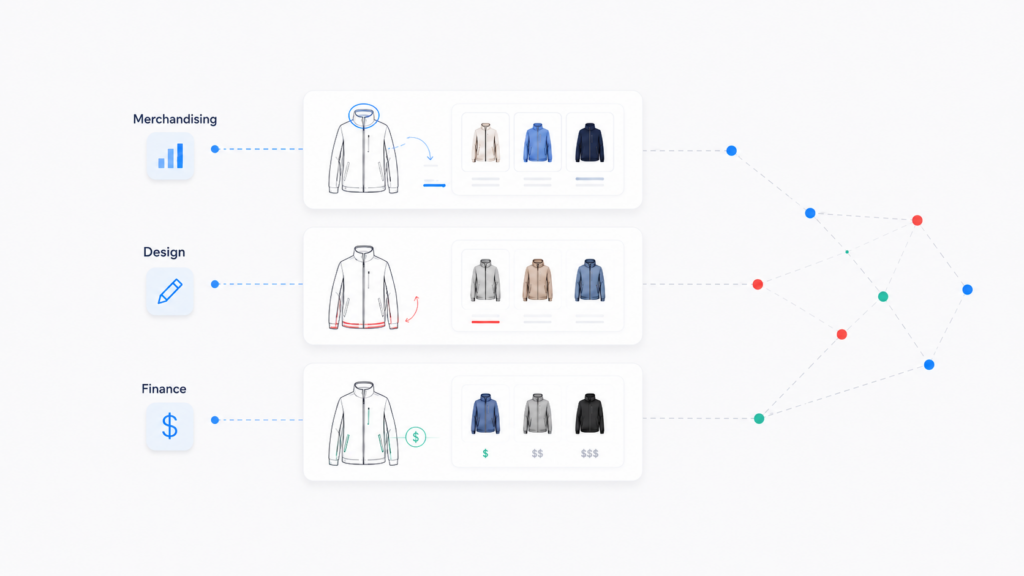
That context includes the assortment strategy, pricing, regional needs, margins, materials and commercial intent. Without that context, more ideas do not automatically create a stronger product line. In many cases, they create more options for teams to sort through while the actual decision-making environment remains scattered across planning systems, PLM databases, Miro boards, PowerPoints, spreadsheets, SharePoint folders and regional conversations.
That’s why the merchandising leaders I know who are thinking most clearly about AI are not only asking how to create more options faster. They are asking how AI can help their teams move from concept to product definition with greater confidence. They want to understand which ideas should be challenged or cut earlier and which have enough commercial clarity to justify the next investment.
That is the missing decision layer in apparel: the high-impact space between creative concept and commercial commitment.
Apparel teams are already using AI to generate more ideas. The harder and more valuable question is how AI helps them get from images to manufacturable, commercially viable products.
What are you pointing your AI at?
I often tell merchandising leaders that AI is only as useful as the context it can see. Point it at an isolated task like concept generation, and you may get faster ideation. Point it at the full product decision environment, and the opportunity becomes much bigger: better assortment decisions, earlier margin visibility, faster alignment and fewer late-stage surprises.
But in most apparel organizations, that decision environment is still too disconnected. Fragmented product development is not a new problem. In fact, it is the problem we set out to solve when we founded VibeIQ.
When I was at PTC, I saw talented design teams creating inside Miro boards, PowerPoints and whiteboards while the business and production context lived somewhere else entirely. The creative work was happening miles away from the systems that contained the information needed to evaluate it commercially.
As a result, we started VibeIQ from the belief that product teams needed a common workspace where design, merchandising, planning, product development and regional teams could see the same line as it evolved. That shared context matters even more in an AI environment because AI cannot support stronger decisions if it is only looking at fragments of the process.
For AI to change how apparel companies operate, it needs a reliable representation of the product line as it develops.
Most companies do not have that today. Their context is still scattered across several tools, teams and conversations. So even when AI enters the workflow, it is often pointed at disconnected pieces of the process instead of the full decision environment.
That is why the next AI investment should not simply be another tool. It should be the shared product decision layer that gives every AI capability the same commercial, creative and operational context to work from.
Can AI fulfill the promise to do more with less?
A few years ago, many apparel organizations bet on a promise: AI would help them do more with less. For many teams, that promise has not yet materialized. The opportunity is real, but AI has often only been added on top of the same fragmented workflows that were already slowing teams down.
One heritage apparel company we work with, for example, is facing the same operating pressure many retailers and brands are dealing with right now. Margins are thinner, teams are leaner, timelines are tighter. And the business is being asked to generate stronger product outcomes with fewer resources.
When we started discussing whether AI could truly help them do more with less, my answer was ‘yes,’ but only if AI reduces complexity instead of adding another tool for teams to manage.
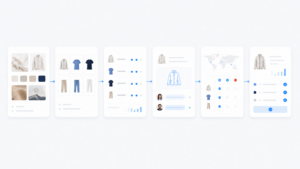
The real opportunity is helping teams move from idea to decision with less drag. That means using AI not just to create more concepts, but to connect the moments that are usually disconnected today. A creative concept becomes an attributed product. The attributed product becomes part of a merchant view. The merchant view connects to cost prediction. Cost prediction informs margin decisions while the line is still fluid enough to change.
Without that connected context, AI risks creating more output for already-stretched teams to sort through: more concepts, more variations, more files, more tools and more handoffs. With that context, AI can help teams make better product decisions earlier, before they become too expensive to backtrack.
That is how apparel companies begin to do more with less. Not by layering AI onto the same disconnected workflow, but by using it to reduce the distance between creation, commercial context and decision.
AI needs to be platformed, not scattered
When I talk to customers, one shift among them is clear. AI is spreading across their organizations and creating a new kind of risk. If every team builds its own version of intelligence – trained on different contexts and powered by different tools – the disconnectedness of the product line could become worse instead of better.
As one merchandising leader put it on a recent call, “We don’t want all the humans engaging with disparate AIs all over the place. We want them to be platformed.” That instinct is exactly right.
The best AI investment apparel companies can make right now is an investment in a single place for AI to work. They need a shared workspace that captures the product context the business uses to make decisions. That workspace gives AI something more valuable than another prompt or another file: the live context of the line as it develops.
In that environment, a designer should be able to look across the line, generate new product ideas, and turn those ideas into attributed products that merchandising can evaluate. A merchant should be able to work from their own view of the same line, adding commercial inputs and understanding margin implications while there is still time to shape the outcome.
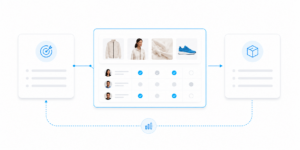
That is the power of an AI-powered product decision layer. It gives every team one environment where they can come together before decisions harden downstream.
I also recognize that new LLM models and generative AI tools will continue to emerge, and I believe that companies should be able to take advantage of them. But I also believe that the team’s workspace should not have to change every time the underlying AI improves. The platform should remain consistent, the product context should remain connected, and the business should be able to apply better AI against the same shared understanding of the line.
This is how merchandising teams make better decisions faster and earlier in the process. When AI can pull forward the context teams need in week four instead of week 27 – from buyer feedback to financial targets to color palettes – teams can challenge the line before their bets harden into regrettable costs.
For me, that is the biggest AI opportunity in apparel: not simply using AI to create more, but using it to help product organizations decide better from the very beginning.