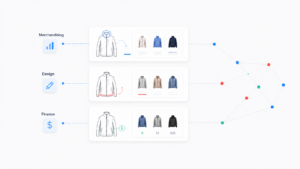

VPs of Merchandising are asked to deliver on two outcomes at once: build a compelling, market-right product line and hit aggressive financial targets. On paper, those goals should move together. In practice, they often evolve on separate tracks.
Assortment strategy takes shape quickly through creative direction, category planning, and product development. Financial plans, meanwhile, update in cycles — through forecasts, reviews, and reporting. By the time the two come together, the line has already taken form and key decisions are harder to change.
The result is a familiar pressure: making high-stakes decisions without full clarity. When strategy and financials aren’t aligned in real time, merchandising can start to feel less like leadership and more like guesswork.
Where misalignment begins
The disconnect doesn’t happen because teams aren’t aligned. It happens because they’re working in different environments.
Merchandising and design teams build assortments visually and iteratively. Categories expand, gaps get filled, and new ideas emerge as the line evolves. At the same time, financial planning tends to live in spreadsheets, periodic reports, and static snapshots that struggle to keep pace with change.
As a result, leaders are often looking at two different versions of reality:
- The line as it’s actively taking shape
- The financial picture as it looked weeks ago
Neither is wrong, but they rarely match in real time.
This creates a structural gap where important decisions are made without a clear understanding of how assortment choices are affecting revenue targets, margin expectations, or investment balance across categories.
The real cost of discovering problems too late
Misalignment rarely shows up as a single, obvious problem. Instead, it reveals itself slowly.
A category starts to feel heavier than planned.
Margins begin to tighten in certain segments.
Revenue projections shift during a review.
But by the time these signals are fully visible, the line direction is often already established.
That’s when the cycle begins:
- Re-forecasting becomes more frequent
- Teams rebuild decks to reflect new realities
- Last-minute assortment edits are made
- Tradeoffs emerge between creativity and profitability
None of this happens because teams made poor decisions. It happens because visibility came too late.
For leadership, the impact is real. Confidence in decisions becomes harder to maintain. Strategy conversations shift from proactive to reactive. And instead of guiding the line forward, time is spent reconciling what has already happened.
The later alignment happens, the more expensive every adjustment becomes.
Why speed to visibility matters more than perfect planning
The biggest challenge isn’t bad strategy or weak financial discipline. It’s timing.
If leaders could see earlier how the assortment is evolving — and how those choices connect to financial outcomes — they could guide the line with more precision.
Earlier visibility allows leaders to:
- Spot overinvestment in certain categories before it compounds
- Identify gaps that may affect revenue potential
- Balance breadth and depth more intentionally
- Protect margin earlier in the process
This isn’t about making perfect decisions. It’s about making informed ones sooner, when change is still possible.
When alignment happens earlier, course correction feels strategic instead of reactive.
The role of visual line planning in financial alignment
Financial alignment becomes much easier when leaders can clearly see the line taking shape.
When assortments live across disconnected decks, spreadsheets, and static reports, it’s difficult to understand the full picture. Decisions get made based on partial views. Conversations focus on individual pieces instead of the whole.
But when line planning is visual, current, and accessible, something shifts.
Leaders can quickly understand:
- Where product concentration is forming
- How categories are balancing out
- Where pricing architecture might be uneven
- How assortment decisions connect to business outcomes
It’s not about producing better reports. It’s about building earlier understanding.
That clarity gives leadership the ability to guide strategy while it’s still fluid, rather than reacting after commitments are locked in.
What changes when alignment happens earlier
When assortment strategy and financial planning move together in real time, the entire go-to-market process becomes more intentional.
Decisions happen faster because leaders have context.
Course correction happens sooner because risks are visible earlier.
Teams spend less time rebuilding and more time refining.
Instead of discovering issues during major reviews, leaders see signals as the line develops. Instead of reacting to gaps, they prevent them.
This creates a different operating rhythm:
- Fewer surprises late in the process
- Stronger alignment across merchandising, design, and finance
- More confidence entering line reviews
- Less friction between creative direction and financial accountability
And most importantly, leaders feel more in control of outcomes.
Bringing strategy and financials together earlier
This is where streamlined visual line planning and reporting can make a meaningful difference.
When merchandising and design teams have a clear, shared view of the evolving assortment — and leadership can see that same picture in real time — alignment stops being a periodic exercise and becomes continuous.
Earlier visibility allows VPs of Merch to:
- Connect product direction to financial outcomes sooner
- Make faster, more informed decisions
- Guide the line with greater confidence
- Reduce the need for reactive adjustments later
Instead of waiting for reporting cycles to understand what’s happening, leaders can stay connected to the line as it develops.
The executive takeaway
The role of a VP of Merchandising has always required balancing creativity with financial performance. That balance becomes significantly harder when alignment happens too late.
When strategy and financials operate separately, decisions carry more risk. When visibility comes earlier, leadership becomes more proactive, more confident, and more precise.
Because in the end, success isn’t just about building the right line. It’s about building the right line and hitting the numbers.
The sooner strategy and financials connect, the sooner leaders can guide the line with confidence and avoid late-stage tradeoffs.
Earlier visibility means smarter decisions with less risk.
Get in touch with VibeIQ to learn how your teams can align assortment strategy and financial outcomes earlier in the process.