Ask most teams to map their product lifecycle, and they’ll show you a calendar: milestones from concept to delivery, deadlines and gates moving left to right. It’s a clean picture, but it misses the part that matters. The lifecycle isn’t a timeline. It’s a chain of decisions, and each one only holds if the next team understands why it was made.
The season doesn’t get lost at the milestones. It leaks in the gaps between them, when one team makes a decision and the next team gets the what without the why. When that context carries forward, the line gets sharper as it moves. When it doesn’t, the next team rebuilds what the last team already knew, and you pay for it again downstream. It shows up as rework, as decisions cut too late, as SKUs that never should have existed, and as air freight to fix a problem that started weeks earlier.
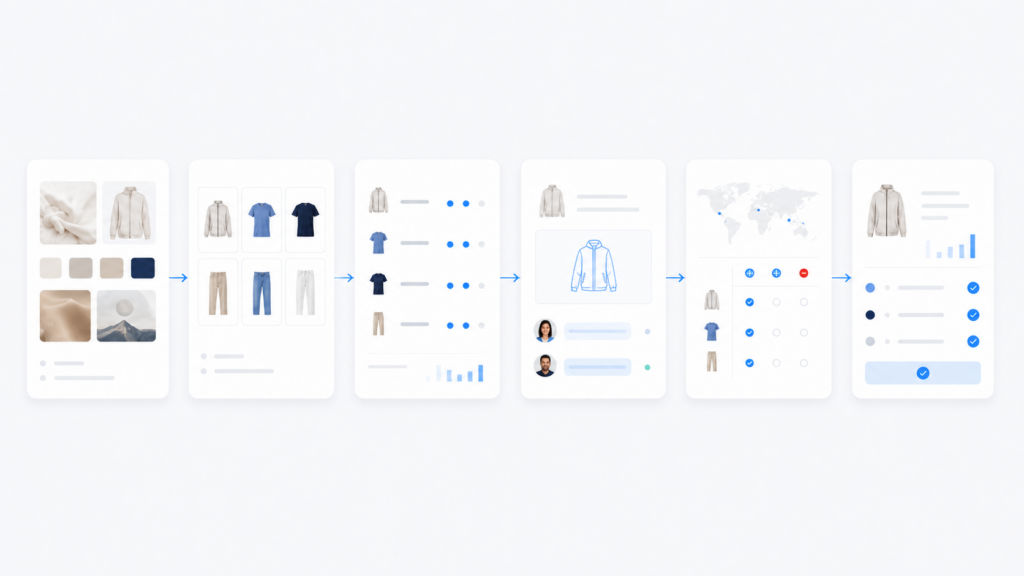
There are six stages. Here’s the decision each one owns, and where it tends to fall apart.
The product development lifecycle is a chain of decisions
Four questions apply at every stage: What decision is being made? Who owns it? Where does it break? And what does it cost later? Watch how similar the breakdowns start to look.
Stage 1 – Trend and concept
The first decision is the vaguest, and it has to carry the entire product development process. What’s this season about? Which trends are worth following, which aren’t, and what the line is meant to say. Design and merchandising leaders make the call, but the reasoning behind it lives in a deck, a mood board, or someone’s head.
That’s the problem. The thinking never becomes something the next team can build on. By the time the brief reaches development, the reasoning is mostly gone, and the team closes the gap on its own. You won’t feel the cost right away. You’ll feel it three stages later, when it becomes a style that gets sampled, debated, and eventually cut. By then it’s already used a development slot that could’ve gone to a product that was easier to defend. Capture the intent early and carry it through design collaboration, so you’re not revisiting the same argument every season.
Stage 2 – Line architecture
Next you shape the line, setting the style count, category mix, price tiers, and how good-better-best fits together. Merch owns it, usually somewhere that can’t show how any of it connects to the original concept.
What breaks is your ability to see the whole line at once. You’re trying to build a line, but all you can see is a spreadsheet full of rows. The gaps, the overlaps, the three mid-tier styles that are basically the same jacket, the category nobody filled. It stays hidden until there are physical samples spread across a table. By then you’ve already paid twice, once for the product you developed to solve a problem that didn’t exist, and again for the product you never made and the gap it left.
Stage 3 – Assortment and line planning
Now the structure becomes an actual line, with styles that have to work against a real number. This is assortment and line planning, and merch planning owns it. It’s the busiest part of the lifecycle and the hardest to see clearly.
The team is weighing a tough tradeoff all at once: how much proven carryover to keep, how much newness to bet on, what each region is actually asking for, and where margin has to land. This is often in tools that won’t let you see the styles side by side or against the target. So the line gets overbuilt, and reducing costs gets harder the further downstream you go. Merch develops extra styles knowing some will be cut, but by the time the cuts come, the money’s spent and the sample slots are gone. That overdevelopment is built into the process itself. As one merchant put it:
“We’re going in with an overdevelopment ratio of about 20 percent… So VibeIQ means we can cut out an additional 20% of samples with the kind of visibility it provides” – apparel brand
Stage 4 – Brief and development
From there it becomes briefs for product development teams, designers, and suppliers. Merch hands the work to design and development, mostly over email and attachments, and by the end of the week there are already multiple versions of the same brief floating around.
This is the stage customers feel the strongest about. Change one input and every downstream team updates everything by hand, because nothing is carrying the decision forward on its own:
“Every category update, every color addition, every image change triggers a manual rebuild on our end. With so many changes and additions across multiple seasons, you can understand how quickly that manual work is adding up.” – footwear brand
Across a full range over a few seasons, that manual work stops being extra work and becomes someone’s whole job. You see it in the competing versions, and in the hours spent sorting files instead of making product. A strong briefing step holds the decision steady from one team to the next, before the rework piles up.
Stage 5 – Regional and channel adoption
No global line is the line that reaches every market. Every channel and region decides for itself what to carry, what to drop, and what should have been included in the first place. Regional merch owns that call, but the detail ends up in a side thread the global team never fully sees.
The decision goes out, but the feedback doesn’t come back in time. The regional read reaches the global team too late to act on, so the buy gets built on global’s best guess of what each market will take. You end up with the wrong product in the wrong place. One region’s short on the styles it flagged, another’s long on styles it never asked for. Make regional adoption visible to the global team early enough to adjust, and you protect margin that otherwise gets written off every season.
Stage 6 – Sell-in and buy
Finally, it comes down to the buy, and product sells into wholesale and B2B accounts. The decision sits with sales and merch, and the line sheet has been rebuilt so many times that one more version feels normal.
It’s the most expensive seam in the lifecycle, because it’s the last chance to change anything before the money is committed. The data gets entered one last time, the buy locks against whatever version happens to be current, and every upstream mistake becomes a purchase order. You know how it ends. Too much product in one place, not enough in another. Air freight to make up for a bad call, and markdowns on the stuff nobody wanted. Run sell-in off the same live decisions as everything upstream, and the buy reflects the season the team actually chose, not an old version sitting in an inbox.
Where decisions break in product creation: one root cause
Put the six stages next to each other and the same problem shows through all of them. A concept that never got captured. A line no one could see, cuts that happen too late, a brief that keeps being rebuilt, a region that got overlooked. Then the buy locks everything into place. Six outcomes, one cause.
There’s no single place where everyone can see the line and decide together, in real time, what gets made and why. Each stage decides inside its own tool, flattens the decision into a file, and passes it on. The next team picks it up, misses half the context, and has to piece it back together. The decision has nowhere to live. It gets made in whatever tool makes sense for that team, then disappears at the handoff.
What changes when the lifecycle has a decision layer
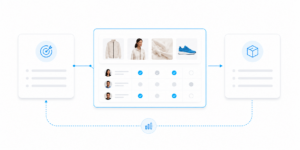
Another system of record won’t fix this, and neither will faster handoffs. What’s missing is a decision layer between creative work and commercial execution, where each stage picks up the thinking and the data instead of rebuilding them.
PLM (product lifecycle management) is your system of record: the approved product, costs, and specs, in one place. The decision layer is the system of decisions, where the calls get made before they land in PLM. How the two work together is its own subject, covered directly in the decision-layer pillar.
In practice, the concept carries into line architecture as something the team can build on, not a deck to reinterpret. The assortment gets decided in one place, with the financial plan and the product design in view at the same time. Late cuts happen early, and the product you would’ve overdeveloped never enters the process. Briefs, regional input, and sell-in all work from the same live decisions, so there are no competing versions to sort out later. From first concept to the buy, the line carries its own context. That’s what a product decision platform is for. It’s where the most expensive decisions get made before any system records them as final.
Skip that layer and the work doesn’t go away. It just keeps moving around in spreadsheets, decks, and meetings, which is where the rework begins. Regional input comes back too late to shape the decision, while incomplete product data gets written into PLM and becomes the record. The brands moving ahead aren’t running the calendar faster than everyone else. They’re making better decisions earlier, and carrying them all the way down the line.
See where the decision layer fits in your stack.