.svg)
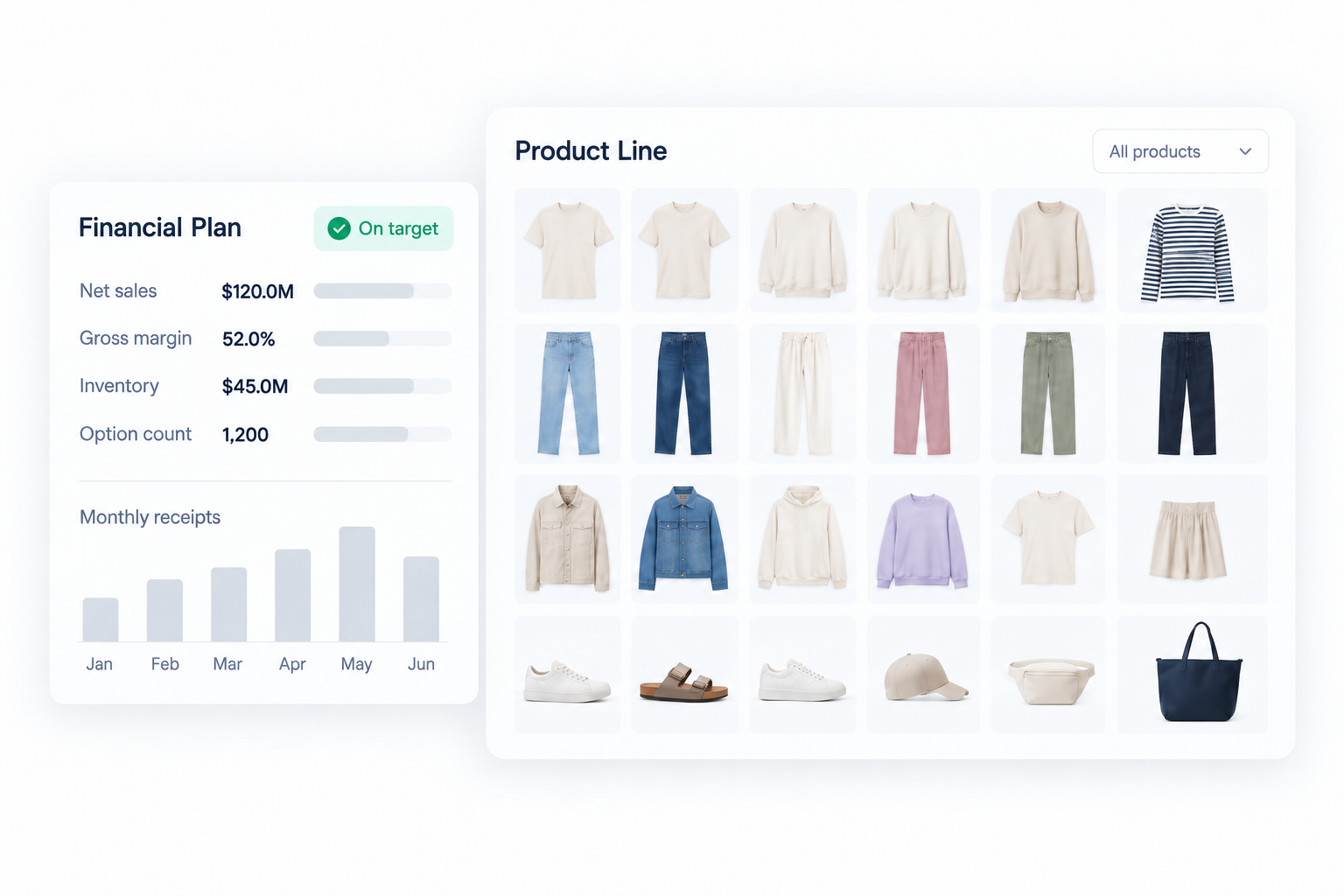
The range review ends with six styles dropped, two prices changed and a delivery moved. Merchandising leaves with a revised deck. Design has another version of the line. Planning still has the assortment that went into the meeting.
Before anyone can assess the financial impact, someone has to establish what was actually decided.
For a head of planning, the value starts with a practical question: how much work does your team do after a review before it can trust the line again?
Start with the work happening outside your planning tool
An approved financial plan establishes what the business needs to achieve. A range architecture may specify categories, price tiers, option counts and newness before every product is selected. Turning that intent into a line requires choices about actual styles, colourways, delivery windows and markets.
Some assortment planning systems already support much of this work. Oracle’s assortment planning workflow, for example, includes product selection and reconciliation to financial targets. The useful starting point is the work your team still does elsewhere.
Where do designers show alternatives? Where do merchants compare the full offer? How do regions record what they will carry? If those decisions happen across separate boards, decks and spreadsheets, the line has to be reconstructed before planning can use it.
That is the rebuild-the-line problem. It persists even when each individual file is carefully maintained, because a product change has to travel through all of them.
What stays in planning and what happens in VibeIQ
The division of work should preserve the planning process you rely on. Agree where each decision is made and which information other teams need from it.
| Work | Role in a connected workflow |
|---|---|
| Financial targets and budgets | Planning owns the approved sales, margin, inventory and open-to-buy plan. Relevant targets guide line decisions in VibeIQ. |
| Line building and review | Merchandising, design and product teams use VibeIQ to develop and assess the actual products together, with planning and sourcing input. |
| Regional and channel adoption | Teams select from the proposed line and capture their local offering, maintaining a connection to the global assortment. |
| Forecasting and buying | Planning uses the agreed product selection and commercial inputs for forecasting, depth and buy decisions in its existing tools. |
| Technical development | PLM remains responsible for governed specifications, bills of materials and development records, with agreed information exchanged as needed. |
Range architecture and product selection can overlap with existing assortment planning capabilities. Decide where your team will author those choices before introducing another working copy. The same principle applies whether the financial model lives in enterprise software or Excel.
In VibeIQ, planned needs can begin as placeholders and become items and options as products take shape. Product visuals and attributes provide a common basis for discussion. Merchandising can review the offer as a set while design develops alternatives and sourcing contributes cost or feasibility information.
The questions become specific. Are three similar jackets serving different needs? Does the opening-price option still exist? Will the intended outfit arrive together? Which products will each region actually carry? Planning can challenge the assumptions while those choices remain open.
How the assortment planning workflow connects through the season
Start by bringing the relevant planning targets into the line-building process. Define their scope: which season, category, market and delivery window they apply to. A global category target is useful context, but it will not explain every regional trade-off on its own.
Merchandising and design then develop the products against that direction. In VibeIQ, Plan holds the working line; Board supports visual collaboration; Showcase supports reviews and assortment selection. These views use shared product and assortment records, reducing the need to recreate the offering for each audience.
As the line develops, regions and channels assess what fits their customers. A global line may cover every intended price tier while one market’s selection leaves a gap. Reviewing adoption alongside the proposed range makes that difference visible before the local buy is final.
Planning then needs the decided offering back: the products still in the line, the markets selecting them, and the current price, cost and timing information required by its models. The agreed fields and transfer method depend on the implementation.
This exchange continues through the season. Development can change costs or dates. Regional feedback can change the selection. Planning may find that the resulting mix no longer supports the forecast. Those findings return to the team while it can still revise the line.
What happens when a product changes
Consider an illustrative footwear range. A trainer was intended to provide an accessible price point in the first delivery. Updated costing puts pressure on its margin, and development now expects it to arrive later.
The merchant has several choices: accept a lower margin, raise the retail price, replace the style or move it to another delivery. Each choice affects more than that product’s row in a plan.
Reviewed alongside the rest of the line, the consequences are easier to discuss. A higher price may put the trainer beside two similar options already in the range. Moving it later may leave the opening delivery without an accessible offer. A replacement may meet the price target but fail to serve the same customer.
Design and sourcing can bring alternatives into that discussion. Planning can assess the commercial assumptions. Regional teams can explain whether the later delivery still fits their market. The decision has a product rationale as well as a financial consequence.
Suppose the team retains the trainer at a higher price and later date, while one region declines it. That revised selection needs to reach planning before the next forecast and buy review. Retaining the original units would assume customers accept the higher price and that the later window can support the same demand. Both assumptions need examination.
Within VibeIQ, connected views draw on shared records; publishing makes the relevant assortment decisions available to the views tied to that assortment. Transfers to external planning and PLM systems follow the agreed process. The objective is for planning to receive the decision the team made, with enough context to act on it.
Why a connected line is different from an exported deck
A deck can be an effective way to present an assortment. The maintenance problem starts after the export, when the products change and someone must update images, prices and selections in another file.
VibeIQ’s connected review views reference the product and assortment records behind the presentation. Teams can return to that shared line for the next review. A PowerPoint or Excel export remains a snapshot; it does not become a live connection simply because it came from VibeIQ.
Kizik’s experience shows what reducing that rebuild can mean. Its line had lived in Excel, with separate presentations that required manual updates as costs, forecasts and product decisions changed. After adopting VibeIQ, VP of Merchandising Heather Kananowicz described major line-plan preparation falling from roughly a week to a day or less.
At Vera Bradley, seeing the assortment together helped expose over-assortment earlier. The company reported 10% fewer SKUs before sampling. These examples show the value of earlier visibility and less repeated preparation; results depend on the workflow and starting point.
Start with one review your team already runs
Choose a category and a recurring line review. Establish which targets come from planning, who maintains the product decisions and what planning needs back after the meeting. Include development and regional participants where their decisions affect that line.
The initial handoff may use files or a scoped integration. Confirm the approach for your systems, including who checks that the receiving data is complete. Deeper automation can follow as the process becomes established.
Measure preparation and reconciliation time across the review cycle, including any new maintenance work. Also ask whether planning received a sufficiently resolved assortment to make the next decision. A faster meeting has limited value if the team spends the following week reconstructing its outcome.
See how VibeIQ turns a plan into a line.
FAQ
Frequently asked questions
Do we stop using our planning tool?
No. VibeIQ works alongside your existing planning process. Financial modelling, demand forecasting, open-to-buy and buy decisions remain in the appropriate planning tools. Agree where product-selection responsibilities sit if your assortment planning system already supports them.
How is this different from exporting the plan to a deck?
An export captures one moment. VibeIQ’s connected views reference shared products and assortments, so the team can review the current offering without rebuilding each presentation. Some changes require publishing; exported files remain snapshots.
Where does VibeIQ fit in our seasonal calendar?
Use it while the line is being developed, reviewed and adopted by regions or channels, before and around buy commitments. Planning, costing and technical development can continue alongside that work, feeding changes back into product decisions.
What information goes back into planning?
The agreed product selection and the attributes your model needs, such as active or dropped status, market adoption, price, cost and delivery timing. The exact fields, level of detail and update process are defined for your implementation.
Do we need a full integration to begin?
A full integration is not always necessary for an initial workflow. Files or a narrower integration may be sufficient. Confirm the supported approach with VibeIQ and agree who maintains, transfers and checks the information.