
Assortment planning software for apparel brands falls into two groups: planning tools that set the numbers, such as budgets, open-to-buy, store clusters and quantities, and line-building tools where merchandising, design and regional teams choose the actual products. You need both, and they need to be connected.
That split explains why "best assortment planning software" lists can feel confusing. A retail planning suite and a visual line planning platform both use the word assortment, but they answer different questions. One asks how much to buy, where. The other asks which products belong in the line, and why.
This guide explains the difference, compares 12 tools that apparel, footwear and other consumer goods teams evaluate, and lists the questions worth asking in a demo. Nine of the 12 are planning tools. The other three, Trasix, VibeIQ and Visulon, are line-building tools: they don't replace a planning tool, they work alongside one.
Last updated: November 2026
Two kinds of assortment planning software
- Planning and optimization tools work from sales history and financial targets. They handle merchandise financial planning, open-to-buy, demand forecasting, store clustering, breadth and depth, and often allocation and replenishment. They decide how much to buy and where it goes.
- Line-building tools work from the products themselves. Merchandising, design and regional teams build and review the line with imagery, prices and attributes together, spot gaps and overlap, and agree what moves into development and sell-in. They decide which products make the line.
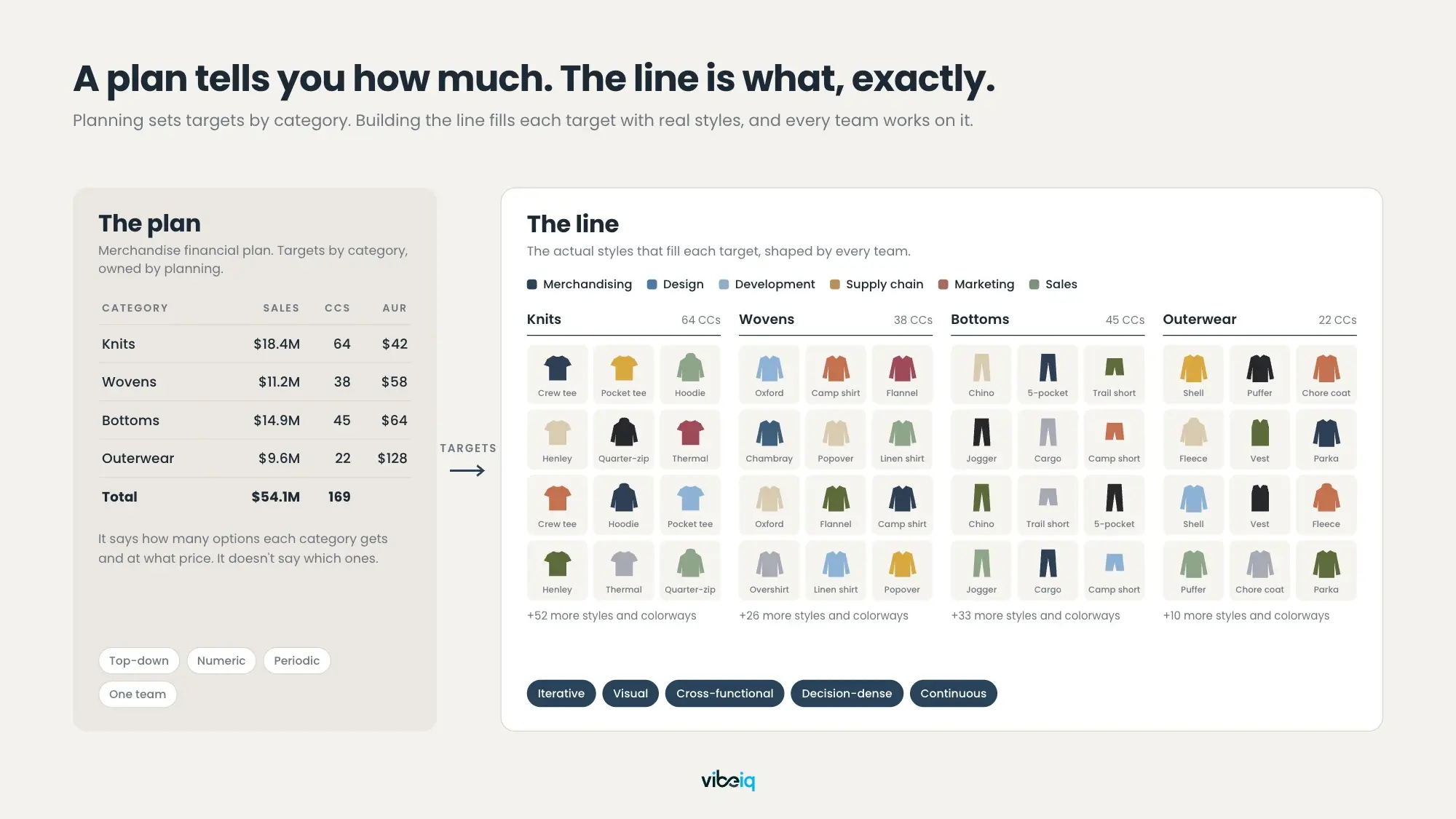
Some tools span both, and the line between them is blurring. But in the evaluations we take part in, the same pattern keeps coming up: the planning tool sets the targets, and the line itself gets built somewhere else, usually in spreadsheets and decks that are rebuilt before every review.
“A lot of the design, product creation stuff just happens in silo, and… assortment becomes more real as we start to enter like this color level information into Anaplan… and then that becomes like the starting point. We lock the line.”
Senior director of planning and analytics at a US activewear brand
12 tools at a glance
The table is split by kind. The first nine are planning tools that set the numbers. The last three build the line those numbers describe, so compare them with each other rather than with the planning tools above them.
Vendor details are taken from each company's own website in November 2026. Features change often, so confirm current capabilities with each vendor.
Planning and optimization tools
These nine tools own the numbers: sales and margin targets, open-to-buy, clustering, quantities and, in most cases, allocation. Several now add visual views of the range, but the plan is still the center of the product.
Anaplan
Anaplan offers Merchandise Financial Planning and Assortment Planning applications built on its planning platform. The Assortment Planning application helps retailers build localized assortments using newness forecasting, cannibalization detection and intelligent clustering, while staying aligned to top-down financial targets.
Best for: large retailers that want planning connected across merchandising, finance and supply chain.
Blue Yonder
Blue Yonder is a supply chain and retail planning suite with dedicated solutions for apparel and footwear. Its retail planning covers financial, assortment and allocation decisions, aligning assortments to local demand by style, color, size, store and channel, alongside fulfillment and returns.
Best for: retailers that want assortment planning tied closely to inventory and fulfillment.
Board
Board describes itself as an agentic planning platform. For retail, it offers merchandise financial planning, open-to-buy, assortment planning, allocation and replenishment, and demand planning, with an AI merchandiser agent.
Best for: retailers that want financial and merchandise planning on one configurable platform.
Centric Software
Centric offers Centric Planning, which connects merchandise financial planning with assortment strategy, pricing, inventory and allocation, alongside Centric PLM and Centric Visual Boards. The nuance is that the Visual Assortment Board runs on product data held in Centric PLM and other connected systems, so a product generally needs to exist as a record there before it shows up on a board for assortment and buying sessions.
Best for: brands and retailers standardizing on the Centric suite, with products set up in its PLM.
o9 Solutions
o9 Assortment Planning helps retailers design assortments by location, channel and need, using demand-driven store clustering. Assortment decisions are connected to o9 Merchandise Financial Planning on a single data model, so financial targets act as constraints on assortment, item and inventory plans.
Best for: enterprise retailers that want financially governed, localized assortments.
Oracle Retail
Oracle Retail Planning and Optimization includes Merchandise Financial Planning, Assortment Planning, Category Management and Assortment and Space Optimization, supported by the Oracle Retail AI Foundation for forecasting and decisions on assortments, inventory placement and pricing.
Best for: large retailers already running Oracle Retail systems.
RELEX Solutions
RELEX offers assortment planning as part of its supply chain and retail planning platform. Teams set category goals for sales, margin and volume, forecast how planned assortments will perform against them, and identify slow-moving or duplicated items to build store-specific assortments.
Best for: multi-store retailers optimizing assortments alongside replenishment and supply chain.
Style Arcade
Style Arcade is a buying and planning workspace for fashion brands. Teams plan the range visually with images and budgets side by side, forecast quantities by style, size and store, and use analytics and recommendations for in-season trading, reorders and markdowns.
Best for: fashion brands that want visual range planning tied to buying and trading data.
Toolio
Toolio brings merchandise planning, open-to-buy, assortment planning and allocation into one AI-powered platform. Its assortment planning includes visual line sheets and a gallery view, AI-generated cluster placeholders, top-down to bottom-up reconciliation with the merchandise plan, and PLM integration to pull in developed styles.
Best for: brands and retailers that want planning, open-to-buy, assortment and allocation in one platform.
Line-building tools
Trasix, VibeIQ and Visulon aren't planning tools in the way the nine above are. Their focus is the products in the line, not the financial plan, so teams typically run them alongside a planning tool that owns budgets, open-to-buy and buy quantities. Where they differ from each other is how far upstream they start and how far into selling they go.
Trasix
Trasix describes itself as an assortment management and connected go-to-market platform for retail. Modules cover visual line planning, live collaboration and campaign management, then regional execution, catalogs and sell-in, and forecasts and orders, with a built-in AI assistant and digital asset management. Its center of gravity is taking an agreed line to market across regions, rather than setting the financial plan.
Best for: global brands managing regional execution and sell-in at scale.
VibeIQ
VibeIQ is a product line creation platform where merchandising, design and regional teams build the line together. Teams start with placeholders for open needs, develop selected concepts into products and colorways, and compare imagery, prices, color and newness on visual boards to find gaps and overlap. Regional and channel assortments are built from a shared global line, and the same products carry into line reviews and sell-in. Budgets, forecasts and buy quantities stay in your planning tool.
All of this happens before PLM. The boards, the line and the history of every decision live in VibeIQ before a product exists as a PLM record, and only approved products move into PLM for development.
Best for: apparel, footwear, accessories and other consumer goods brands where merchandising, design and regional teams decide together which products belong in the line before sampling.
Visulon
Visulon offers a cloud platform for apparel, sports and fashion brands that covers early line planning, visual assortment planning and a digital sales showroom with presentations and mood boards, plus planograms and store layouts built from the assortment. It lists two-way integrations with systems including SAP, PTC FlexPLM, Centric PLM and CLO, which is how it typically connects to the systems that hold the plan and the product data.
Best for: apparel and footwear brands that want visual assortments, wholesale selling tools and store planograms from one vendor.
What to compare
How the two kinds work together
The strongest setup connects them. The planning tool sets sales, margin, option counts and open-to-buy. The line is built and reviewed against those targets, with merchandising, design and regional teams working on the actual products. The agreed assortment then goes back to planning for depth, sizing and allocation, and into PLM for development.
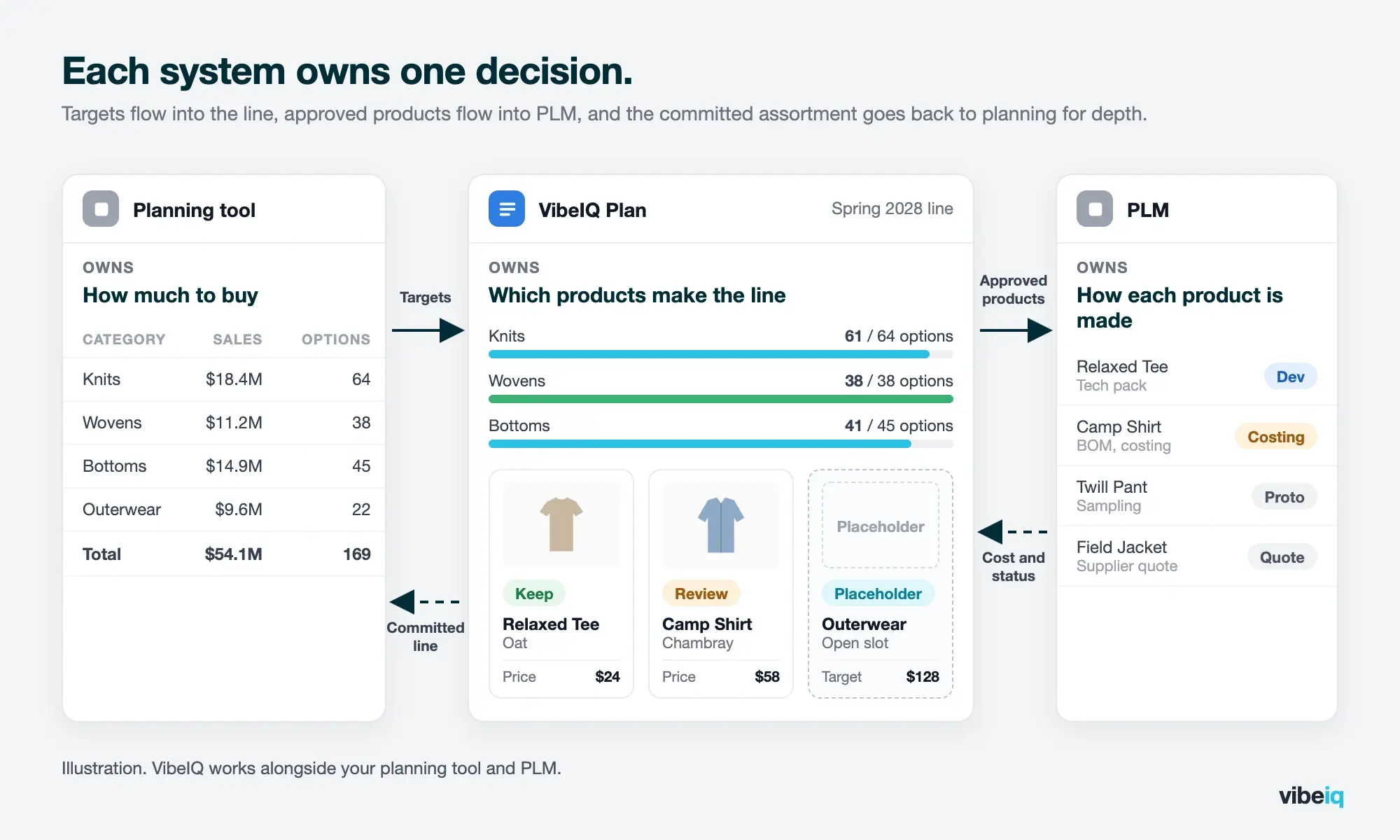
We cover the handoffs in more detail in using VibeIQ and your planning tool together and where VibeIQ fits alongside PLM, ERP and planning.
“The connectivity within Vibe has been such an unlock for us.”
Jessica Mason, Senior Manager, Product Data, Carter's
What makes VibeIQ different
Planning tools tell you what the line needs to achieve. VibeIQ is where teams build the line that achieves it.
- Start before the products exist. Placeholders carry the category, target price and key attributes for open needs, then become products and colorways as design delivers.
- Merchandising and design in the same view. Teams compare imagery, prices, color and newness together, so gaps and near-duplicates show up while there's still time to act.
- One shared line, many assortments. Regional and channel teams build their selections from the global line, and every selection stays connected to the same product records.
- Change it once. Update a product or drop an option and publish, then refresh connected line boards and sell-in presentations instead of rebuilding them.
- Built on one data model. VibeIQ is the only AI-native platform purpose-built to connect product creation and merchandising around one evolving product line, measured against the plan's targets.
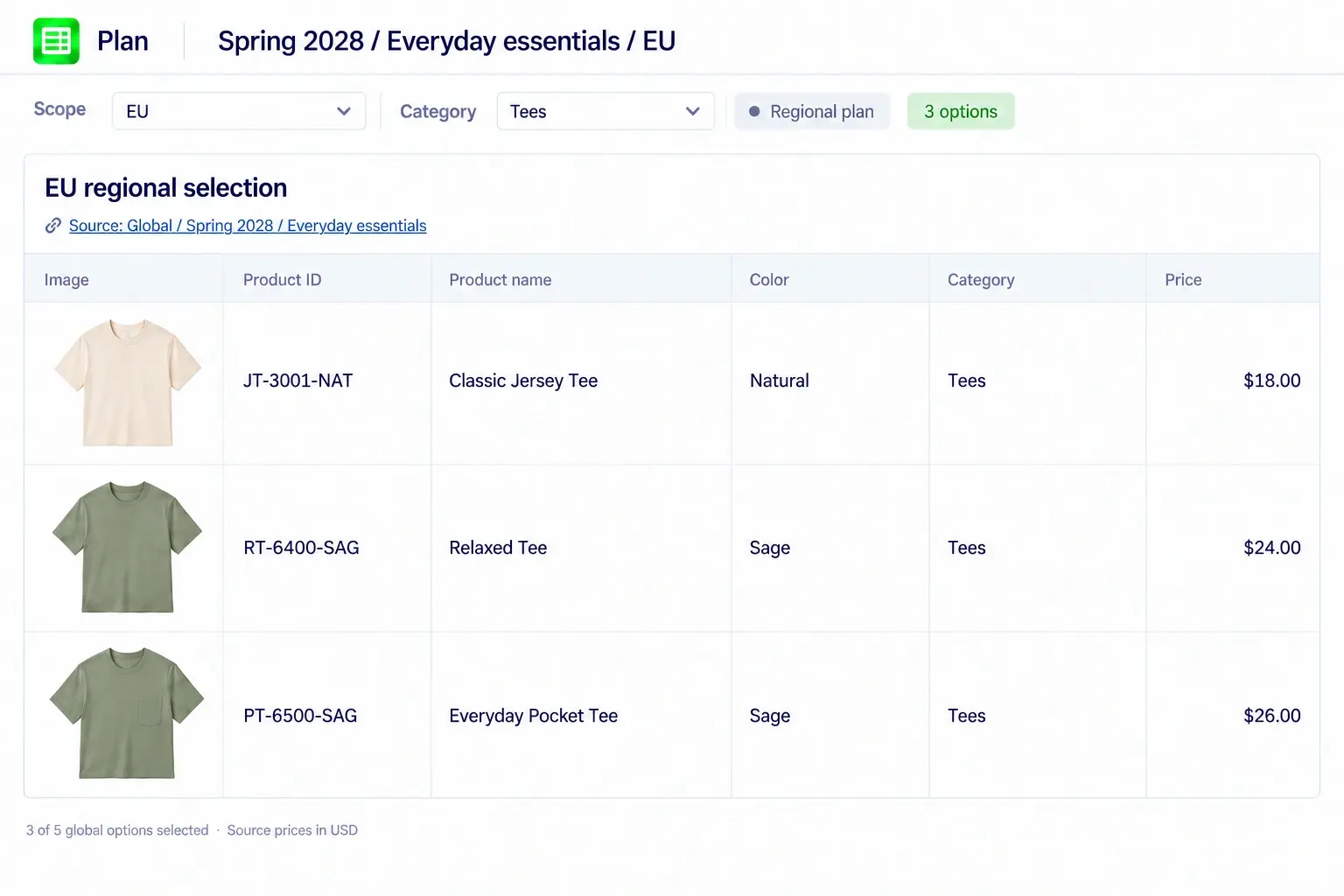
What VibeIQ doesn't do: merchandise financial planning, open-to-buy, demand forecasting, allocation or replenishment. Those stay in your planning tool, and VibeIQ works alongside it.
Vera Bradley used earlier visibility of its full assortment to cut 10% of seasonal SKUs before sampling.
Kizik cut preparation for a key line-plan milestone from about a week to a day or less.
Carter's merchants get back 36 hours each per season, and New Balance gets regional feedback to its global teams 12 weeks earlier.
Frequently asked questions
What is the best assortment planning software for fashion brands?
Start with the decision you need help with. Budgets, open-to-buy, clustering and quantities belong in a planning tool such as Toolio, o9, Anaplan, Board, Oracle Retail or Blue Yonder. Building the actual line with merchandising, design and regional teams needs a line-building tool connected to that planning tool. That second job is the one VibeIQ is built for, and it works alongside the planning tool you already have.
What is the difference between assortment planning and merchandise financial planning?
Merchandise financial planning sets the targets: sales, margin, inventory and open-to-buy. Assortment planning turns those targets into a specific mix of products for each region, channel or store.
Do we need visual assortment planning if we already have a planning tool?
Often, yes. Planning tools are built to own the numbers, and they do that well. If your line reviews still depend on decks and spreadsheets rebuilt by hand, a visual line-building tool connected to your planning system usually removes that work.
Is category management or planogram software the same thing?
No. Category management and planogram tools focus on shelf space and in-store layout, which matters most in grocery and general merchandise. Apparel assortment planning is about the products in the line and how the mix varies by market.
When should apparel brands start assortment planning?
As soon as seasonal targets are set, and before design is complete. Placeholders for open needs let teams shape the line while concepts are still being developed, so decisions happen before sampling rather than after it. Our guide to assortment planning in fashion covers the process step by step.
See your next line review in VibeIQ.
Bring a current line plan or assortment. We'll show how your team could build it, review it against targets and adapt it by market, alongside your planning tool.