
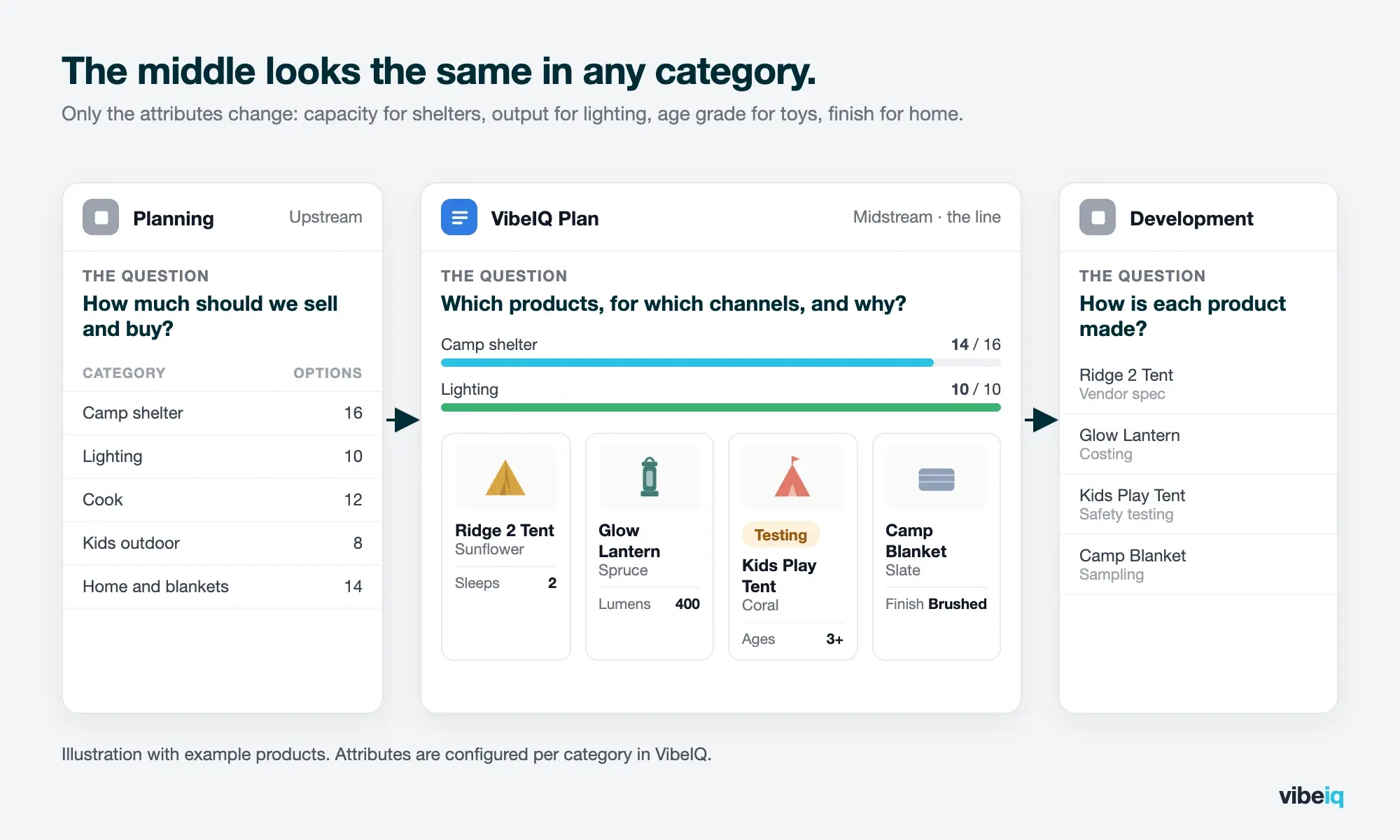
Midstream merchandising software sits between merchandise financial planning and PLM. It's where consumer goods teams turn the plan's targets into an actual product line, review it visually, adapt it by channel and region, and hand the approved products to development.
Most consumer goods brands have invested at both ends. A planning tool sets sales, margin and open-to-buy. PLM, or a mix of vendor files and shared folders, manages development. The middle step, deciding which products make the line, often still happens in spreadsheets, slide decks and meetings.
That gap shows up in how merchants spend their time. In McKinsey's January 2026 merchant survey, respondents said they still spend 40 percent of their time on low-value tasks, such as repetitive spreadsheet work and reconciling data across siloed systems.
This guide explains what midstream software does, how the middle works in apparel, home, toys and outdoor, the three ways teams cover it, and nine tools worth comparing.
Last updated: November 2026
What "midstream" means
The midstream stage is where creative and commercial decisions meet. Design brings concepts, merchandising shapes the mix against targets, regional and channel teams adapt it, and development needs a clear answer about what to build.
How the middle works in different categories
The stages are the same across consumer goods, but the calendar, the attributes and the cost of a late change are not. Here's what shapes the middle in each category.
Apparel and footwear
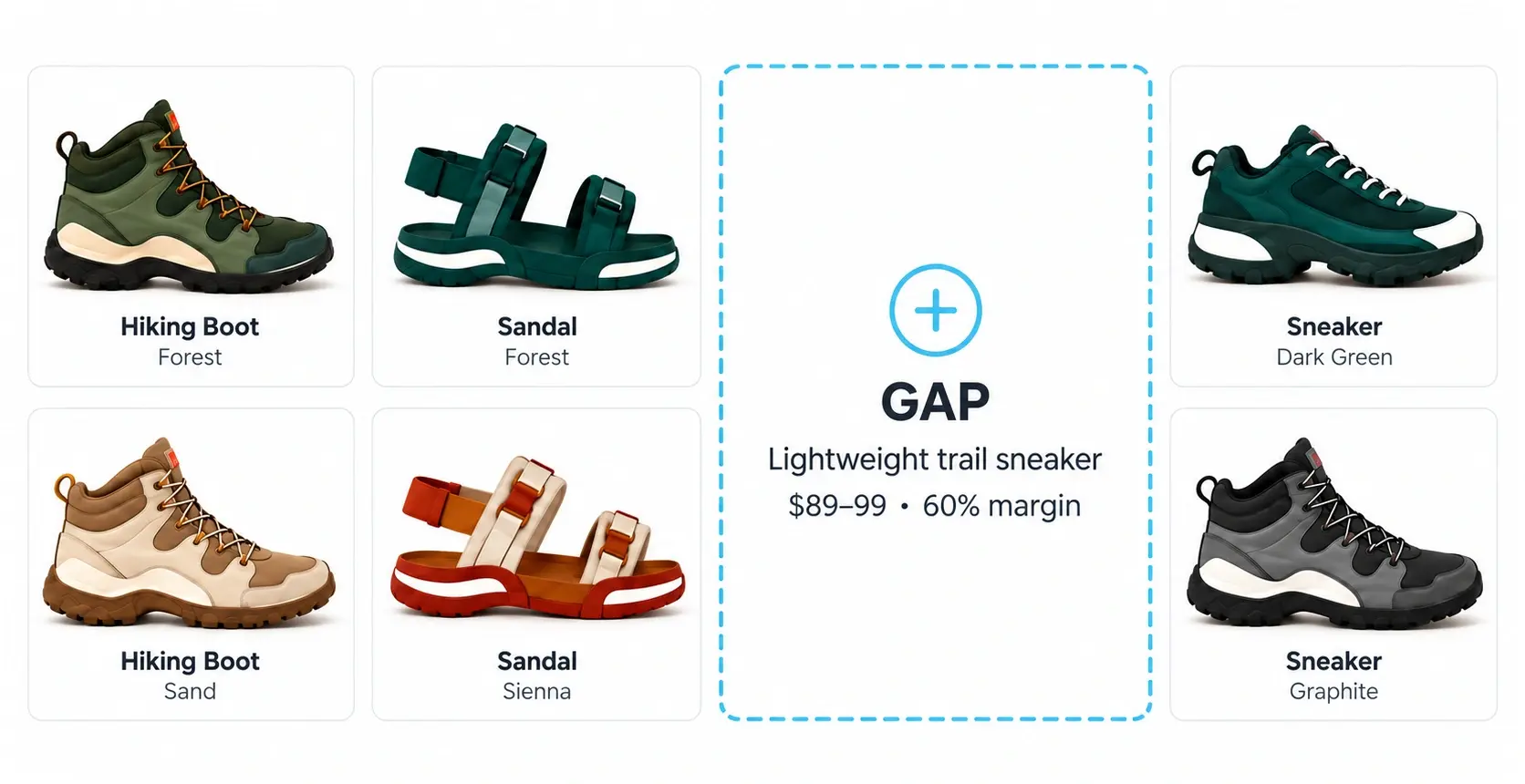
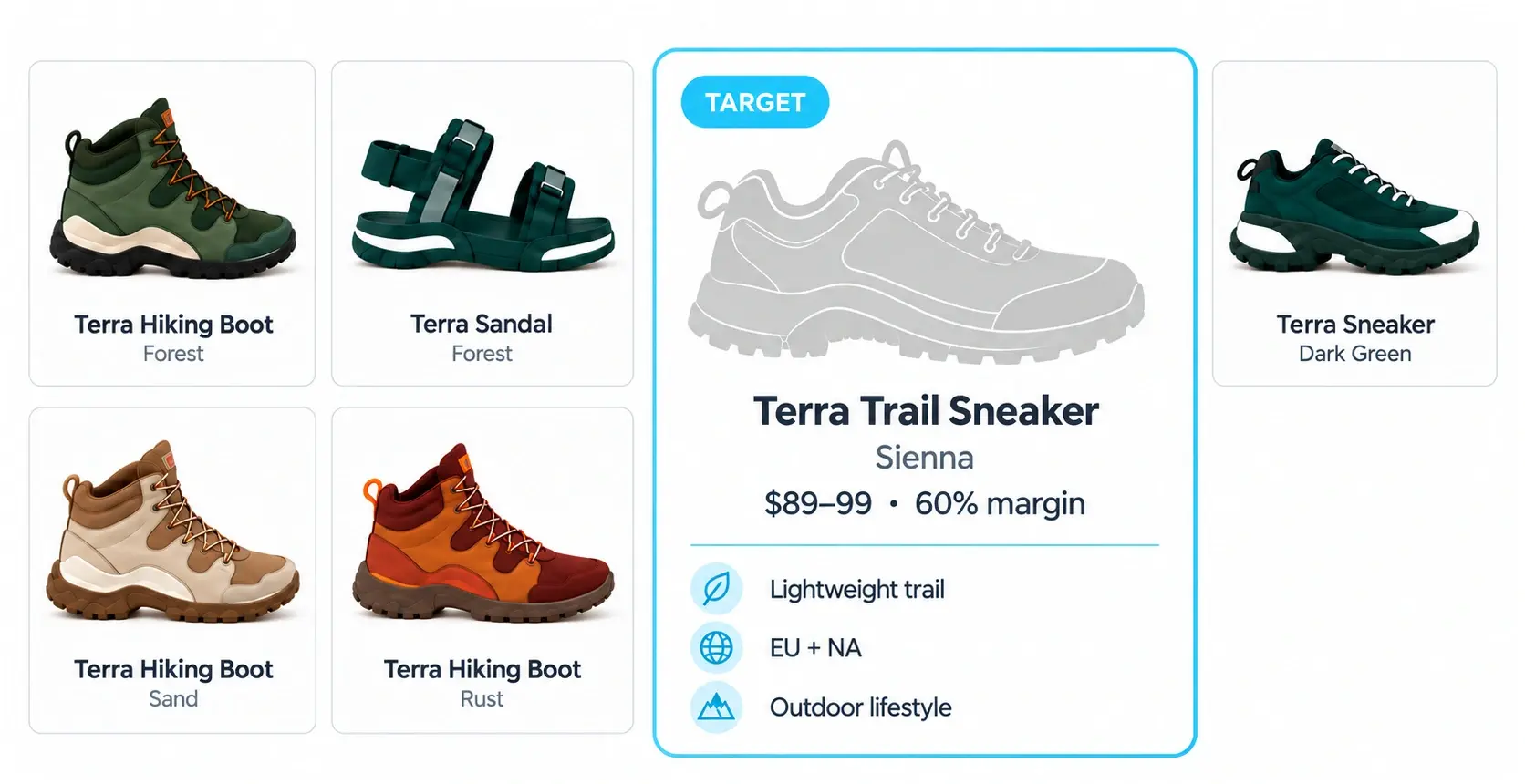
Lines are built by season, with many colorways and size runs per style, and regional teams often need their own version of the line. In footwear, new soles and lasts can need new tooling, so adding or dropping a style late costs more than in most categories. Sales samples are another pressure point. Footwear brand Kizik cut the time to prepare sales samples from four to five days to about 24 hours once the line lived in one place.
What the line needs to carry: colorways, size ranges, target prices and regional selections, all tied to one master line.
Home goods
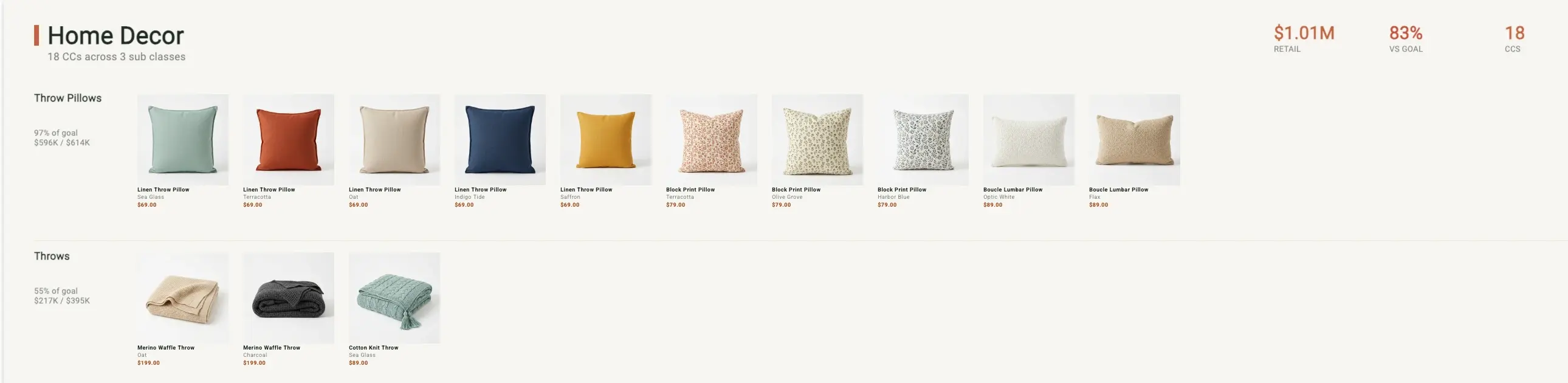
Home collections are often planned well ahead and built around a theme that has to hold across many product types. Homewares developer Magenta, which develops more than 4,000 new products a year for retailers such as TJX and Costco, forecasts up to two years out and plans "form families" and "finish families" so a theme can extend across categories. Each concept then goes through rounds of sampling before it earns shelf space.
Demand is also tied to the calendar. SPS Commerce notes that patio furniture peaks in spring, holiday decor in fall and bedding and bath in January, and that much of the category is sourced overseas, so decisions for a season are made months before product reaches the shelf.
What the line needs to carry: materials, finishes, pattern and color stories, sets and multi-piece items, and retailer-specific selections.
Toys
U.S. retail toy sales reached $30.3 billion in 2025, according to The Toy Association's figures from Circana, cited by SPS Commerce. Much of the category runs on fixed retail moments. Seasonal and holiday toys have a retail window of around six to ten weeks, and design and buyer commitments often happen nine to twelve months or more in advance, with usually one shot at the buy.
Timing has become harder to predict, too. Kidscreen reported that Hasbro moved toward releasing ranges in smaller waves rather than one large launch, so it could adapt when content or shipments slip. Safety rules add attributes that need to be tracked from the start: toys must meet ASTM F963, and from July 8, 2026, U.S. importers must file Certificate of Compliance data electronically at customs entry.
What the line needs to carry: age grading, licensed properties and approvals, launch waves, retailer exclusives and compliance status.
Outdoor and sporting goods
Outdoor brands mix apparel, footwear and equipment, and products are often field-tested before they're final. When Outdoor Research expanded into mountain biking, about 18 months passed between spotting the opportunity and launching an eight-piece spring line, including three to four months of feedback from athletes and staff to refine the products.
What the line needs to carry: activity, technical specifications, materials and testing status, alongside the commercial targets for each part of the range.
Accessories and bags
Accessories lines often have many prints, colors and small items per collection, which makes it easy for the line to grow faster than the plan. Vera Bradley used earlier visibility of its full assortment to cut 10% of seasonal SKUs before sampling.
What the line needs to carry: prints and colorways, price tiers and SKU counts against the plan.
Signs your midstream is the bottleneck
- The line lives in a spreadsheet and the review lives in a deck. Someone rebuilds one from the other before every meeting.
- Targets and products never sit side by side. The plan says 40 options at an opening price point, but nobody can see whether the line delivers them.
- Channel and regional versions drift. Each market or retail partner gets its own file, and changes to the master line don't reach them.
- Development hears about changes late. Products are added or dropped after samples are ordered, and the cost lands on the development team.
- There's no PLM, or PLM starts too late. Many consumer goods companies build lines with agencies, vendors and shared documents, so there's no single place where the line is decided.
“It’s a lot of rework. It’s a lot of template making… we create completely new decks… So we have decks on decks. And so there’s almost zero accountability when it goes back to like, hey, what did you show me weeks and weeks ago?”
Senior manager of global merchandising at a consumer appliances brand
Three ways teams cover the middle
- Extend the planning tool down. Several planning platforms now include assortment planning, placeholders and image views. This works well when the main need is financially governed assortments. Planning tools are built for planners, so design and regional teams usually need a connected place to build the line with them.
- Extend PLM up, or buy planning and PLM from one vendor. Some suites add planning modules and visual boards to PLM. This suits brands already standardized on that suite, though the boards work on products already set up in PLM, and early, fast-changing decisions often happen before that point.
- Add a dedicated line creation platform. A purpose-built platform sits between the two, connected to both. It's another system to adopt, but it gives merchandising, design and regional teams one shared place to build and decide the line before PLM.
“If somebody says, OK, well… instead of 19.99, because of cost increases, we have to actually bump up the retail to 24.99, then in order for that to reflect in Flex, somebody has to go in and manually update that.”
Senior analyst at a US sporting goods retailer
9 tools at a glance
Vendor details are taken from each company's own website in November 2026. Features change often, so confirm current capabilities with each vendor.
The tools in more detail
Anaplan
Anaplan offers Merchandise Financial Planning and Assortment Planning applications on its planning platform. Assortment Planning helps retailers build localized assortments with newness forecasting, cannibalization detection and intelligent clustering, aligned to top-down financial targets.
Best for: large retailers connecting merchandise planning with finance and supply chain.
Aptean Retail Planning
Aptean Retail Planning combines merchandise financial planning, assortment planning, allocation and replenishment, and PLM. Its assortment tools run from goals and store clustering through breadth and depth, item selection and size decisions to a virtual "style out" that previews the range against the financial plan. The PLM side covers line planning, tech packs, supplier collaboration and costing, with Adobe Illustrator and Photoshop integration.
Best for: retailers and brands that want planning and PLM from a single vendor.
Bamboo Rose
Bamboo Rose TotalPLM covers planning and merchandising, visual collaboration, product development, supplier management, sourcing, purchase orders and global trade in one platform. It's built for fashion and apparel, food and consumables, and general merchandise.
Best for: multi-category retailers that want planning through sourcing in a single PLM platform.
Board
Board describes itself as an agentic planning platform. For retail, it covers merchandise financial planning, open-to-buy, assortment planning, allocation and replenishment, and demand planning, with an AI merchandiser agent.
Best for: retailers that want financial and merchandise planning on one configurable platform.
Centric Software
Centric connects merchandise financial planning with assortment strategy, pricing and allocation through Centric Planning, and adds Centric PLM and Centric Boards. The nuance is that the boards run on product data held in Centric PLM and other connected systems, so a product generally needs to exist as a record there before it shows up on a board. Centric also offers PLM for home and furniture, outdoor and consumer goods.
Best for: brands and retailers standardizing on the Centric suite.
o9 Solutions
o9 Assortment Planning designs assortments by location, channel and need using demand-driven store clustering. It's connected to o9 Merchandise Financial Planning on a single data model, so financial targets act as constraints on assortment and inventory plans.
Best for: enterprise retailers that want financially governed, localized assortments.
Toolio
Toolio brings merchandise planning, open-to-buy, assortment planning and allocation into one AI-powered platform. Its assortment planning includes visual line sheets and a gallery view, AI-generated placeholders, reconciliation with the merchandise plan, and PLM integration to pull in developed styles.
Best for: brands and retailers that want planning, open-to-buy, assortment and allocation in one platform.
Trasix
Trasix describes itself as a connected go-to-market platform for global fashion and consumer goods brands. Modules cover line planning, live collaboration and campaign management, then regional execution, catalogs and sell-in, and forecasts and orders.
Best for: global brands managing regional execution and sell-in at scale.
VibeIQ
VibeIQ is a product line creation platform for consumer goods brands. Merchandising, design and regional teams build the line together, from placeholders with target prices to products and colorways, review it on visual boards against the plan's targets, build channel and regional assortments from a shared line, and carry the same products into sell-in. Attributes are configured per category, so the same platform can carry finishes for home, age grading for toys or technical specs for outdoor.
All of this happens before PLM. The boards, the line and the history of every decision live in VibeIQ before a product exists as a PLM record. Approved products then move into PLM, or straight into development where there is no PLM.
Best for: consumer goods brands with seasonal, visual product lines decided by several teams together.
What to compare
What makes VibeIQ different
Planning sets the targets. VibeIQ is where the plan becomes the product line.
- Built for the middle. VibeIQ isn't a planning tool extended down or a PLM extended up. It's built for the stage where teams decide which products make the line, and works alongside the planning and PLM systems you already have.
- Merchandising, design and regions in one place. Teams see imagery, prices and attributes together, compare options against targets and make changes during the review instead of after it.
- Starts before the products exist. Placeholders carry target prices and attributes for open needs, then become products as design delivers.
- Works with or without PLM. Approved products move into PLM through configured integrations, or straight into development and vendor workflows where there's no PLM.
- Start small. Teams can begin with one product range, workflow or line review, then expand across categories, regions and teams.
- One shared data model. VibeIQ is the only AI-native platform purpose-built to connect product creation and merchandising around one evolving product line, measured against the plan's targets.
What VibeIQ doesn't do: financial planning, open-to-buy, forecasting, allocation or replenishment. Those stay with your planning tool. Read more on where VibeIQ fits alongside PLM, ERP and planning and why more concepts won't fix assortment planning.
Vera Bradley used earlier visibility of its full assortment to cut 10% of seasonal SKUs before sampling.
Kizik managed 7x more new SKUs as its line expanded, and cut preparation for a key line-plan milestone from about a week to a day or less.
“We’re really just setting up the styles once in Vibe. They flow through to our ERP, then that flows through to Shopify.”
Michele Mesmer, Director of Merchandising, Malbon Golf
Frequently asked questions
What is midstream merchandising software?
It's software for the stage between merchandise financial planning and product development, where teams decide which products make the line, how the mix works by channel and region, and what moves into development.
Which consumer goods categories does it suit?
Categories with seasonal, visual product lines decided by several teams together, such as apparel, footwear, accessories, home goods, toys and outdoor products. It's less relevant for formulation-led categories such as food and beauty.
How far ahead do consumer goods brands build the line?
Further ahead than the retail calendar suggests. Seasonal toy commitments often happen nine to twelve months or more ahead, some homewares developers forecast up to two years out, and outdoor brands may spend 18 months taking a new range from idea to launch. The longer the runway, the more the line changes before it's final, which is why the middle needs one shared, current version.
Do we need PLM to use midstream software?
No. Many consumer goods companies work with agencies, vendors and shared documents rather than PLM. In VibeIQ, approved products can move straight into development and vendor workflows, and connect to PLM if you add one later.
How is it different from assortment planning software?
Some assortment planning tools focus on quantities, clustering and allocation. Midstream software focuses on building the line itself with merchandising and design. Our assortment planning software comparison covers that split in detail.
Does it replace our merchandise financial plan?
No. The financial plan sets the targets, and midstream software is where teams build a line that meets them. The agreed assortment then goes back to planning for depth and buys. See using VibeIQ and your planning tool together.
See where the plan becomes your product line.
Bring one category and your current line plan. We'll show how your team could build it against targets, adapt it by channel and hand it to development, whatever your categories.